
·
Last Updated: August 18, 2026
Introduction
The Pietra Dura art of Agra is one of the finest examples of craftsmanship in the world and a defining feature of Mughal architecture. Visitors to the Taj Mahal often admire its gleaming white marble, but it is the intricate floral patterns and colorful stone inlays that truly bring the monument to life. This remarkable decorative technique, known as Pietra Dura, transformed marble into a canvas for artistic expression and helped make the Taj Mahal one of the world’s greatest architectural masterpieces.
Beyond the Taj Mahal, Agra remains a center for this centuries-old craft. Skilled artisans continue to create stunning marble inlay products using traditional methods passed down through generations. In this guide, you’ll learn about the history, techniques, significance, and modern-day legacy of Pietra Dura in Agra.
What Is Pietra Dura?
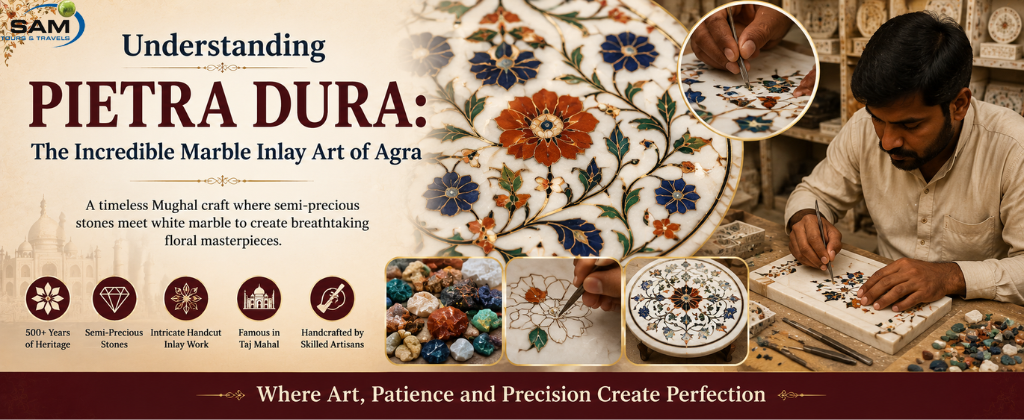
Pietra Dura, meaning “hard stone” in Italian, is a decorative art technique in which precisely cut semi-precious stones are carefully fitted into carved marble to create intricate designs.
Unlike painting or engraving, Pietra Dura uses actual gemstones embedded into the marble surface, producing colorful and durable patterns that can last for centuries.
Common motifs include:
- Flowers
- Leaves
- Vines
- Geometric patterns
- Birds
- Fruits
- Traditional Mughal designs
The polished finish gives the artwork a smooth surface where each stone fits perfectly without visible gaps.
The Origins of Pietra Dura
Although the technique originated in Italy during the Renaissance, it reached extraordinary levels of perfection under the Mughal Empire.
During the reign of Emperor Shah Jahan, master craftsmen from Persia, Central Asia, and India refined the art into what is known today as Parchin Kari, the Indian form of Pietra Dura.
The Taj Mahal became the greatest showcase of this magnificent craftsmanship.
Pietra Dura in the Taj Mahal


Every visitor notices the Taj Mahal’s brilliant white marble, but many overlook the thousands of delicate inlay designs decorating its walls.
Artisans used hundreds of thousands of hand-cut stone pieces to create breathtaking floral compositions.
Some of the stones found in the Taj Mahal include:
- Jasper
- Carnelian
- Lapis Lazuli
- Malachite
- Turquoise
- Onyx
- Mother of Pearl
- Jade
- Agate
Each stone was selected for its natural color, allowing the flowers and vines to appear vivid without using paint.
How Is Pietra Dura Made?
Creating a single marble inlay piece requires exceptional patience and precision.
Step 1: Designing the Pattern
The artist first sketches the floral or geometric design directly onto the marble.
Step 2: Cutting the Stones
Small pieces of semi-precious stones are carefully cut into tiny petals, leaves, and shapes using traditional hand tools.
Each piece may take several hours to complete.
Step 3: Carving the Marble
Matching grooves are carved into the marble using fine chisels.
The cavities must fit each stone perfectly.
Step 4: Setting the Stones
The artisan places every stone into its corresponding groove using natural adhesives.
Step 5: Polishing
The entire surface is polished until the marble and stones become completely smooth, creating a seamless finish.
Why Pietra Dura Is So Special
Unlike painted decorations that fade over time, Pietra Dura uses real stones whose natural colors remain vibrant for centuries.
Its unique qualities include:
- Exceptional durability
- Timeless beauty
- Incredible precision
- Resistance to fading
- Handmade craftsmanship
- Luxurious appearance
Even after more than 350 years, much of the Taj Mahal’s marble inlay remains remarkably beautiful.
Agra: The Home of Marble Inlay Art


Agra is still one of India’s leading centers for marble inlay craftsmanship.
Many families have preserved the tradition for generations, with artisans continuing to produce:
- Marble tabletops
- Jewelry boxes
- Decorative plates
- Coasters
- Wall art
- Vases
- Home décor
- Religious artifacts
Many workshops welcome visitors, allowing them to watch skilled craftsmen shape tiny stone pieces by hand.
Parchin Kari: India’s Version of Pietra Dura
In India, Pietra Dura is commonly called Parchin Kari.
Although inspired by Italian techniques, Indian artisans developed their own distinctive style featuring:
- More elaborate floral patterns
- Mughal-inspired symmetry
- Persian artistic influence
- Rich use of gemstones
- Highly detailed craftsmanship
Today, Parchin Kari is recognized as one of Agra’s most valuable traditional art forms.
How to Identify Authentic Marble Inlay
Because marble inlay products are popular souvenirs, it’s helpful to know how to distinguish genuine craftsmanship from imitations.
Look for:
- Real marble rather than resin or ceramic
- Semi-precious stones instead of printed designs
- Smooth, seamless inlays
- Fine detailing
- Handcrafted imperfections that reflect authentic workmanship
Authentic pieces are more expensive because they require many hours—or even weeks—of skilled labor.
Why Tourists Love Marble Inlay Workshops
Many visitors include a marble inlay workshop in their Agra itinerary because it offers a deeper understanding of Mughal artistry.
Highlights include:
- Watching live demonstrations
- Learning about traditional tools
- Seeing raw gemstones transformed into artwork
- Purchasing handmade souvenirs directly from artisans
- Supporting local craftsmanship
These experiences provide a meaningful connection to the artistic heritage behind the Taj Mahal.
Preserving a Living Heritage
The marble inlay tradition faces challenges from machine-made replicas and cheaper imitations.
Fortunately, many artisan families, cultural organizations, and government initiatives continue working to preserve this centuries-old craft through training programs, exhibitions, and responsible tourism.
Choosing authentic handmade products helps support these skilled craftsmen and keeps the tradition alive for future generations.
Conclusion
The Pietra Dura art of Agra is much more than decorative marble work—it is a living legacy of Mughal craftsmanship and artistic excellence. From the breathtaking floral inlays of the Taj Mahal to the workshops where artisans continue this tradition today, Pietra Dura reflects centuries of patience, precision, and creativity. Exploring this remarkable art form gives visitors a deeper appreciation of Agra’s cultural heritage and the extraordinary skill that transformed marble into timeless masterpieces.
Frequently Asked Questions (FAQs)
1. What is Pietra Dura?
Pietra Dura is an artistic technique that involves inlaying carefully cut semi-precious stones into marble to create intricate decorative patterns.
2. Is Pietra Dura the same as Parchin Kari?
Yes. In India, the marble inlay technique is commonly known as Parchin Kari, which evolved under the Mughal Empire.
3. Which monument is most famous for Pietra Dura?
The Taj Mahal is the world’s most celebrated example of Pietra Dura craftsmanship.
4. Can visitors watch artisans making marble inlay art in Agra?
Yes. Many workshops in Agra offer live demonstrations where visitors can observe skilled artisans creating marble inlay artwork.
5. What stones are commonly used in Pietra Dura?
Common stones include lapis lazuli, jasper, agate, carnelian, malachite, jade, turquoise, onyx, and mother of pearl.