
·
Last Updated: August 18, 2026
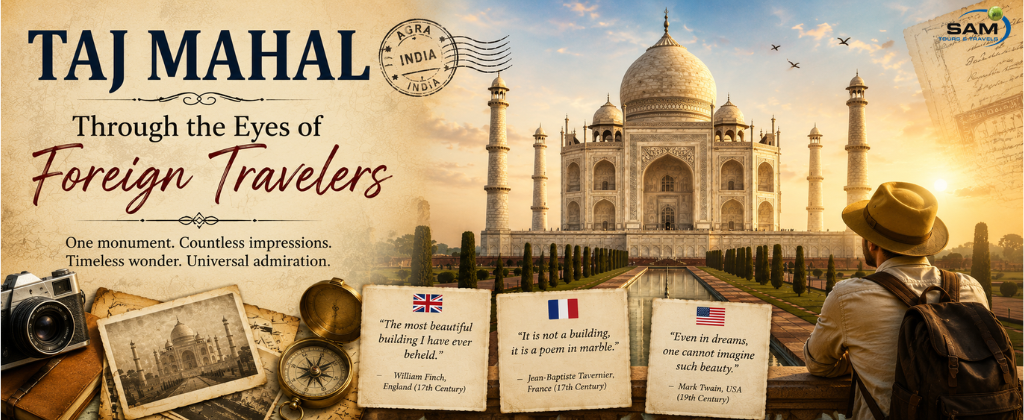
Taj Mahal Through the Eyes of Foreign Travelers: 400 Years of Wonder
The Taj Mahal has fascinated people from around the world for nearly four centuries. Long before social media and travel blogs, foreign travelers journeyed across continents to witness its beauty. They recorded their experiences in journals, letters, and books, leaving behind valuable historical accounts that continue to shape how the world views this architectural masterpiece.
From Persian merchants and European explorers to British officials and modern travel writers, each visitor brought a unique perspective. Some admired its perfect symmetry, while others praised its artistic craftsmanship or the emotional story behind its construction. Together, these observations reveal how the Taj Mahal has remained a global symbol of beauty, love, and architectural excellence.
In this article, we explore the Taj Mahal through the eyes of foreign travelers, tracing nearly 400 years of admiration, curiosity, and wonder.
Why Foreign Travelers Were Drawn to the Taj Mahal
Since its completion in the 17th century, the Taj Mahal has attracted visitors from distant lands. During the Mughal Empire, Agra was an important center for trade, diplomacy, and culture. Merchants, ambassadors, scholars, and explorers often visited the city and made the Taj Mahal one of their most memorable destinations.
Several factors made the monument irresistible to travelers:
- Its reputation as the world’s greatest monument to love
- Remarkable Mughal architecture
- Intricate marble craftsmanship
- Beautiful riverside setting
- Stories shared by traders and royal courts
Many travelers arrived with high expectations, yet their writings often reveal that the monument exceeded them.
Early European Travelers and Their First Impressions
Among the earliest Europeans to describe the Taj Mahal were merchants, diplomats, and adventurers who traveled through Mughal India during the 17th century.
Most were amazed by the monument’s scale and elegance. They often compared it to Europe’s greatest cathedrals and palaces but noted that its graceful design and white marble gave it a character unlike anything they had seen before.
Several travelers described the Taj Mahal as a structure that appeared almost unreal, especially when viewed from a distance.
Their accounts helped introduce the monument to readers across Europe.
Jean-Baptiste Tavernier’s Detailed Observations
One of the best-known foreign visitors was the French jeweler and traveler Jean-Baptiste Tavernier, who visited India several times during the Mughal period.
He admired the Taj Mahal’s craftsmanship, particularly its marble inlay work and precious stones. Tavernier also wrote about the immense resources and skilled artisans involved in its construction.
Although some of his observations—such as the story of a planned Black Taj Mahal—have since been questioned by historians, his travel writings remain among the earliest detailed European descriptions of the monument.
His accounts sparked curiosity about Mughal India throughout Europe.
François Bernier’s Perspective on Mughal Grandeur
Another influential French traveler, François Bernier, spent several years in India during the reign of Emperor Aurangzeb.
Bernier admired the wealth and sophistication of the Mughal Empire. He described the Taj Mahal as one of its greatest achievements, emphasizing its balanced proportions and artistic excellence.
Unlike many later visitors, Bernier viewed the monument within the broader context of Mughal politics, culture, and royal traditions.
His writings helped Europeans understand that the Taj Mahal was not simply a beautiful building but also a reflection of imperial power and artistic ambition.
British Travelers During the Colonial Era
During the 18th and 19th centuries, British officials, soldiers, artists, and scholars frequently visited the Taj Mahal.
Many were captivated by its peaceful gardens and elegant architecture. British painters created detailed sketches and watercolor paintings that introduced the monument to audiences across Europe.
Travel writers often described the Taj Mahal as one of the finest buildings ever constructed.
Some even believed no illustration could fully capture its beauty, insisting that it had to be seen in person.
These accounts greatly increased international interest in India.
Artists Who Captured the Taj Mahal
Foreign artists played an important role in preserving the monument’s history.
Before photography became common, painters created detailed illustrations showing:
- The marble dome
- Reflecting pools
- Garden pathways
- Decorative carvings
- Daily life around the monument
These artworks appeared in books, exhibitions, and travel journals, allowing people who had never visited India to admire the Taj Mahal.
Many early paintings remain valuable historical records today.
The Arrival of Photography Changed Global Perception
The invention of photography in the 19th century transformed how people experienced the Taj Mahal.
Foreign photographers documented the monument from different angles and during different seasons.
These photographs revealed details that paintings sometimes overlooked, including:
- Marble carvings
- Quranic calligraphy
- Geometric symmetry
- Delicate floral inlay
As photographs spread through newspapers, magazines, and books, the Taj Mahal became one of the world’s most recognizable landmarks.
Tourism increased significantly during this period.
Writers Inspired by the Monument
Many foreign authors found inspiration in the Taj Mahal.
Travel literature often described it as:
- A masterpiece of love
- A poem carved in stone
- A dream in marble
- A symbol of eternal devotion
Some writers focused on its emotional story, while others admired its architectural perfection.
Their descriptions helped establish the Taj Mahal’s romantic image in global culture.
Even today, these poetic interpretations continue to influence travelers.
Modern Travelers Share New Perspectives
Today’s international visitors experience the Taj Mahal differently from early explorers.
Modern transportation allows millions of tourists to visit every year.
Travel bloggers, photographers, filmmakers, and social media creators now share their experiences instantly with audiences around the world.
Many modern visitors continue to praise:
- The monument’s symmetry
- The peaceful atmosphere
- The changing colors of the marble
- The craftsmanship of the carvings
- The emotional history behind its construction
Although technology has changed, the sense of wonder remains remarkably similar to that expressed by travelers centuries ago.
How Different Cultures View the Taj Mahal
Foreign travelers often interpret the Taj Mahal through the lens of their own cultural backgrounds.
Some see it primarily as:
- A monument to love
- An architectural masterpiece
- A religious symbol
- A historical landmark
- A UNESCO World Heritage Site
These different perspectives enrich the monument’s global significance.
The Taj Mahal means different things to different people, yet it continues to inspire admiration across cultures.
What Foreign Travelers Admire Most
Despite coming from different countries and historical periods, many travelers highlight similar qualities.
The features most frequently praised include:
1. Architectural Symmetry
Visitors often describe the perfect balance of the design as unforgettable.
2. Marble Craftsmanship
The detailed carvings and stone inlay continue to impress architects and artists alike.
3. Changing Colors
Many travelers mention how the monument appears to change color throughout the day.
4. Peaceful Gardens
The Charbagh gardens create a calm environment that enhances the visitor experience.
5. The Story of Love
The romantic story of Shah Jahan and Mumtaz Mahal remains one of the monument’s greatest attractions.
How Foreign Accounts Help Historians
Travel diaries provide valuable historical evidence.
They help researchers understand:
- The monument’s original appearance
- Changes over time
- Restoration efforts
- Mughal society
- Visitor experiences across different centuries
Although some travel accounts contain exaggerations or misunderstandings, historians compare multiple sources to build a more complete picture of the Taj Mahal’s history.
Then and Now: Changing Impressions
| 17th Century Travelers | Modern Visitors |
|---|---|
| Reached Agra after long journeys | Travel easily by air, rail, and road |
| Recorded experiences in journals | Share instantly through social media |
| Focused on Mughal wealth and architecture | Appreciate history, photography, and culture |
| Relied on sketches and paintings | Capture high-resolution photos and videos |
| Introduced the Taj Mahal to Europe | Inspire millions of global travelers online |
Why the Taj Mahal Continues to Inspire the World
Very few monuments have maintained global admiration for nearly 400 years.
The Taj Mahal continues to impress because it combines:
- Timeless architecture
- Rich history
- Artistic excellence
- Emotional storytelling
- Cultural significance
Whether viewed through the writings of a 17th-century explorer or the camera lens of a modern traveler, its beauty remains universal.
Every generation discovers something new while experiencing the same sense of wonder described centuries ago.
Frequently Asked Questions (FAQs)
Who was one of the first foreign travelers to describe the Taj Mahal?
French traveler Jean-Baptiste Tavernier was among the earliest Europeans to provide detailed written descriptions of the Taj Mahal.
Why did foreign travelers admire the Taj Mahal?
They praised its white marble, perfect symmetry, intricate craftsmanship, beautiful gardens, and the love story behind its construction.
How did photography change the Taj Mahal’s global image?
Photography allowed people around the world to see accurate images of the monument, greatly increasing its international popularity.
Are early travel accounts historically reliable?
Many are valuable historical sources, although historians compare multiple accounts because some travelers included personal opinions or unverified stories.
Why does the Taj Mahal remain popular with international tourists?
Its combination of history, architecture, cultural significance, and emotional appeal continues to attract visitors from every corner of the world.
Conclusion
The Taj Mahal through the eyes of foreign travelers tells a remarkable story of enduring admiration. For nearly 400 years, explorers, merchants, diplomats, artists, writers, and tourists have described the monument with awe, each adding a unique perspective to its legacy. Their observations have helped transform the Taj Mahal from a Mughal masterpiece into one of the world’s most recognized symbols of beauty and love.
Although the ways people travel and share experiences have changed dramatically over the centuries, the monument’s ability to inspire remains constant. Whether admired through the pages of an old travel journal or captured in a modern photograph, the Taj Mahal continues to leave an unforgettable impression on everyone who sees it.