
·
Last Updated: August 18, 2026
The Secret Symbolism of the Taj Mahal: Meanings Hidden in Marble
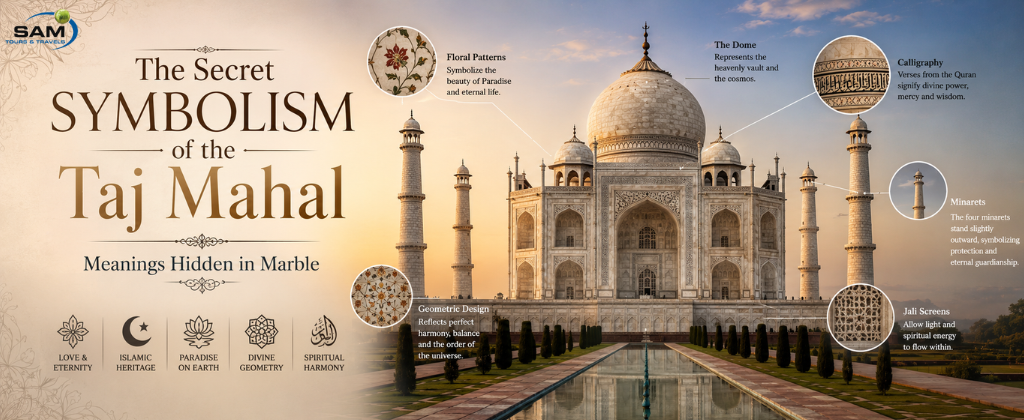
The Taj Mahal is more than one of the world’s most beautiful monuments. It is also a masterpiece filled with hidden meanings, symbolic designs, and spiritual messages. Built by the Mughal Emperor Shah Jahan in memory of his beloved wife, Mumtaz Mahal, this iconic monument represents eternal love. However, beneath its breathtaking beauty lies a carefully planned world of symbolism.
Every marble panel, floral carving, garden, dome, and Quranic inscription was designed with purpose. The architects combined Islamic beliefs, Persian artistic traditions, and Mughal craftsmanship to create a monument that reflects paradise, purity, balance, and eternal life.
Many visitors admire the Taj Mahal for its beauty without realizing that every detail tells a story. In this article, we explore the secret symbolism of the Taj Mahal and uncover the hidden meanings carved into its magnificent marble.
Why Symbolism Was Important in Mughal Architecture
The Mughal Empire was known for creating buildings that were not only visually impressive but also rich in meaning. Architecture during this period often reflected religious beliefs, royal authority, and spiritual ideals.
When Shah Jahan commissioned the Taj Mahal in 1632, he wanted it to be more than a tomb. He envisioned a monument that symbolized eternal love while reflecting the Islamic vision of paradise.
As a result, every part of the Taj Mahal was carefully designed to express harmony, perfection, and divine beauty.
White Marble: A Symbol of Purity and Eternity
One of the most recognizable features of the Taj Mahal is its brilliant white marble.
Unlike many Mughal buildings that were constructed with red sandstone, Shah Jahan chose pure white marble for this monument. In Islamic tradition, white often symbolizes purity, peace, and spirituality.
The marble also reflects changing light throughout the day.
- Pink at sunrise
- Bright white during daylight
- Golden at sunset
- Silver under moonlight
These changing colors symbolize the different stages of life and the passage of time. They remind visitors that beauty, like life itself, is constantly changing.
The marble’s timeless appearance also represents eternal love that never fades.
The Perfect Symmetry Represents Divine Order
One of the Taj Mahal’s most remarkable qualities is its perfect symmetry.
Almost every element mirrors another.
- Four identical minarets
- Balanced gardens
- Matching gateways
- Equal proportions
- Central dome aligned perfectly
This symmetry is not merely an architectural achievement. It represents balance, harmony, and the order of the universe.
In Islamic art, symmetry often reflects the perfection of God’s creation. The Taj Mahal’s flawless design encourages visitors to experience a sense of peace and spiritual balance.
The Central Dome Symbolizes Heaven
The massive white dome dominates the Taj Mahal’s skyline.
Architecturally, it creates grandeur. Symbolically, it carries much deeper meaning.
Many historians believe the dome represents the vault of heaven. Rising high above the mausoleum, it symbolizes the soul’s journey from Earth toward eternity.
The lotus-shaped decoration beneath the finial further reinforces this idea. Across many cultures, the lotus symbolizes purity, renewal, and spiritual awakening.
Together, the dome and lotus create a powerful image of eternal life.
The Charbagh Garden Represents Paradise
The gardens surrounding the Taj Mahal are not ordinary landscapes.
They follow the traditional Persian Charbagh layout, which divides the garden into four equal sections using water channels.
This design is inspired by descriptions of Paradise found in the Quran, where rivers of water, milk, honey, and wine flow through lush gardens.
Walking through these gardens symbolizes a spiritual journey toward heaven.
The trees, flowers, fountains, and flowing water all reinforce the idea that the Taj Mahal is not simply a tomb but a representation of paradise on Earth.
Flowing Water Reflects Life and Purity
Water plays an essential role throughout the Taj Mahal complex.
Long reflecting pools stretch toward the mausoleum, creating stunning mirror-like images.
Symbolically, water represents:
- Purification
- Life
- Renewal
- Divine blessings
The reflections also carry deeper meaning.
Seeing the Taj Mahal mirrored in still water reminds visitors that earthly beauty is temporary, while spiritual beauty lasts forever.
Floral Marble Inlay Symbolizes Eternal Life
One of the finest artistic features of the Taj Mahal is its marble inlay work.
Thousands of colorful semi-precious stones were carefully placed into white marble to create flowers, vines, and leaves.
Unlike real flowers that eventually fade, these stone flowers remain forever.
This symbolizes everlasting beauty and eternal life.
The artisans deliberately avoided depicting humans or animals, following traditional Islamic artistic practices that emphasize geometric and floral patterns instead.
Each flower reminds visitors that paradise is filled with everlasting gardens.
Quranic Calligraphy Carries Spiritual Messages
Beautiful black calligraphy decorates many entrances and walls of the Taj Mahal.
These inscriptions contain verses from the Quran that speak about:
- Mercy
- Judgment
- Paradise
- Eternal peace
- God’s compassion
As visitors approach the monument, the inscriptions become gradually larger.
This clever optical illusion makes every letter appear the same size from ground level.
Besides showcasing extraordinary craftsmanship, the calligraphy reminds visitors that the Taj Mahal is a sacred resting place rather than merely a royal monument.
The Four Minarets Symbolize Protection
Four elegant minarets stand at each corner of the marble platform.
They create perfect visual balance while serving symbolic and practical purposes.
Interestingly, each minaret leans slightly outward.
Engineers believe this was intentional so that, in the event of an earthquake, the towers would fall away from the central mausoleum instead of damaging it.
Symbolically, the four minarets are often interpreted as guardians protecting the sacred tomb.
Their presence also creates a sense of completeness and stability.
Light as a Symbol of Divine Presence
Natural light plays an important role in the Taj Mahal’s symbolism.
Throughout the day, sunlight enters the monument differently, illuminating various parts of the interior.
The marble itself reflects light rather than absorbing it.
In Islamic tradition, light often represents God’s presence, wisdom, and guidance.
This thoughtful use of natural light gives the monument a peaceful and almost heavenly atmosphere.
The Octagonal Chamber Represents Infinity
Inside the mausoleum lies the central octagonal chamber.
The number eight holds symbolic importance in Islamic architecture.
Many scholars associate the octagon with the transition between Earth and Heaven.
The shape also creates perfect balance while allowing visitors to move around the central tomb from multiple directions.
This design reinforces the monument’s themes of eternity and spiritual continuity.
Hidden Geometry Demonstrates Universal Harmony
One of the lesser-known secrets of the Taj Mahal is its mathematical precision.
Architects used carefully calculated proportions throughout the structure.
Many dimensions follow consistent geometric relationships.
This precise planning reflects the Mughal belief that mathematics reveals the order of creation.
The harmony of numbers mirrors the harmony of the universe itself.
Visitors may not consciously notice these proportions, but they contribute to the monument’s extraordinary visual balance.
Precious Stones and Their Symbolic Meaning
The Taj Mahal originally featured thousands of precious and semi-precious stones imported from across Asia and Europe.
Some commonly used stones included:
- Jasper
- Jade
- Lapis Lazuli
- Carnelian
- Turquoise
- Agate
Each stone was selected not only for its beauty but also for its symbolic value.
For example:
- Jade represented wisdom.
- Carnelian symbolized courage and protection.
- Lapis Lazuli was associated with royalty and the heavens.
- Turquoise represented prosperity and good fortune.
Together, these stones transformed the monument into a masterpiece of symbolic art.
Why the Taj Mahal Still Fascinates Historians
Centuries after its construction, historians continue to study the Taj Mahal’s symbolism.
Modern research has revealed that almost every decorative element serves both artistic and spiritual purposes.
Rather than relying on elaborate sculptures or paintings, Mughal architects used geometry, light, floral designs, water, and calligraphy to communicate deeper meanings.
This subtle approach makes the Taj Mahal one of the world’s greatest examples of symbolic architecture.
Symbolism at a Glance
| Feature | Hidden Meaning |
|---|---|
| White Marble | Purity, peace, eternal love |
| Central Dome | Heaven and eternal life |
| Charbagh Garden | Paradise described in the Quran |
| Water Channels | Purity, life, reflection |
| Floral Inlay | Everlasting beauty |
| Calligraphy | Divine guidance and mercy |
| Four Minarets | Protection and balance |
| Symmetry | Universal harmony and perfection |
| Octagonal Chamber | Transition between Earth and Heaven |
| Natural Light | God’s presence and spiritual enlightenment |
Frequently Asked Questions (FAQs)
Why is the Taj Mahal made of white marble?
White marble symbolizes purity, peace, and eternity. It also reflects changing light beautifully, enhancing the monument’s spiritual and artistic appeal.
What do the gardens of the Taj Mahal represent?
The Charbagh gardens symbolize the Islamic vision of paradise, with four sections divided by flowing water channels.
Why is the Taj Mahal perfectly symmetrical?
The symmetry reflects harmony, balance, and the perfection of God’s creation, which are central themes in Islamic art and architecture.
What is the meaning of the Quranic inscriptions?
The inscriptions include verses about paradise, mercy, divine judgment, and eternal peace, emphasizing the mausoleum’s spiritual significance.
What makes the Taj Mahal unique compared to other monuments?
Its combination of architectural precision, symbolic design, exquisite marble craftsmanship, and spiritual themes makes it one of the world’s most meaningful and admired monuments.
Conclusion
The secret symbolism of the Taj Mahal extends far beyond its breathtaking appearance. Every architectural detail, from the white marble and elegant dome to the peaceful gardens and intricate calligraphy, was designed to convey ideas of purity, paradise, balance, and eternal love. Rather than being just a royal mausoleum, the Taj Mahal stands as a carefully crafted expression of faith, artistry, and devotion.
Understanding these hidden meanings allows visitors to appreciate the monument on a deeper level. Its enduring beauty is not only found in its marble walls but also in the timeless symbols that continue to inspire people from around the world.