
·
Last Updated: August 18, 2026
The Agra Marble Inlay Art is one of the city’s most treasured artistic traditions and a living legacy of the Mughal Empire. While millions of visitors admire the intricate floral patterns decorating the Taj Mahal, many don’t realize that the same centuries-old craftsmanship continues to thrive in workshops across Agra today.
Known as Pietra Dura or Parchin Kari, this remarkable art form involves embedding semi-precious stones into polished white marble to create stunning floral, geometric, and decorative designs. In this guide, you’ll learn about the history of Agra’s marble inlay art, how it is created, where to see authentic craftsmanship, and how to identify genuine handmade products.
What Is Marble Inlay Art?
Marble inlay art is the delicate process of carving grooves into marble and fitting precisely cut semi-precious stones into the surface.
Unlike painting or engraving, every colored stone is individually shaped and permanently embedded into the marble.
The finished artwork is completely smooth to the touch and incredibly durable.
This exquisite technique reached its highest level during the construction of the Taj Mahal in the 17th century.
The History of Agra’s Marble Inlay Art
The marble inlay technique was introduced to India during the Mughal period, drawing inspiration from Persian and Italian decorative traditions.
Emperor Shah Jahan commissioned thousands of skilled artisans to decorate the Taj Mahal using this intricate method.
Master craftsmen from Persia, Central Asia, and India worked together to produce the breathtaking floral patterns that continue to amaze visitors today.
Many of today’s artisans in Agra are descendants of those original craftsmen, preserving techniques that have been passed down through generations.
What Is Pietra Dura (Parchin Kari)?
Pietra Dura, known locally as Parchin Kari, is the traditional art of decorating marble with colorful stones.
The process involves:
- Designing the pattern
- Cutting marble by hand
- Shaping tiny stone pieces
- Embedding each stone into carved grooves
- Polishing the surface until perfectly smooth
The result is an elegant design that becomes part of the marble itself rather than sitting on top of it.
Semi-Precious Stones Used
Authentic marble inlay work often includes:
- Lapis Lazuli
- Jasper
- Carnelian
- Jade
- Malachite
- Turquoise
- Mother of Pearl
- Onyx
- Agate
- Tiger Eye
Each stone contributes its own natural color without the need for artificial paint.
How Authentic Marble Inlay Art Is Made
Creating a single handcrafted piece may take days or even months, depending on its complexity.
Step 1: Selecting the Marble
High-quality white marble, often sourced from Makrana in Rajasthan, is carefully prepared.
Step 2: Drawing the Design
Artists sketch detailed floral or geometric patterns inspired by Mughal architecture.
Step 3: Cutting the Stones
Tiny pieces of semi-precious stones are cut by hand using specialized tools.
Step 4: Carving the Marble
The marble surface is carefully carved to match the exact shape of each stone.
Step 5: Inlay Work
Every stone is fitted into its corresponding groove with exceptional precision.
Step 6: Final Polishing
The completed artwork is polished until the marble and stones become perfectly level.
Why the Taj Mahal Is Famous for Marble Inlay
The Taj Mahal contains some of the world’s finest examples of Pietra Dura.
Visitors can admire:
- Floral vines
- Delicate flowers
- Quranic calligraphy borders
- Geometric patterns
- Decorative panels
The intricate craftsmanship appears almost like painting, yet every detail is created entirely from stone.
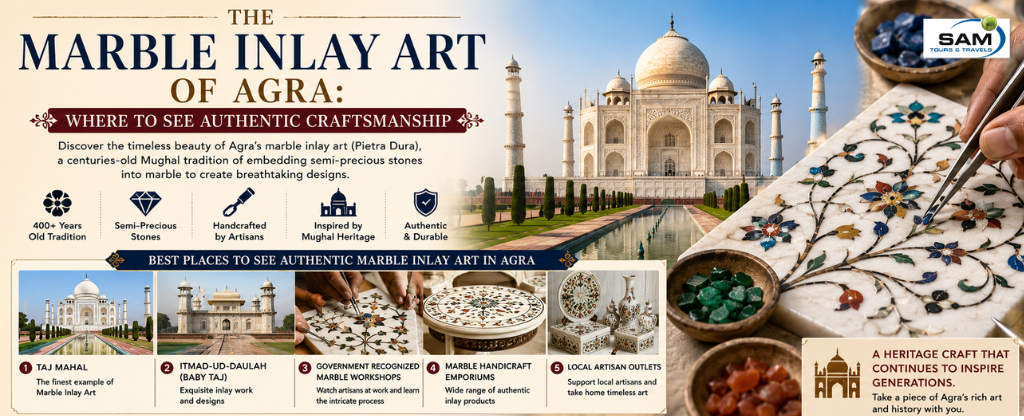
Where to See Authentic Marble Inlay Art in Agra
1. Taj Mahal
The monument itself remains the greatest showcase of marble inlay craftsmanship.
Take time to observe the floral details around the cenotaphs, entrance arches, and decorative panels.
2. Itmad-ud-Daulah (Baby Taj)
Often called the “Baby Taj,” this beautiful Mughal tomb features extensive marble inlay work and offers a quieter setting for appreciating the artistry up close.
3. Government-Recognized Marble Workshops
Several family-run workshops in Agra welcome visitors to watch artisans demonstrate the inlay process.
These workshops often explain:
- Stone cutting
- Marble carving
- Polishing techniques
- Traditional tools
Purchasing directly from reputable workshops also supports local craftsmen.
4. Marble Handicraft Emporiums
Agra has several trusted showrooms where visitors can find authentic handcrafted marble products, including:
- Tabletops
- Coasters
- Decorative plates
- Jewelry boxes
- Elephant figurines
- Vases
- Wall panels
Always ask about the materials used and whether the piece is handmade.
How to Identify Authentic Marble Inlay Art
Because Agra is a popular tourist destination, many imitation products are also sold.
Here are a few tips to help you identify genuine craftsmanship:
- The surface should feel completely smooth.
- The colored sections should be real stone, not paint or printed designs.
- Handcrafted pieces often show slight natural variations.
- Authentic work is heavier because it uses real marble.
- Reputable sellers provide details about the materials and craftsmanship.
Why Supporting Local Artisans Matters
Purchasing authentic marble inlay products helps preserve a centuries-old artistic tradition.
It also supports families who have practiced this craft for generations, ensuring that these remarkable skills continue to thrive for future generations.
Suggested Tour : Agra Sightseeing Tour
Tips for Visitors
To enjoy the best experience:
- Visit a workshop with a knowledgeable guide.
- Watch a live demonstration if possible.
- Compare several shops before purchasing.
- Avoid deals that seem unusually cheap.
- Ask about the stones used in each piece.
- Pack marble items carefully for travel.
Best Souvenirs to Buy
Popular marble inlay souvenirs include:
- Decorative tabletops
- Jewelry boxes
- Marble coasters
- Candle holders
- Photo frames
- Pen stands
- Wall art
- Animal figurines
- Flower vases
These handmade pieces make elegant gifts and lasting reminders of your visit to Agra.
Conclusion
Agra’s marble inlay art is much more than a beautiful souvenir—it’s a centuries-old tradition that reflects the extraordinary skill and creativity of Mughal artisans. From the breathtaking floral patterns of the Taj Mahal to the family-run workshops where craftsmen continue this heritage today, every piece tells a story of patience, precision, and artistic excellence.
Whether you’re a history enthusiast, architecture lover, or collector of fine handicrafts, taking the time to witness authentic marble inlay craftsmanship will add a deeper appreciation to your journey through Agra.
Frequently Asked Questions (FAQs)
1. What is marble inlay art?
Marble inlay art is the process of embedding precisely cut semi-precious stones into marble to create decorative patterns.
2. What is Pietra Dura?
Pietra Dura, also called Parchin Kari in India, is the traditional technique used to decorate marble with colorful stone inlays.
3. Where can I see authentic marble inlay work in Agra?
The Taj Mahal, Itmad-ud-Daulah, and several government-recognized marble workshops are among the best places to experience authentic craftsmanship.
4. How can I identify genuine marble inlay products?
Look for smooth surfaces, real semi-precious stones, natural variations, and reputable sellers who can explain the materials and techniques used.
5. Are marble inlay products good souvenirs?
Yes. Handmade marble inlay products are among Agra’s most popular souvenirs because they combine beauty, durability, and centuries of artistic tradition.