
·
Last Updated: August 18, 2026
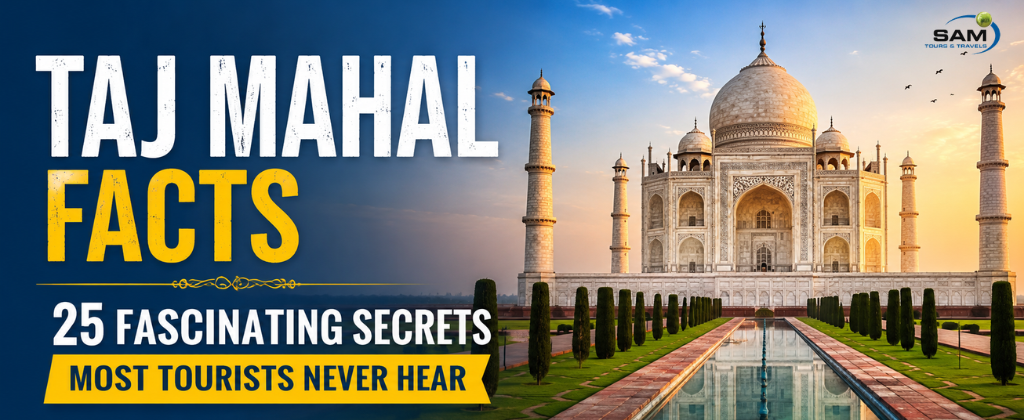
Taj Mahal Facts reveal that this iconic monument is far more than a symbol of love. These Taj Mahal facts uncover hidden architectural secrets, remarkable engineering, fascinating history, and little-known stories that most tourists never hear.
Whether you’re planning your first visit or have already admired its beauty, these 25 fascinating facts will help you appreciate the Taj Mahal from a completely new perspective.
1. The Taj Mahal Took Over 22 Years to Complete
Construction began in 1632 after Mumtaz Mahal’s death and was largely completed in 1653. Thousands of craftsmen, artisans, engineers, and laborers worked tirelessly to create this architectural masterpiece.
2. More Than 20,000 Workers Built the Monument
Around 20,000 artisans from different regions of India, Persia, Central Asia, and the Ottoman Empire contributed to the construction.
These included:
- Marble sculptors
- Stone inlay artists
- Calligraphers
- Architects
- Dome specialists
- Garden designers
3. The Marble Came from Rajasthan
The stunning white marble wasn’t sourced locally.
It was transported from the famous marble quarries of Makrana in Rajasthan, located nearly 300 kilometers from Agra.
Interestingly, the same marble is still considered among the finest in the world.
4. Over 1,000 Elephants Were Used During Construction
Without modern machinery, transporting enormous marble blocks and precious stones was a massive challenge.
Historical records suggest that over 1,000 elephants were used to carry heavy materials across northern India.
5. The Taj Mahal Isn’t Purely White
Many visitors believe the monument is simply white marble.
In reality, the marble changes color depending on:
- Sunrise – Soft pink
- Morning – Bright white
- Sunset – Golden hue
- Moonlight – Silvery blue
This remarkable transformation is one of the monument’s most magical features.
6. The Four Minarets Lean Slightly Outward
Look closely and you’ll notice something unusual.
Each of the four minarets is intentionally tilted slightly away from the main mausoleum.
This brilliant engineering ensures that if an earthquake occurs, the towers would collapse outward instead of damaging the central tomb.
7. There Are No Human Figures Inside the Decoration
Following Islamic artistic traditions, you’ll find no statues or human carvings.
Instead, the Taj Mahal features:
- Floral motifs
- Geometric patterns
- Arabic calligraphy
- Semi-precious stone inlay work
8. More Than 28 Types of Precious Stones Decorate the Monument
The marble walls are decorated using the ancient Pietra Dura technique.
Some stones include:
- Jasper
- Jade
- Lapis Lazuli
- Turquoise
- Carnelian
- Sapphire
- Crystal
- Agate
- Onyx
Many were imported from distant countries including Tibet, Sri Lanka, Persia, and China.
9. The Quranic Calligraphy Appears Perfectly Uniform
One of the greatest optical illusions at the Taj Mahal is its calligraphy.
Although the letters become progressively larger higher up, they appear exactly the same size from ground level.
This demonstrates the incredible mathematical precision of Mughal architects.
10. The Central Tombs Are Not the Real Graves
Most tourists photograph the beautifully decorated marble cenotaphs.
However, the actual graves of Shah Jahan and Mumtaz Mahal are located in a lower chamber beneath the main floor.
11. The Garden Represents Paradise
The famous Charbagh garden is far more than landscaping.
Its four-part layout symbolizes the gardens of Paradise described in Islamic tradition, with flowing water channels representing rivers of heaven.
12. Every Flower Has Symbolic Meaning
The carved marble flowers aren’t random decorations.
Many represent:
- Eternal life
- Purity
- Paradise
- Renewal
- Divine beauty
13. No Two Floral Designs Are Exactly Identical
Although the monument appears perfectly symmetrical, careful observation reveals that many floral carvings have subtle differences.
This showcases the extraordinary craftsmanship of Mughal artisans.
14. The Taj Mahal Is Perfectly Symmetrical—Almost
Nearly every part of the Taj Mahal follows perfect symmetry.
The only exception is Shah Jahan’s cenotaph.
Since it was added after his death, it sits beside Mumtaz Mahal’s tomb, slightly disrupting the otherwise flawless balance.
15. It Is Built Along the Yamuna River for a Reason
The river wasn’t chosen merely for its beauty.
It helped:
- Stabilize the foundation
- Provide water for construction
- Supply the fountains and gardens
- Enhance reflections of the monument
16. The Foundation Uses Ancient Engineering
Instead of deep concrete foundations, builders used massive wells filled with stone and timber to support the structure.
This innovative technique has helped the monument remain stable for centuries.
17. The Dome Is Larger Than It Appears
The iconic onion-shaped dome rises approximately 73 meters (240 feet) above the ground, making it one of the largest Mughal domes ever constructed.
18. The Taj Mahal Is a UNESCO World Heritage Site
The monument was designated a UNESCO World Heritage Site in 1983 for its outstanding universal value and exceptional architecture.
Today it is recognized as one of humanity’s greatest architectural achievements.
19. Millions Visit Every Year
The Taj Mahal welcomes millions of visitors annually, making it one of the world’s most visited historical monuments.
Peak tourist seasons include:
- October to March
- Christmas holidays
- New Year
- Long weekends
20. The Monument Looks Different in Every Season
Each season offers a unique experience:
- Winter mornings often feature mystical fog.
- Spring brings colorful gardens.
- Summer provides dramatic golden sunsets.
- Monsoon skies create striking reflections and photography opportunities.
21. The Taj Mahal Has Exceptional Acoustics
The main mausoleum’s interior creates a gentle echo due to its high dome and symmetrical architecture.
Even a soft sound can resonate beautifully within the chamber.
22. The Finial Combines Different Cultural Influences
The golden finial atop the dome blends Islamic and traditional Indian design elements.
Its crescent shape, when viewed from certain angles, resembles a trident—an example of the artistic fusion seen throughout Mughal architecture.
23. The Monument Is Surrounded by Protected Green Zones
To help preserve the white marble from pollution, the area around the Taj Mahal is part of the Taj Trapezium Zone (TTZ), where strict environmental regulations limit polluting industries and vehicle emissions.
24. Every Visit Reveals New Details
From intricate marble carvings and gemstone inlays to hidden geometric patterns and delicate calligraphy, the Taj Mahal rewards careful observation.
Many visitors notice new details even after multiple visits.
25. A Knowledgeable Guide Can Transform Your Experience
While the Taj Mahal is breathtaking on its own, understanding its history, symbolism, engineering, and artistic details makes the visit far more meaningful.
A licensed local guide can explain hidden stories, point out architectural features that are easy to miss, and help you appreciate why the Taj Mahal remains one of the world’s greatest masterpieces.
Tips for Visitors
To make the most of your visit:
- Arrive early to enjoy cooler weather and smaller crowds.
- Wear comfortable footwear, as you’ll walk extensively.
- Carry a valid ID and your entry ticket.
- Respect monument rules and avoid touching the marble surfaces.
- Bring a camera or smartphone to capture the changing colors of the monument throughout the day.
Conclusion
The Taj Mahal is much more than a beautiful monument—it is a masterpiece of architecture, engineering, artistry, and symbolism. From its earthquake-resistant minarets and optical illusions to its precious stone inlay and paradise-inspired gardens, every detail reflects extraordinary craftsmanship and vision.
Whether you’re a history enthusiast, architecture lover, photographer, or first-time traveler, discovering these hidden facts adds a deeper appreciation to every step you take through this iconic landmark. The next time you stand before the Taj Mahal, you’ll see more than white marble—you’ll witness centuries of history, innovation, and timeless beauty.
Frequently Asked Questions (FAQs)
1. What is the most interesting fact about the Taj Mahal?
One of the most fascinating facts is that the four minarets lean slightly outward. This was an intentional engineering decision so they would fall away from the main mausoleum in the event of an earthquake.
2. Why does the Taj Mahal change color?
The white Makrana marble reflects sunlight differently throughout the day, giving the monument pink hues at sunrise, brilliant white during the day, golden tones at sunset, and a soft silvery glow under moonlight.
3. Are the tombs inside the Taj Mahal real?
The marble tombs visitors see are decorative cenotaphs. The actual graves of Shah Jahan and Mumtaz Mahal are located in a lower chamber beneath the main floor.
4. How many workers built the Taj Mahal?
Historical accounts suggest that around 20,000 artisans, craftsmen, laborers, and engineers worked on the construction over approximately 22 years.
5. Which marble was used to build the Taj Mahal?
The monument was built using high-quality white Makrana marble from Rajasthan, renowned for its durability, purity, and luminous appearance.