
·
Last Updated: September 21, 2026
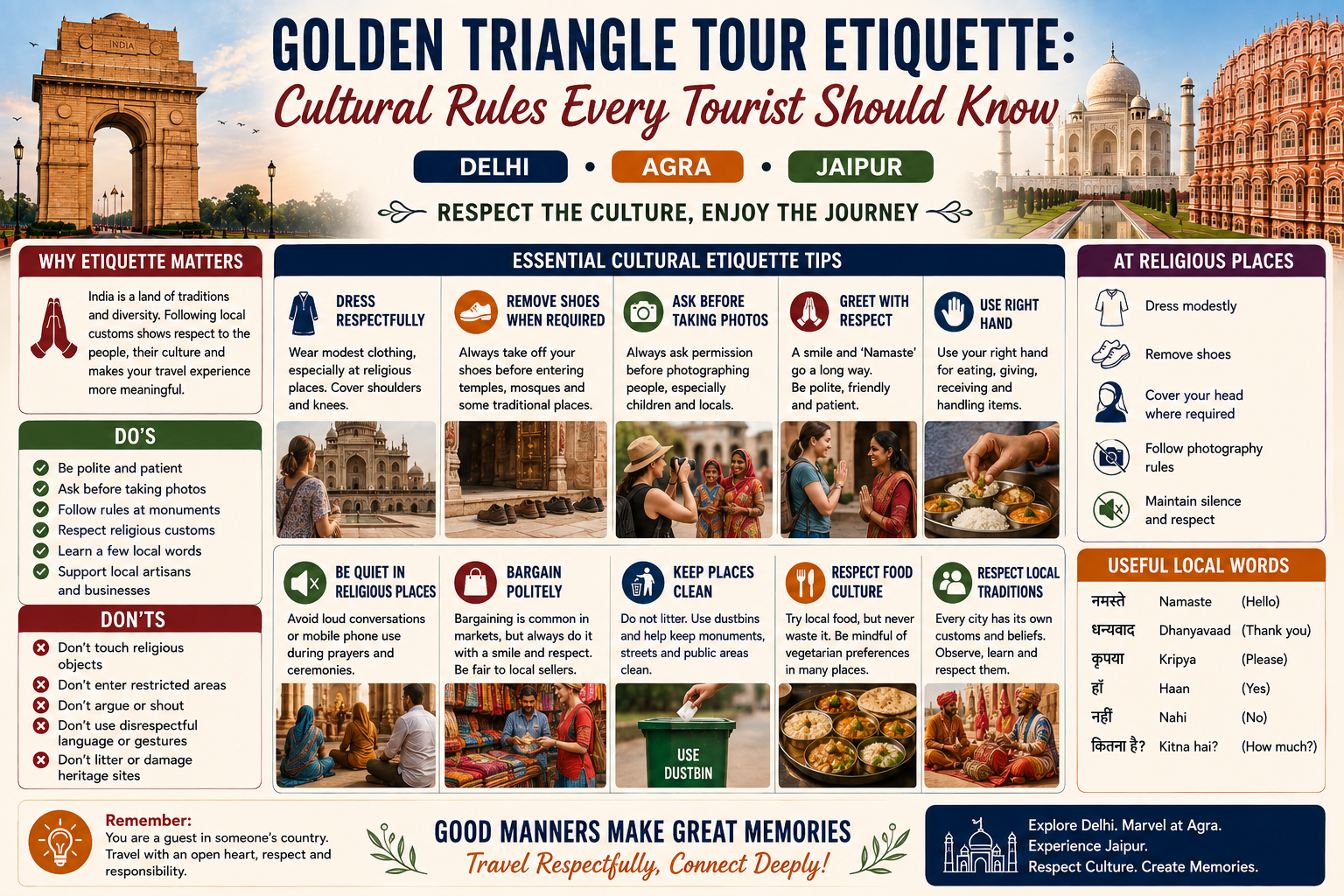
A Golden Triangle Tour through Delhi, Agra, and Jaipur is more than a journey to famous monuments. It is an opportunity to experience India’s history, traditions, food, religion, art, and everyday culture.
For first-time visitors, some local customs may be different from what they are used to at home. Understanding basic Indian travel etiquette can make your trip more comfortable and help you interact respectfully with local communities.
From visiting temples and mosques to taking photographs, eating local food, shopping in traditional markets, and greeting people, a little cultural awareness goes a long way.
This Golden Triangle Tour etiquette guide covers important cultural rules and practical tips every tourist should know before exploring Delhi, Agra, and Jaipur.
Why Cultural Etiquette Matters in India
India is culturally diverse, and customs can vary between regions, communities, religions, and individual families.
You do not need to know every tradition before visiting. However, showing respect, observing your surroundings, and being willing to adapt will help you have better experiences.
Simple gestures such as dressing appropriately at religious sites, removing your shoes when required, asking before taking someone’s photograph, and avoiding disrespectful behavior can make a meaningful difference.
Remember that you are visiting places where people live, worship, work, and celebrate their traditions every day.
1. Dress Respectfully at Religious Places
One of the most important etiquette rules for tourists is dressing appropriately when visiting religious sites.
India has many temples, mosques, gurudwaras, and other places of worship, and individual sites may have their own dress requirements.
When visiting a religious place:
- Choose modest clothing.
- Cover shoulders and knees where appropriate.
- Avoid excessively revealing outfits.
- Follow any posted dress guidelines.
- Observe what local visitors are wearing.
You do not necessarily need traditional Indian clothing, but modest and respectful attire is usually a safe choice.
2. Remove Your Shoes When Required
Shoes may need to be removed before entering temples, certain religious buildings, and some private or traditional spaces.
Look for signs or observe whether other visitors are removing their footwear.
If shoes must be removed, place them in the designated area rather than leaving them in an inappropriate location.
Wearing easy-to-remove footwear can make sightseeing more convenient.
3. Ask Before Taking Photographs of People
India is a fantastic destination for photography, but travelers should remember that people are not tourist attractions.
If you want to take a close-up photograph of someone, ask for permission first.
This is particularly important when photographing:
- Children
- Religious ceremonies
- Vendors
- Artisans
- Elderly people
- Worshippers
- Private gatherings
A simple smile and gesture asking permission can make the interaction more respectful.
4. Follow Photography Rules at Monuments
Major attractions may have specific rules about photography.
Some locations may restrict:
- Flash photography
- Tripods
- Professional equipment
- Photography inside certain rooms
- Video recording
Always follow signs and instructions from staff.
Even if you see another person ignoring a rule, that does not mean the restriction does not apply.
5. Be Respectful Inside Temples and Mosques
Religious sites require additional sensitivity.
Avoid loud conversations, inappropriate gestures, or behavior that could disturb worshippers.
Depending on the place, you may be expected to:
- Remove your shoes
- Cover your head
- Dress modestly
- Avoid certain areas
- Follow a particular entrance or exit
- Refrain from photography
If you are uncertain, quietly ask a staff member or local guide.
6. Learn How to Greet People
A friendly greeting is always appreciated.
The traditional greeting “Namaste”, often accompanied by bringing the palms together, is widely recognized throughout India.
A simple “hello” is also perfectly acceptable, particularly in tourist areas.
You do not need to imitate every local gesture. Being friendly, polite, and respectful is more important than getting every cultural detail perfect.
7. Be Careful With Physical Contact
Social customs around physical contact can vary.
Avoid assuming that everyone is comfortable with hugs, touching, or other forms of physical contact.
When meeting someone for the first time, a verbal greeting or Namaste is generally a safe and respectful approach.
Be particularly mindful in religious environments and when interacting with people from more traditional communities.
8. Use Your Right Hand When Appropriate
In many Indian cultural settings, the right hand is traditionally preferred for giving, receiving, eating, or handling certain items.
This is especially relevant when eating traditional food with your hands or exchanging items.
If you naturally use your left hand, do not panic. Cultural etiquette is about awareness rather than perfection.
When eating with your hands, using the right hand is generally considered more appropriate.
9. Respect Food Traditions
Food is an important part of Indian culture.
India has a large vegetarian population, and dietary practices can be connected to religious or cultural traditions.
You may encounter restaurants that are:
- Vegetarian
- Non-vegetarian
- Jain
- Halal
- Regional specialty restaurants
Respect the food choices of your hosts and fellow travelers.
If you are invited to share a meal, avoid making negative comments about unfamiliar dishes. If you have dietary restrictions, communicate them politely.
10. Do Not Waste Food
Food is highly valued in Indian households and traditional hospitality.
If you are invited to someone’s home or served a large meal, take a reasonable portion first.
You can always ask for more.
Trying local dishes is encouraged, but taking more food than you can eat creates unnecessary waste.
11. Be Polite When Bargaining
Bargaining is common in many traditional markets in Delhi, Agra, and Jaipur.
However, bargaining should remain friendly.
Instead of becoming aggressive over a small price difference:
- Ask politely for the best price.
- Compare products at different shops.
- Decide what you are comfortable paying.
- Walk away if you cannot agree.
Remember that a price that seems inexpensive to an international traveler may represent meaningful income for a local artisan or seller.
12. Do Not Feel Pressured to Buy
Markets can be lively, and sellers may enthusiastically recommend their products.
You are free to browse without purchasing.
If you do not want something, a polite:
“No, thank you.”
is usually enough.
Avoid promising to return if you have no intention of doing so, as this can create unnecessary expectations.
13. Respect Local Religious Practices
India is home to many religions and traditions.
During your Golden Triangle journey, you may encounter:
- Hindu ceremonies
- Muslim prayer
- Sikh traditions
- Jain practices
- Buddhist traditions
- Local festivals
You do not need to participate in religious activities unless you genuinely wish to and are permitted to do so.
Observing quietly and respectfully is perfectly acceptable.
14. Be Quiet During Religious Ceremonies
If you attend a ceremony or religious gathering, keep your voice low.
Avoid:
- Loud conversations
- Laughing at inappropriate moments
- Playing music
- Using your phone unnecessarily
- Blocking entrances
- Interrupting worshippers
If you are unsure where to stand or sit, follow the behavior of local visitors or ask a guide.
15. Respect Sacred Objects
Never touch religious statues, offerings, sacred objects, or ceremonial items unless you are explicitly invited to do so.
Avoid placing personal belongings on religious structures.
If you are visiting a temple or other sacred site, observe how local worshippers behave and follow the site’s instructions.
16. Be Considerate Around Animals
Animals are a visible part of everyday life in many Indian cities.
You may see cows, dogs, monkeys, birds, and other animals around streets and tourist areas.
Do not assume that an animal is safe to approach or feed.
In particular, avoid getting too close to unfamiliar animals simply for a photograph.
Keep food and personal belongings secure around animals that may approach you.
17. Respect Local Communities When Visiting Villages
Some Golden Triangle itineraries include village visits or rural experiences.
Remember that these are people’s homes and communities, not open-air tourist attractions.
When visiting rural areas:
- Ask before taking photographs.
- Avoid entering private property.
- Follow your guide’s instructions.
- Do not disturb daily activities.
- Dress appropriately.
- Purchase local products fairly.
Responsible tourism means allowing local communities to benefit without feeling exploited.
18. Ask Permission Before Entering Private Spaces
A colorful doorway, courtyard, shop, or home may look perfect for a photograph, but it does not automatically mean you can enter.
Always ask permission before:
- Entering private property
- Photographing inside homes
- Photographing workshops
- Touching personal belongings
- Joining private ceremonies
Respecting boundaries is one of the simplest ways to be a responsible traveler.
19. Be Patient in Crowded Places
Delhi, Agra, and Jaipur can become extremely busy, particularly around major attractions, markets, railway stations, and festivals.
Crowds may move differently from what you are accustomed to.
Try to remain patient.
Avoid pushing, shouting, or becoming frustrated over small delays.
A calm attitude will make your experience much more enjoyable.
20. Learn Basic Indian Travel Phrases
You can get around the Golden Triangle using English in many tourist areas, but learning a few simple Hindi expressions can create warmer interactions.
Useful phrases include:
Namaste – Hello/Greetings
Dhanyavaad – Thank you
Kripya – Please
Haan – Yes
Nahi – No
Kitna hai? – How much is it?
You do not need perfect pronunciation. Making the effort is often appreciated.
21. Avoid Public Arguments
Travel can sometimes involve misunderstandings, particularly when dealing with transportation, shopping, or language differences.
If a disagreement occurs, remain calm.
Instead of raising your voice:
- Ask for clarification.
- Repeat the agreed price.
- Show written information if available.
- Contact your hotel or tour operator if necessary.
- Leave if the situation becomes uncomfortable.
Being calm and firm is generally more effective than becoming confrontational.
22. Respect Personal Space
Personal space can vary considerably between cultures and environments.
Busy markets and public transportation may naturally involve close physical proximity.
However, do not intentionally invade someone’s personal space.
When queues are present, follow the local system and avoid pushing ahead.
23. Understand Queue Etiquette
At popular monuments, railway stations, ticket counters, and restaurants, queues can become crowded.
Look for designated lines and follow staff instructions.
If you are uncertain about where to stand, ask someone politely rather than assuming.
At major attractions, having tickets ready can also help you move through entry points more efficiently.
24. Be Careful With Public Displays of Affection
India’s social norms can be more conservative than those in some Western countries.
Couples should be mindful of their surroundings and avoid excessive public displays of affection, particularly near religious sites and in conservative communities.
A respectful approach is appropriate throughout the Golden Triangle.
25. Respect Local Dress Traditions
Jaipur and other parts of Rajasthan have strong traditional clothing traditions.
You may see people wearing colorful garments, turbans, sarees, kurtas, and other regional attire.
Avoid making jokes about someone’s clothing or treating traditional dress as a costume.
If you want to photograph someone wearing traditional clothing, ask first.
26. Be Sensitive About Religion and Politics
Religion and politics can be important and sometimes sensitive subjects.
Avoid making assumptions about someone’s beliefs.
If a conversation turns toward religion or politics, listen respectfully and avoid making offensive comments about local traditions or communities.
Travel is an opportunity to learn, not to judge.
27. Respect Local Guides and Drivers
Guides and drivers are often an important part of a Golden Triangle Tour.
Communicate clearly about:
- Timings
- Stops
- Prices
- Waiting periods
- Shopping visits
- Sightseeing preferences
If you are unhappy with a service, explain the issue politely rather than becoming aggressive.
A good working relationship can make your journey much smoother.
28. Tip When Appropriate
Tipping practices vary by service and situation.
In restaurants, hotels, guiding services, and transportation, a tip may be appreciated when service has been good.
You do not need to tip every person you encounter.
If a service charge has already been added to a restaurant bill, check the bill before deciding whether you want to leave anything extra.
29. Keep Public Places Clean
Responsible travel also includes environmental etiquette.
Do not throw plastic bottles, wrappers, food waste, or other rubbish on streets or at monuments.
Use designated bins whenever available.
Historic sites, gardens, lakes, and public spaces belong to everyone, so keeping them clean helps protect them for future visitors and local communities.
30. Respect Heritage Sites
The Golden Triangle contains some of India’s most important historical monuments.
Never:
- Scratch walls
- Write names on monuments
- Climb restricted structures
- Remove stones or artifacts
- Touch delicate artwork unnecessarily
- Ignore barriers
A photograph is a much better souvenir than a piece of historical architecture.
Golden Triangle Etiquette by Destination
Each city has its own character, so keep a few destination-specific points in mind.
Delhi
Delhi is fast-paced and multicultural.
Be particularly mindful of:
- Traffic
- Crowds
- Religious sites
- Busy markets
- Public transportation
- Personal belongings
Give yourself extra time when traveling across the city.
Agra
Agra receives visitors from around the world because of the Taj Mahal and its Mughal heritage.
When visiting monuments:
- Follow photography restrictions.
- Dress appropriately.
- Avoid touching protected structures.
- Be cautious with unsolicited guides.
- Respect religious and heritage sites.
When shopping, compare prices before purchasing expensive marble or handicraft products.
Jaipur
Jaipur offers a strong connection to Rajasthani culture and traditional craftsmanship.
Be respectful when:
- Photographing people in traditional dress
- Visiting temples
- Exploring local markets
- Buying handicrafts
- Visiting artisan workshops
If you participate in a cultural experience, follow the instructions of your host or guide.
Golden Triangle Etiquette for Photography Lovers
Delhi, Agra, and Jaipur are outstanding photography destinations.
However, good travel photography requires more than finding a beautiful subject.
Before Taking a Portrait
Ask permission.
Inside Religious Sites
Follow photography rules.
Around Children
Avoid photographing children without permission from a parent or responsible adult.
In Markets
Be aware of people’s privacy and personal space.
At Monuments
Do not climb barriers or enter restricted areas for a better photograph.
The best travel photographs are those captured without compromising someone’s dignity or safety.
Golden Triangle Etiquette for Solo Travelers
Solo travelers have more freedom, but they should also remain aware of their surroundings.
A few useful habits include:
- Keep accommodation details accessible.
- Use reliable transportation.
- Tell someone your basic itinerary.
- Avoid unnecessary arguments.
- Respect local customs.
- Be cautious when accepting invitations from strangers.
- Stay in well-reviewed accommodation.
Being friendly does not mean you have to accept every offer or invitation.
Golden Triangle Etiquette for Families
Families traveling with children should introduce basic cultural etiquette before visiting India.
Teach children to:
- Speak quietly in religious places.
- Ask before touching objects.
- Avoid running through monuments.
- Ask permission before photographing people.
- Dispose of rubbish properly.
- Respect local traditions.
Children who understand these simple rules can enjoy cultural experiences while being respectful to the communities they visit.
Golden Triangle Etiquette for Couples
Couples can enjoy romantic experiences throughout Delhi, Agra, and Jaipur.
However, be aware that public behavior expectations may differ from those in your home country.
Keep public displays of affection relatively modest, especially around religious locations and conservative communities.
A respectful approach allows you to enjoy your trip without unintentionally offending local residents.
Things Tourists Should Avoid in India
While every situation is different, visitors should generally avoid:
- Disrespecting religious practices
- Photographing people without permission
- Touching sacred objects
- Entering restricted areas
- Bargaining aggressively
- Making jokes about religion or traditions
- Littering
- Damaging monuments
- Ignoring local dress requirements
- Shouting during disagreements
- Feeding unfamiliar animals
- Treating local communities as tourist attractions
Most of these rules are simply common courtesy.
Golden Triangle Cultural Etiquette Checklist
Before starting your trip, remember these simple rules:
Dress respectfully at religious and traditional sites.
Ask before photographing people.
Remove your shoes whenever required.
Use your right hand for eating and giving or receiving items when appropriate.
Bargain politely in markets.
Respect religious ceremonies.
Follow monument rules.
Do not litter or damage heritage sites.
Avoid aggressive behavior.
Learn a few local words.
Be patient with crowds and traffic.
Respect people’s privacy.
Support local artisans and businesses fairly.
What If You Make a Cultural Mistake?
Do not worry if you accidentally make a small etiquette mistake.
India is a large and diverse country, and even locals may follow different customs depending on their background.
If someone politely corrects you:
- Listen.
- Apologize if necessary.
- Follow the appropriate custom.
- Move on.
Most people understand that foreign visitors may not know every local tradition.
Showing genuine respect matters more than being perfect.
How to Be a Responsible Golden Triangle Tourist
Cultural etiquette and responsible tourism go hand in hand.
Consider supporting local communities by:
- Hiring local guides
- Eating at locally owned restaurants
- Buying directly from artisans
- Choosing responsible cultural experiences
- Avoiding exploitative animal activities
- Respecting local neighborhoods
- Reducing plastic waste
- Protecting historical sites
Your travel choices can have a positive impact on the destinations you visit.
Final Thoughts
Understanding Golden Triangle Tour etiquette does not require memorizing hundreds of rules. The most important principles are simple: show respect, observe your surroundings, ask permission, and remain open-minded.
Delhi, Agra, and Jaipur each have their own cultural character. You may encounter different religious traditions, languages, foods, clothing styles, social customs, and ways of life during the same journey.
Treat people respectfully, follow the rules at monuments and religious sites, dress appropriately, ask before taking photographs, bargain with patience, and avoid behavior that could damage cultural or historical places.
The goal of responsible travel is not to behave exactly like a local. It is to be a thoughtful visitor.
When you combine curiosity with respect, your Golden Triangle Tour becomes more than a visit to famous monuments. It becomes an opportunity to understand and appreciate the people, traditions, and living culture that make Delhi, Agra, and Jaipur so special.