
·
Last Updated: September 18, 2026
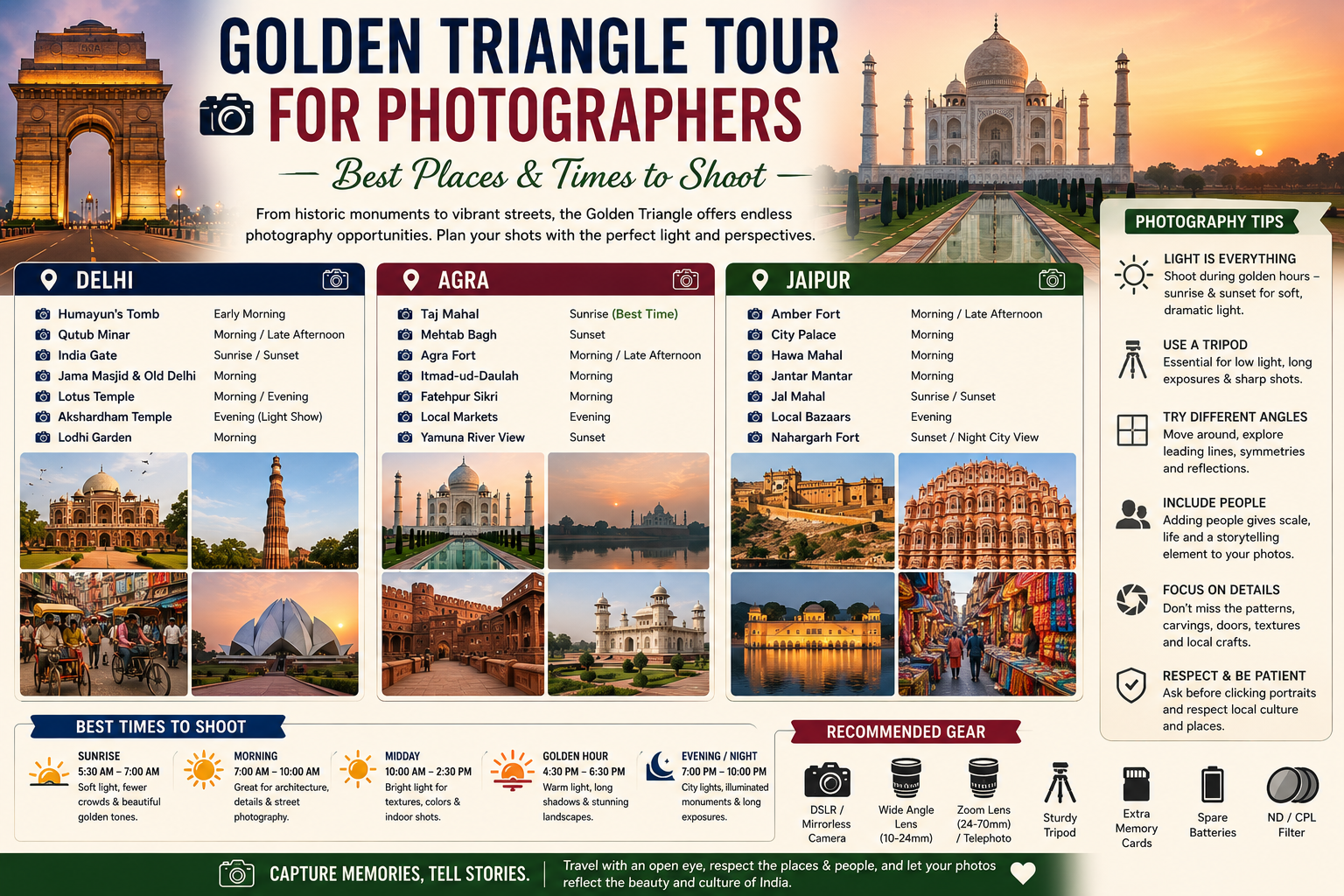
The Golden Triangle Tour is one of India’s most rewarding journeys for photography lovers. Connecting Delhi, Agra, and Jaipur, this famous travel circuit brings together historic monuments, Mughal architecture, royal palaces, colorful streets, traditional markets, local crafts, and fascinating everyday life.
For photographers, the Golden Triangle is not simply about photographing famous landmarks. It is about discovering how light, color, architecture, people, and atmosphere change from one city to another.
A sunrise at the Taj Mahal can create a completely different mood from a busy afternoon in Old Delhi. Jaipur’s colorful markets offer a different photographic experience from Agra’s elegant Mughal architecture. With the right timing and a little patience, even familiar landmarks can produce unique images.
Whether you are a professional photographer, travel blogger, beginner, or smartphone enthusiast, this guide will help you plan a photography-focused Golden Triangle Tour.
Why the Golden Triangle Is Great for Photography
The Golden Triangle offers an impressive variety of photographic subjects within a relatively compact route.
Delhi: Urban & Cultural Photography
Delhi combines ancient monuments, busy markets, modern buildings, historic neighborhoods, street food, and everyday city life.
Agra: Architecture & Heritage
Agra is best known for the Taj Mahal, but its forts, gardens, markets, and traditional craftsmanship also provide excellent subjects.
Jaipur: Color & Royal Architecture
Jaipur is filled with colorful buildings, magnificent forts, decorated palaces, textiles, jewelry, and vibrant bazaars.
The contrast between these three cities makes the Golden Triangle ideal for building a diverse travel photography portfolio.
The Best Time of Day for Golden Triangle Photography
The time you photograph a location can be just as important as the location itself.
Sunrise
Sunrise is one of the best times for outdoor photography.
The light is generally softer, shadows can be longer, and some popular locations may be less crowded than later in the day.
Sunrise is particularly valuable for:
- Taj Mahal
- Jal Mahal
- Historic gardens
- Forts
- Quiet streets
- Landscapes
Morning
Morning light works particularly well for architecture.
It can reveal textures and details without the extremely harsh contrast sometimes found around midday.
Midday
Bright sunlight can be challenging, but it is useful for high-contrast photography.
Look for:
- Shadows
- Geometric shapes
- Architectural details
- Market scenes
- Textures
- Indoor areas where photography is permitted
Golden Hour
The period around sunset can provide warm, soft light.
It is excellent for:
- Forts
- Palaces
- Cityscapes
- Portraits
- Landscapes
- Silhouettes
Evening
Once the sun goes down, switch your attention to city life.
Markets, illuminated buildings, restaurants, streets, and evening activity can provide atmospheric photographs.
Delhi: A Photographer’s First Stop
Delhi is a city of contrasts.
Ancient monuments stand close to modern roads. Traditional markets operate alongside contemporary businesses. Quiet gardens exist only a short distance from busy streets.
This diversity makes Delhi particularly interesting for photographers.
Humayun’s Tomb
Humayun’s Tomb is one of the best locations in Delhi for architectural photography.
Its symmetrical design, large dome, red sandstone, white marble details, and surrounding gardens provide many composition possibilities.
Best Time to Shoot
Early morning or late afternoon
What to Photograph
- Symmetry
- Arches
- Domes
- Garden pathways
- Architectural details
- Reflections
- People for scale
Creative Tip
Stand along the central pathway and carefully align the architectural elements.
Then change your position and search for a less conventional angle.
Qutub Minar
Qutub Minar is ideal for photographers who enjoy dramatic architectural perspectives.
The monument’s height allows you to experiment with wide-angle compositions.
Best Time
Morning or late afternoon
Try photographing the tower from close to the base and use the surrounding structures to create depth.
Also look for:
- Stone carvings
- Arches
- Repeating patterns
- Shadows
- Textures
A telephoto lens can help isolate small architectural details.
Old Delhi
Old Delhi is one of the most exciting places for street photography.
The streets are filled with movement and visual contrasts.
You may encounter:
- Food vendors
- Rickshaws
- Shopkeepers
- Markets
- Historic buildings
- Street signs
- Religious architecture
- Crowds
Best Time
Morning
Early hours can offer interesting activity before some areas become even busier.
Street Photography Tip
Do not walk constantly while photographing.
Find an interesting location, compose your frame, and wait.
The right moment may come to you.
India Gate
India Gate can work well for wide cityscape compositions.
Best Time
Early morning or evening
At sunset, the changing light can create silhouettes and atmospheric images.
After dark, the illuminated monument can also provide a different visual style.
Agra: The Heart of the Photography Journey
Agra is the city most closely associated with the Taj Mahal, but photographers should resist the temptation to spend the entire visit at one monument.
The city provides opportunities for:
- Mughal architecture
- Landscapes
- Street photography
- Crafts
- Food photography
- Portraits
- Architectural details
Taj Mahal Sunrise Photography
The Taj Mahal is undoubtedly the photographic centerpiece of the Golden Triangle.
Its white marble changes appearance as the light changes.
Best Time
Sunrise and early morning, subject to the monument’s current opening schedule.
Early morning can offer softer light and potentially fewer visitors than later periods.
Start With the Classic Photograph
Begin with the traditional symmetrical view.
Then explore.
Try:
- Different camera heights
- Side perspectives
- Wide-angle compositions
- Architectural details
- Reflections
- Framing through doorways
- People for scale
The goal is not to avoid the classic photograph.
It is to create photographs beyond it.
Taj Mahal Photography Details
Look closely at the monument’s craftsmanship.
Photograph:
- Marble inlay
- Floral designs
- Carved marble
- Geometric patterns
- Arches
- Decorative details
Close-up images can complement your wide architectural photographs.
Important
Always follow current photography restrictions at the monument.
Do not enter restricted areas, climb structures, or disturb other visitors for a better photograph.
Mehtab Bagh
Mehtab Bagh provides a different perspective of the Taj Mahal from across the Yamuna.
This is a useful location for photographers who want a wider landscape composition.
Best Time
Late afternoon and sunset
Instead of filling the entire frame with the Taj Mahal, include surrounding elements such as the sky, landscape, and river area where appropriate.
This creates a more atmospheric photograph.
Agra Fort
Agra Fort offers strong opportunities for architectural photography.
The combination of red sandstone, courtyards, arches, walls, and decorative details provides plenty of variety.
Best Time
Morning or late afternoon
Look for the contrast between illuminated surfaces and deep shadows.
Try photographing:
- Arched corridors
- Gateways
- Courtyards
- Decorative details
- Textured walls
- Framed views
Itmad-ud-Daulah’s Tomb
This elegant Mughal monument is particularly suitable for detail photography.
Instead of concentrating only on the entire structure, explore its decorative elements.
Look for:
- Marble patterns
- Inlay work
- Geometric designs
- Windows
- Carvings
- Garden views
A standard lens can work well for environmental photographs, while a longer lens can isolate details.
Photograph Agra Beyond the Monuments
Some of the strongest travel photographs can be found away from major tourist attractions.
Explore local markets and look for:
- Marble craftsmanship
- Traditional sweets
- Street food
- Textiles
- Shops
- Rickshaws
- Everyday life
When photographing people closely, ask for permission.
A respectful interaction often results in a more natural portrait.
Jaipur: A Photographer’s Color Paradise
Jaipur brings an entirely different visual style to the Golden Triangle.
The city is known for its distinctive architecture, colorful streets, royal heritage, markets, textiles, jewelry, and crafts.
This makes it particularly attractive for:
- Color photography
- Street photography
- Architecture
- Portraits
- Detail photography
Hawa Mahal
Hawa Mahal is one of Jaipur’s most recognizable buildings.
Its repeated windows and decorative façade create strong geometric patterns.
Best Time
Morning
The façade can look particularly attractive under softer morning light.
Photography Ideas
Try:
- Symmetry
- Tight crops
- Repeating windows
- Street-level photographs
- Wide compositions
- People in the foreground
Do not feel obligated to photograph the entire building every time.
A small section can create a powerful abstract image.
Amber Fort
Amber Fort combines architecture with a dramatic hill setting.
Best Time
Morning or late afternoon
The softer light can emphasize textures and architectural details.
Look for:
- Large gateways
- Courtyards
- Decorative walls
- Arches
- Windows
- Hill landscapes
Try combining people with the architecture to communicate scale.
City Palace
City Palace provides excellent opportunities for colorful architectural photography.
Look for:
- Decorative doors
- Courtyards
- Painted surfaces
- Patterns
- Textiles
- Royal details
Rather than photographing every room, choose the strongest compositions and spend more time observing.
Jantar Mantar
Jantar Mantar is ideal for photographers interested in geometry.
The astronomical instruments create unusual combinations of:
- Curves
- Lines
- Angles
- Shadows
- Shapes
Experiment with unusual camera positions.
Try both wide compositions and close-up abstract photographs.
Jal Mahal
Jal Mahal is particularly interesting as a landscape subject.
Best Time
Sunrise or sunset
The surrounding water and sky can provide a natural frame around the palace.
Try capturing several versions of the scene as the light changes.
Jaipur Markets
Jaipur’s markets offer some of the strongest colors on the entire Golden Triangle route.
Photograph:
- Textiles
- Jewelry
- Bangles
- Pottery
- Traditional clothing
- Handicrafts
- Food
Creative Tip
Instead of photographing the entire market, look for a single visual theme.
For example:
Red textiles + gold jewelry + pink architecture
This creates a stronger color story.
Photographing Local Crafts
Traditional craftsmanship can add depth to your Golden Triangle photography collection.
Depending on the location, you may encounter:
- Block printing
- Blue pottery
- Jewelry making
- Textile work
- Marble craftsmanship
Photograph both the process and the finished product where permitted.
Hands working on a craft can often create a more meaningful image than a simple photograph of the finished object.
Always ask the artisan or business owner before photographing inside a workshop.
Best Photography Spots at a Glance
| City | Location | Best Time | Photography Focus |
|---|---|---|---|
| Delhi | Humayun’s Tomb | Morning | Architecture |
| Delhi | Qutub Minar | Morning/Evening | Architecture |
| Delhi | Old Delhi | Morning | Street Life |
| Delhi | India Gate | Evening | Cityscape |
| Agra | Taj Mahal | Sunrise | Architecture |
| Agra | Mehtab Bagh | Sunset | Landscape |
| Agra | Agra Fort | Morning/Evening | Heritage |
| Agra | Local Markets | Morning/Evening | Street Photography |
| Jaipur | Hawa Mahal | Morning | Architecture |
| Jaipur | Amber Fort | Morning | Fort & Landscape |
| Jaipur | City Palace | Morning/Afternoon | Details |
| Jaipur | Jantar Mantar | Morning/Afternoon | Geometry |
| Jaipur | Jal Mahal | Sunrise/Sunset | Landscape |
| Jaipur | Local Markets | Evening | Color & Culture |
Opening hours and photography restrictions can change, so check current information before planning your shoot.
A 7-Day Golden Triangle Photography Itinerary
Day 1 – Delhi
Arrive and explore the local surroundings.
Use the evening for relaxed street or city photography.
Day 2 – Delhi
Start with Humayun’s Tomb or Qutub Minar.
Spend the afternoon exploring Old Delhi.
Finish with evening street photography.
Day 3 – Agra
Travel from Delhi to Agra.
Visit Agra Fort and explore local areas.
Day 4 – Agra
Wake early for the Taj Mahal.
Spend the afternoon photographing architectural details.
Visit a suitable sunset viewpoint in the evening.
Day 5 – Jaipur
Travel from Agra to Jaipur.
Explore Jaipur’s streets and markets in the evening.
Day 6 – Jaipur
Photograph Amber Fort, City Palace, and Jantar Mantar.
Use the evening for Hawa Mahal and street photography.
Day 7 – Jaipur
Spend the morning photographing markets and local crafts.
Use the remaining time for any missed locations or a final sunset shoot.
How to Photograph People in India Respectfully
People can transform a travel photograph from a simple location image into a story.
However, photographers should always respect personal boundaries.
For close-up portraits:
Ask permission first.
Avoid photographing people during private or sensitive moments.
Be especially careful when photographing:
- Children
- Religious ceremonies
- Worshippers
- Private gatherings
- People in distress
If someone does not want to be photographed, respect their decision.
Golden Triangle Photography Equipment
You can photograph the Golden Triangle with almost any modern camera.
A practical setup might include:
Camera Body
Mirrorless, DSLR, or smartphone.
Wide-Angle Lens
Useful for architecture and landscapes.
Standard Zoom
Good for general travel photography.
Telephoto Lens
Useful for distant architectural details and compressed perspectives.
Spare Batteries
Important during full-day photography trips.
Memory Cards
Carry enough storage for the entire journey.
Lens Cloth
Useful because dust and fingerprints can affect photographs.
Tripod
A compact tripod can be useful for suitable low-light photography, but always confirm whether tripods are permitted at the location.
Smartphone Photography Tips
You do not need expensive equipment to capture the Golden Triangle.
For better smartphone photographs:
- Clean the camera lens.
- Use grid lines.
- Look for symmetry.
- Try different perspectives.
- Use natural light.
- Avoid unnecessary digital zoom.
- Experiment with reflections.
- Take both wide and close photographs.
The most important camera is the one you have with you when the moment happens.
How to Photograph in Crowded Locations
Popular attractions can become busy.
Instead of fighting the crowds, use them creatively.
You can:
- Include people to show scale.
- Photograph upward.
- Use close compositions.
- Focus on architectural details.
- Wait for a clear moment.
- Turn crowds into part of the story.
For cleaner monument photographs, arrive as early as possible.
Photography Tips for Better Golden Triangle Images
Look for Leading Lines
Use pathways, walls, corridors, and architectural features to guide the viewer’s eye.
Use Symmetry
The Taj Mahal and several Mughal and Rajasthani structures are perfect for symmetrical compositions.
Photograph Details
Do not overlook small patterns and textures.
Change Your Perspective
Move closer, step back, lower your camera, or look upward.
Watch the Background
A distracting background can weaken an otherwise excellent photograph.
Wait for the Moment
Sometimes the best photograph happens when the right person enters the frame.
Avoid These Common Photography Mistakes
Arriving Too Late
You may miss the best morning light.
Taking Only Tourist Photos
Try photographing everyday life as well as famous monuments.
Ignoring the Background
Check every corner of your frame before pressing the shutter.
Carrying Too Much Equipment
A heavy camera bag can make sightseeing exhausting.
Forgetting Backup Batteries
Long photography days can quickly drain batteries.
Ignoring Local Rules
Never sacrifice safety or heritage protection for a photograph.
Spending the Whole Trip Behind the Camera
Remember to experience the destination as well as photograph it.
Create a Golden Triangle Photo Story
Instead of collecting hundreds of unrelated photographs, create a visual narrative.
Start with:
Delhi – The City
Show streets, architecture, markets, and people.
Continue with:
Agra – The Heritage
Show the Taj Mahal, Mughal architecture, craftsmanship, and landscapes.
Finish with:
Jaipur – The Colors
Show royal buildings, markets, textiles, crafts, and local life.
Add photographs of food, transportation, people, and small details between the major landmarks.
The result will feel like a journey rather than a simple collection of tourist attractions.
Responsible Photography on the Golden Triangle
Great travel photography should respect the destination.
Always:
- Follow attraction rules.
- Ask before photographing people closely.
- Respect religious spaces.
- Avoid touching protected structures.
- Stay behind barriers.
- Do not enter restricted areas.
- Avoid disturbing ceremonies.
- Respect local privacy.
Your photographs should preserve memories without negatively affecting the people or places you photograph.
Final Thoughts
The Golden Triangle Tour for photographers offers an incredible range of visual experiences.
Delhi provides energetic streets and historic architecture. Agra delivers magnificent Mughal monuments and the unforgettable Taj Mahal. Jaipur brings color, royal heritage, traditional markets, and remarkable craftsmanship.
The secret to better Golden Triangle photography is not simply owning an expensive camera.
It is about being in the right place at the right time.
Wake up early for architectural photography. Use golden hour for monuments and landscapes. Explore markets when you want color and movement. Look closely at craftsmanship and architectural details. Wait patiently for meaningful moments.
Most importantly, do not photograph only what everyone else is photographing.
Walk a little farther. Change your perspective. Look at the details. Observe how people interact with their surroundings.
When you combine good light, thoughtful composition, patience, and cultural respect, your Golden Triangle photographs can become more than travel souvenirs.
They can become a visual story of Delhi’s energy, Agra’s heritage, and Jaipur’s color and culture.