
·
Last Updated: August 18, 2026
Agra is famous for the Taj Mahal. However, the city has another beautiful story to tell.
For centuries, skilled artisans in Agra have worked with marble and coloured stones. They create delicate designs by placing tiny pieces of stone inside marble.
This traditional craft is called marble inlay work.
For many artisans, this work is more than a job. It is a skill passed from one generation to the next.
But what does a typical day look like for a marble inlay artist in Agra?
Let’s find out.
The Day Starts with Careful Preparation
A marble inlay artist usually begins the day by preparing the materials.
The artisan checks the marble first. Then, they select the coloured stones for the design.
Common materials include:
- White marble
- Coloured stones
- Semi-precious stones
- Small cutting tools
- Files
- Polishing materials
Each material has a purpose.
The marble must be strong. The stones must also have the right colour and shape.
Therefore, preparation is an important part of the work.
Every Design Begins with an Idea
The artisan does not start cutting stones immediately.
First, the artist studies the design.
Some designs feature flowers and leaves. Others include geometric patterns.
Next, the artist draws the design on the marble.
This step requires great care. Even a small mistake can affect the final result.
The artist must decide:
- Where each stone will go
- Which colours will work together
- How large the design should be
- How the pattern will look on the marble
As a result, planning plays an important role in marble inlay work.
Cutting the Coloured Stones
After planning the design, the artisan begins cutting the stones.
This is a delicate process.
Each stone must match the required shape. Some pieces are very small. Others have curves and unusual edges.
The artisan works slowly.
If the artist cuts a stone incorrectly, the piece may become unusable.
Therefore, patience is essential.
The artist may spend a long time working on a single small piece.
Fitting the Pieces into the Marble
The next step involves fitting the stones into the marble.
First, the artisan creates small spaces in the marble. Then, the artist places the coloured stones inside those spaces.
Each piece must fit carefully.
If a stone is too large, the artisan adjusts it. If it is too small, the artist may need to prepare another piece.
This process can take several attempts.
However, the result is worth the effort.
The finished design looks smooth and detailed.
Patience Is the Artist’s Greatest Tool
Marble inlay work requires patience.
An artist may spend hours working on a small part of a larger design.
The final product may look simple. However, every detail requires time and concentration.
The artisan must focus on:
- The shape of each stone
- The size of each piece
- The colours in the design
- The position of every element
Therefore, the artist cannot rush the process.
One careless movement can damage a stone or disturb the design.
The Taj Mahal Inspires Agra’s Artisans
The Taj Mahal has influenced Agra’s artistic traditions for centuries.
Visitors admire its beautiful marble decoration and detailed inlay work.
Many local artisans continue to work with similar traditional techniques today.
However, modern artisans also create their own designs.
They make products for homes, hotels, offices, and visitors.
In this way, the craft continues to grow while keeping its traditional roots.
Learning the Craft Takes Time
Many marble inlay artists learn the craft from their families.
Young learners often begin by watching older artisans.
Later, they start with simple tasks.
They may learn how to:
- Handle tools
- Cut small stones
- Prepare the marble
- Follow a design
With practice, they slowly improve.
Learning the craft can take years.
Therefore, every experienced artisan carries years of knowledge and practice.
The Hands Behind the Artwork
Visitors often notice the finished artwork first.
They may see a beautiful table, box, panel, or decorative piece.
However, they may not see the work behind it.
The artisan may have spent many hours creating that piece.
The work includes:
- Planning the design.
- Selecting the materials.
- Cutting the stones.
- Preparing the marble.
- Fitting every piece.
- Polishing the final product.
Each step requires skill.
Therefore, handmade marble inlay work has a special value.
What Does an Artisan’s Workshop Feel Like?
A traditional workshop has a unique atmosphere.
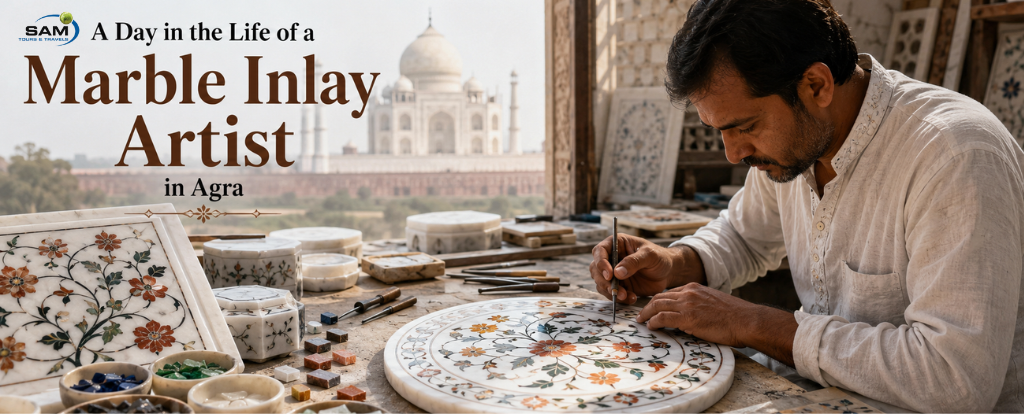
Small pieces of stone may cover the worktable. Tools may sit beside unfinished designs.
The artisan works quietly and carefully.
You may hear the sound of tools cutting and shaping the stone.
Unlike factory production, handmade work takes time.
Each piece receives individual attention.
As a result, no two handmade products are exactly the same.
Traditional Craft Faces Modern Challenges
Today, traditional artisans face several challenges.
Machine-made products can be produced quickly. They can also cost less.
However, handmade marble inlay work offers something different.
Every piece reflects the artist’s skill and effort.
The artist also gives personal attention to every design.
Therefore, supporting local artisans helps protect traditional craftsmanship.
It also helps keep important skills alive for future generations.
A Marble Inlay Piece Is More Than a Souvenir
Many visitors buy marble inlay products during their Agra trip.
These products can become memorable souvenirs.
However, they represent more than a simple purchase.
A handmade piece can represent:
- Agra’s culture
- Traditional craftsmanship
- Artistic skill
- Family knowledge
- The influence of the Taj Mahal
The finished product may be small.
Nevertheless, it may represent many hours of work.
The Connection Between Agra’s Artisans and the Taj Mahal
The Taj Mahal is Agra’s most famous monument.
However, its artistic influence extends beyond the monument itself.
Local artisans continue to work with traditional materials and techniques.
Their work creates a connection between Agra’s past and present.
The Taj Mahal preserves history through its architecture.
Meanwhile, artisans preserve tradition through their skills.
Together, they create an important part of Agra’s cultural identity.
When the Working Day Ends
After several hours of work, the artisan eventually puts down the tools.
Some pieces may be finished.
Others may need more work the next day.
The unfinished designs remain ready for the next stage.
Then, the process begins again the following morning.
The artisan will once again select stones, prepare marble, and work on new designs.
This daily routine keeps the traditional craft alive.
Discover Agra Beyond the Taj Mahal
Most visitors come to Agra to see the marble inlay artist in Agra
However, the city offers much more.
Its artisans, markets, workshops, and traditional crafts reveal another side of Agra.
A marble inlay artist may spend days creating a piece.
A visitor may admire that piece for only a few minutes.
Still, those few minutes represent years of skill and tradition.
That is what makes handmade craftsmanship special.
Final Thoughts
A day in the life of a marble inlay artist in Agra is a story of patience and skill.
The process begins with a simple idea.
Then, the artist carefully selects the materials. Next, they cut the stones and fit them into the marble.
The work takes time.
However, that time gives each handmade piece its unique character.
The next time you visit Agra, look beyond the Taj Mahal.
Remember the artisans who continue to protect the city’s traditional crafts.
The Taj Mahal may be Agra’s most famous masterpiece.
However, the city’s skilled artisans continue to create beautiful works of art every day.