
·
Last Updated: August 26, 2026
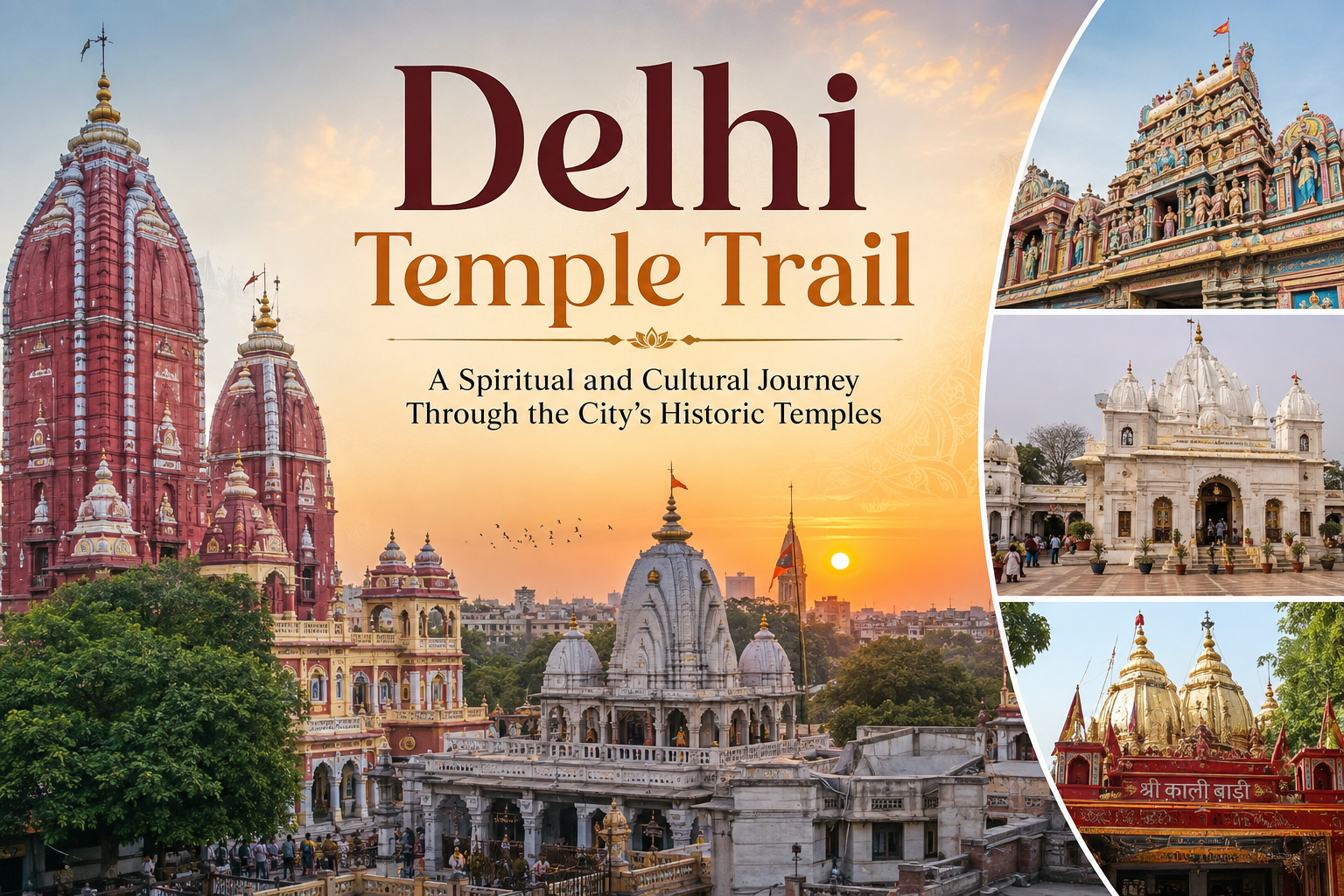
A Spiritual and Cultural Journey Through the City’s Historic Temple Trail
Delhi is often described as a city of monuments, forts, markets, and historic neighborhoods. But another important part of the capital’s identity can be discovered through its temples. From ancient traditions and historic shrines to grand modern temple complexes, Delhi offers a fascinating journey through India’s religious architecture, spirituality, art, and everyday culture.
A Delhi temple trail is more than a list of places to visit. It is an opportunity to experience different architectural styles, observe devotional traditions, discover stories connected with Hindu deities, and understand how temples continue to function as important community spaces.
The city’s temples range from centuries-old shrines hidden within busy neighborhoods to large modern complexes that attract thousands of visitors. Some are famous for their architecture, while others are known for their festivals, spiritual atmosphere, history, or connection with particular traditions.
For visitors, the best way to explore Delhi’s temples is to move at a comfortable pace. Instead of trying to visit every temple in one day, select a few that interest you and allow enough time to appreciate each place.
This guide explores some of the most interesting temples to include on a Delhi temple trail, along with practical advice on planning your visit respectfully.
Why Explore Delhi’s Temple Heritage?
Temples are an important part of India’s cultural landscape.
They are places of worship, but their role often extends beyond religious rituals. Temples can serve as centers for festivals, music, community gatherings, charity, education, food distribution, and cultural traditions.
Delhi’s temples reflect the diversity of Hindu traditions found across India.
A visitor may encounter temples dedicated to Hanuman, Shiva, Lakshmi, Krishna, Durga, and other deities. Architectural styles also vary considerably.
Some temples are associated with older traditions, while others were constructed or expanded during the modern period.
This variety makes a temple trail a rewarding way to understand Delhi beyond its famous monuments.
Start With Birla Mandir
One of the most accessible places to begin a Delhi temple trail is Birla Mandir, also known as the Laxminarayan Temple.
Located near central Delhi, the temple is dedicated primarily to Lord Vishnu and Goddess Lakshmi and is one of the city’s best-known modern Hindu temples.
The temple complex is notable for its architecture, decorative details, and spacious surroundings.
Visitors can observe the use of traditional temple design elements while also experiencing a busy urban religious center.
The temple is particularly lively during major Hindu festivals.
For first-time visitors, Birla Mandir offers a useful introduction to Delhi’s temple culture because it combines worship, architecture, and community activity in one location.
The Spiritual Atmosphere of Birla Mandir
One of the most interesting aspects of visiting Birla Mandir is seeing the contrast between the peaceful temple environment and the busy city outside.
Delhi’s roads can be crowded and noisy, but entering a temple complex can create a noticeably different atmosphere.
Visitors should take time to slow down.
Observe the architecture.
Listen to the sounds of prayers and bells.
Watch devotees participating in rituals.
If photography is permitted, take photographs respectfully, but avoid allowing photography to interfere with worship.
The experience is more meaningful when the temple is treated as a living religious space rather than simply an architectural attraction.
Akshardham Temple
Another major stop on a Delhi temple trail is Swaminarayan Akshardham.
The complex is known for its large scale, elaborate architecture, detailed stone carving, landscaped areas, and cultural presentation.
It has become one of Delhi’s most prominent modern religious and cultural attractions.
The architecture draws inspiration from traditional Indian temple traditions while presenting them on a monumental scale.
Visitors can spend considerable time exploring the complex and its various attractions.
Because entry rules, security procedures, photography restrictions, and visitor arrangements can change, it is sensible to check current official information before visiting.
Exploring Akshardham’s Architecture
Akshardham is particularly interesting for visitors who enjoy architectural details.
Look closely at the carvings and decorative elements.
Traditional motifs cover many parts of the complex, demonstrating the level of craftsmanship involved in its construction.
The temple illustrates how traditional Indian architectural ideas can be interpreted in a contemporary setting.
For a visitor interested in the relationship between heritage and modern religious architecture, this is an important stop.
The scale of the complex also demonstrates how temples continue to attract large communities in modern urban India.
ISKCON Temple, East of Kailash
The ISKCON Temple in East of Kailash is another popular destination for visitors interested in Delhi’s religious and cultural life.
The temple is associated with the International Society for Krishna Consciousness and is dedicated to Krishna and Radha.
Its spiritual environment is strongly connected with devotional practices, chanting, music, and community activities.
Visitors may encounter devotional singing and other religious activities depending on the time of their visit.
The temple provides a different experience from the grand architectural scale of Akshardham.
Here, the emphasis on devotional culture and community participation is particularly noticeable.
Experiencing Krishna Devotion
For visitors unfamiliar with the traditions associated with ISKCON, the temple can provide an introduction to Krishna-centered devotional practices.
Music and chanting can form an important part of the atmosphere.
Rather than simply watching, visitors can take time to understand what is happening.
If you are interested in the cultural side of the experience, ask about the traditions respectfully.
The temple also provides an opportunity to explore the connection between spirituality, music, food, and community.
Chhatarpur Temple
The Chhatarpur Temple, associated with Goddess Katyayani, is another major destination for a Delhi temple trail.
Located in the Chhatarpur area, the complex is known for its large scale and extensive collection of temple structures.
The architecture incorporates elements inspired by different Indian temple traditions.
Because the complex is large, visitors should allow enough time rather than attempting to rush through it.
The temple becomes especially lively during major festivals, when devotees gather in large numbers.
For travelers, visiting outside the busiest periods can make it easier to appreciate the architecture and atmosphere.
Why Chhatarpur Is Worth Visiting
Chhatarpur demonstrates how religious complexes can develop into large cultural landscapes.
Rather than consisting of one small shrine, the complex contains multiple structures and spaces associated with different forms of worship.
The scale of the site makes it particularly interesting for visitors who want to see how modern religious architecture can create a major pilgrimage destination within a growing urban area.
Hanuman Mandir at Connaught Place
A Delhi temple trail can also include smaller temples located within major commercial districts.
The Hanuman Mandir near Connaught Place is one such example.
Located in a busy central area, the temple demonstrates how religious traditions exist alongside modern commercial life.
Devotees visit throughout the day, and the temple can become particularly busy on Tuesdays and Saturdays.
Its location makes it easy to combine with a visit to Connaught Place.
This is a good example of how Delhi’s religious heritage is not separated from everyday city life.
A visitor can move from shopping streets and restaurants into a traditional religious space within a short distance.
Lotus Temple
Although the Lotus Temple is not a Hindu temple, it can sometimes be included in a broader Delhi spiritual trail.
The building belongs to the Baháʼí Faith and is known for its distinctive lotus-inspired architecture and emphasis on prayer and reflection.
It is important to distinguish it from Hindu temples when describing a temple trail.
However, visitors interested in Delhi’s broader religious heritage may find it a worthwhile addition.
The building demonstrates the city’s religious diversity and provides an opportunity to experience a different approach to spiritual architecture.
Kali Temple at Kalka Ji
The Kalkaji Mandir is one of Delhi’s important Hindu pilgrimage sites.
Dedicated to Goddess Kali, the temple attracts devotees throughout the year.
Its religious importance becomes especially visible during festivals and special occasions.
The area around the temple can become extremely busy.
Visitors should therefore plan accordingly and be prepared for crowds.
The temple offers an experience that is different from large planned complexes such as Akshardham.
Here, the focus is strongly connected with devotional practice and pilgrimage.
Experiencing a Temple During a Festival
Festivals can transform Delhi’s temples.
A normally quiet temple may become filled with decorations, music, devotional activity, food offerings, and large numbers of visitors.
Major Hindu festivals such as Diwali, Navratri, Janmashtami, Hanuman Jayanti, and Shivratri can create particularly energetic environments.
For travelers, festival visits can be memorable, but they also require patience.
Crowds can be substantial.
Entry procedures may change.
Some areas may have restricted access.
If you choose to visit during a festival, check current local information and be prepared for longer waiting times.
Most importantly, remember that the event is primarily religious rather than a tourist performance.
Temple Architecture in Delhi
Delhi’s temples provide an excellent opportunity to explore different forms of Indian architecture.
Shikhara
Many Hindu temples feature a rising tower known as a shikhara above the main shrine.
Its form can vary according to architectural tradition.
Mandapa
A mandapa is a hall or pavilion associated with temple architecture.
It may serve as a gathering space for devotees.
Sculptural Decoration
Temple exteriors and interiors may contain detailed carvings representing deities, flowers, animals, mythological stories, and geometric patterns.
Sacred Geometry
Temple layouts often follow traditional principles of proportion and spatial organization.
Courtyards
Large temple complexes may include courtyards where devotees gather, processions take place, or festivals are celebrated.
These elements make temple architecture worth studying beyond its overall appearance.
Temples as Living Heritage
One of the most important things to remember during a Delhi temple trail is that temples are living heritage sites.
A fort or monument may primarily function as a historical attraction.
A temple continues to serve a religious community.
People visit to pray, perform rituals, celebrate festivals, seek blessings, and participate in traditions.
This difference should influence how visitors behave.
A respectful traveler observes before photographing, follows instructions, dresses appropriately, and avoids disturbing worshippers.
What to Wear on a Temple Trail
There is no single dress code for every temple in Delhi.
However, modest clothing is generally a sensible choice.
Some temples may have specific expectations regarding clothing.
You may also need to remove your shoes before entering certain areas.
Carry footwear that is easy to remove and put back on.
During hot weather, choose comfortable clothing that allows you to walk and wait outdoors.
If you are visiting several temples in one day, practical clothing can make the experience much more comfortable.
Temple Etiquette for Visitors
A few simple rules can help make your visit respectful.
Follow signs and instructions.
Remove footwear where required.
Do not touch sacred objects unless permitted.
Avoid entering restricted areas.
Ask before photographing people.
Keep your voice low when appropriate.
Do not block entrances or pathways.
Avoid using flash photography if it is not permitted.
Do not litter.
If you are unsure about a custom, politely ask a temple staff member or observe what other visitors are doing.
These small actions show respect for the religious community.
Food and Temple Traditions
Food is an important part of many Hindu temple traditions.
Visitors may encounter prasad, which refers to food offered in a religious context and then distributed to devotees.
Some temples also have community kitchens or food distribution programs.
Food traditions vary considerably from one temple to another.
If you are offered prasad, accept it respectfully if you wish to participate.
If you have dietary restrictions or concerns, ask before eating.
The connection between worship, food, generosity, and community is an important part of temple culture.
A Relaxed One-Day Delhi Temple Trail
Trying to visit every major temple in Delhi in one day is unrealistic.
A better plan is to select a few locations that are relatively practical to combine.
Morning: Birla Mandir
Begin with Birla Mandir.
Spend time exploring the complex and appreciating its architecture.
Late Morning: Connaught Place and Hanuman Mandir
Continue toward Connaught Place.
Visit the Hanuman Mandir and then take a break for breakfast or refreshments.
Afternoon: Akshardham
Travel to Akshardham and allow sufficient time for the complex.
Because security and entry procedures can take time, avoid scheduling another major attraction immediately afterward.
Evening: ISKCON Temple
If you still have energy, visit ISKCON Temple in the evening.
The devotional atmosphere can provide a peaceful conclusion to the day.
This itinerary focuses on variety rather than quantity.
A Two-Day Temple Trail
If you have more time, a two-day itinerary can be more comfortable.
Day One: Central and East Delhi
Start with Birla Mandir.
Continue to Hanuman Mandir near Connaught Place.
After a break, visit Akshardham.
End the day with a relaxed meal.
Day Two: South Delhi
Begin with Kalkaji Mandir.
Continue to the Lotus Temple if you want to explore Delhi’s broader religious architecture.
Then visit ISKCON Temple.
If time permits, continue toward Chhatarpur Temple.
This approach gives you more time to experience each location without spending the entire day traveling between sites.
The Best Time to Explore Delhi Temples
Delhi’s weather can have a major impact on temple sightseeing.
Cooler months are generally more comfortable for walking and waiting outdoors.
During hotter periods, start early and avoid spending too much time outside during the hottest part of the afternoon.
Festival periods can be spiritually significant and visually impressive but are usually much busier.
If you prefer a calmer experience, consider visiting outside major festival dates.
Always check current temple timings and visitor information before traveling because schedules can change.
Exploring With Family
A Delhi temple trail can be a good family activity.
Children may enjoy the architecture, large temple complexes, gardens, stories, and colorful decorations.
However, large crowds can be tiring.
If traveling with children, avoid creating an overly ambitious schedule.
Choose two or three major temples and include breaks.
Keep children close in crowded areas and explain temple etiquette before entering.
The goal should be to create a positive cultural experience rather than simply completing a list of places.
Exploring With Senior Travelers
Older travelers may also enjoy Delhi’s temple heritage, but some sites involve significant walking, stairs, queues, or crowded areas.
Plan carefully.
Check accessibility where possible.
Use transportation strategically.
Take regular breaks.
Avoid visiting too many large complexes in a single day.
A slower itinerary often produces a better experience for everyone.
Photography on a Temple Trail
Delhi’s temples can be visually impressive.
Architectural details, towers, sculptures, courtyards, gardens, and decorative elements provide many photographic opportunities.
However, photography rules vary.
Some temples may restrict photography entirely or in particular areas.
Always follow posted instructions.
Avoid photographing private religious moments without permission.
Remember that the presence of a camera should never interfere with worship.
Sometimes putting the phone away for a few minutes allows you to appreciate the atmosphere more fully.
Common Mistakes to Avoid
Trying to Visit Too Many Temples
Delhi has more temples than you can reasonably cover in one day.
Choose a few meaningful destinations.
Ignoring Temple Rules
Every temple may have different expectations.
Follow local instructions.
Visiting Only for Photography
Architecture is important, but temples are primarily religious spaces.
Forgetting Festival Crowds
Major festivals can dramatically change crowd levels and travel times.
Skipping Breaks
A temple trail can involve significant walking and waiting.
Not Checking Timings
Temple schedules can change because of rituals, festivals, or special events.
Treating Prasad Casually
Food offered in a religious context should be treated respectfully.
Delhi’s Temples and the City’s Identity
Delhi’s temples demonstrate how religion remains closely connected with urban life.
A temple may stand beside a shopping district.
Another may be surrounded by residential neighborhoods.
A large modern complex may attract visitors from across the country.
An old shrine may continue traditions that have been practiced for generations.
This mixture of old and new is one of the most interesting aspects of Delhi.
The city is not divided neatly into historical and modern areas.
Instead, different layers of culture exist together.
Why a Delhi Temple Trail Is Worth Experiencing
A temple trail offers a different perspective on Delhi.
Visitors often come to the city for the Red Fort, India Gate, Humayun’s Tomb, museums, or Old Delhi markets.
These places are important, but temples reveal another dimension of the capital.
They show how spirituality, architecture, community, festivals, music, food, and daily life interact.
They also demonstrate the diversity within Hindu traditions.
Different temples can have different architectural styles, devotional practices, and cultural identities.
Exploring several of them allows visitors to appreciate that diversity.
Final Thoughts: Experience Delhi’s Temples Respectfully
A Delhi temple trail is more than a sightseeing itinerary.
It is a journey through the city’s spiritual life, architectural traditions, festivals, community practices, and cultural history.
From Birla Mandir and Akshardham to ISKCON, Chhatarpur, Kalkaji, and the Hanuman Mandir near Connaught Place, each temple offers something different.
Some impress visitors with their scale.
Others are memorable because of their atmosphere.
Some are important for their architecture.
Others are deeply significant to devotees.
The best way to explore them is to slow down and remain respectful.
Learn a little about each temple before visiting.
Dress appropriately.
Follow local customs.
Respect worshippers.
Check current timings.
Take breaks.
And do not try to see everything in a single day.
Delhi’s temples are not simply attractions scattered across a large city. They are living parts of the communities around them.
When approached with curiosity and respect, a temple trail can reveal a side of Delhi that many visitors never experience.
It can show you the city’s devotion, creativity, architecture, traditions, and everyday spiritual life.
And ultimately, that is what makes a Delhi temple trail so rewarding: it allows you to see the capital not only as a historic city, but as a living cultural landscape where faith and modern urban life continue to exist side by side.