
·
Last Updated: August 27, 2026
Delhi’s Historic Gates and the Stories Behind Them
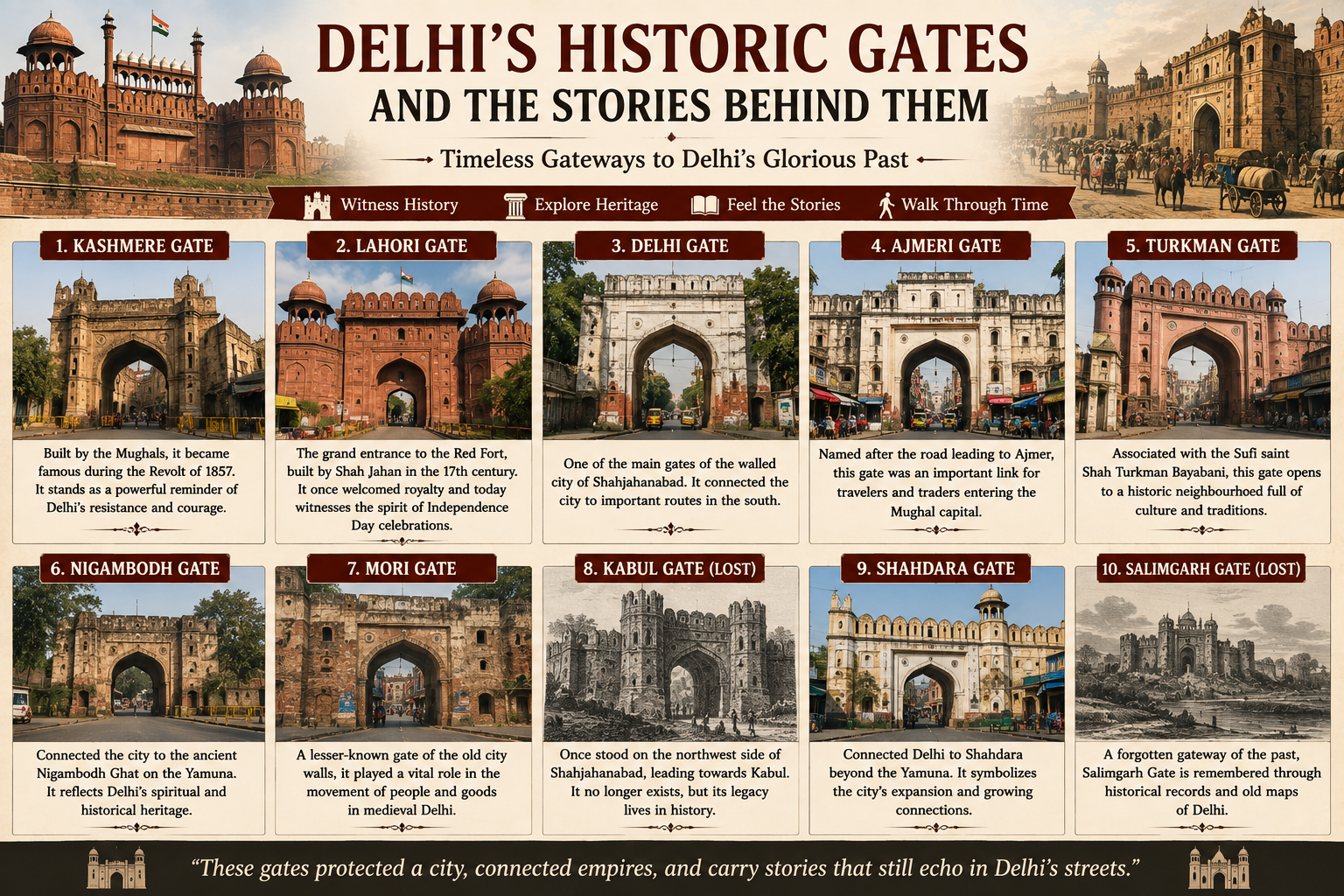
Delhi is a city where history can be discovered not only through grand forts and magnificent tombs but also through the old gates that once controlled entry into its historic settlements. These gates were important parts of Delhi’s defensive walls, connecting roads, markets, neighborhoods, and royal centers.
Over the centuries, different dynasties built, rebuilt, and expanded fortified cities across Delhi. Some gates have disappeared completely, while others survive as reminders of the city’s changing political and architectural landscape.
From Kashmere Gate and Lahori Gate to Ajmeri Gate and Turkman Gate, each surviving gateway has a story connected with Delhi’s rulers, traders, soldiers, travelers, and residents.
If you want to explore a lesser-known side of Delhi’s heritage, discovering its historic gates is an excellent way to understand how the city grew and changed over time.
1. Kashmere Gate – A Witness to the Revolt of 1857
Kashmere Gate is one of the most famous historic gates in Delhi and perhaps the one most strongly associated with the events of 1857.
The gate was built during the British period as part of the northern defenses of the walled city. Its name comes from its position on the route toward Kashmir.
During the Indian Rebellion of 1857, Delhi became a major center of resistance against British rule. Kashmere Gate and the surrounding area became strategically important during the fighting.
The gate suffered damage during the British assault on Delhi. The marks of conflict became part of its historical identity.
Today, Kashmere Gate stands as an important reminder of the political and military events that transformed Delhi in the 19th century.
The surrounding area contains several other historic landmarks, including St. James’ Church and remnants of colonial-era Delhi.
Why visit: 1857 history, colonial architecture, military heritage, and Old Delhi’s historic landscape.
2. Lahori Gate – The Grand Entrance to the Red Fort
Lahori Gate is the principal entrance of the Red Fort and one of the most recognizable historic gateways in Delhi.
It was constructed as part of Shah Jahan’s magnificent Mughal fort complex when he established Shahjahanabad in the 17th century.
The name “Lahori Gate” is traditionally associated with the direction of Lahore, one of the important cities of the Mughal Empire.
The gateway was designed to create a powerful first impression. Visitors entering through it would proceed into the fort and eventually encounter the royal spaces of the Mughal court.
The gate has also acquired enormous significance in modern Indian history. India’s Prime Minister traditionally addresses the nation from the Red Fort on Independence Day.
As a result, Lahori Gate connects Mughal imperial history with India’s modern national identity.
Why visit: Mughal architecture, Red Fort history, photography, and national heritage.
3. Delhi Gate – An Important Entrance to Shahjahanabad
Delhi Gate was another important gateway through the historic walls of Shahjahanabad.
The gate connected the walled city with routes leading toward the southern parts of the region. Its strategic position made it an important point of movement for people, goods, and travelers.
Like other gates of the old city, it was more than a simple entrance. The gateways formed part of a larger defensive system designed to control access to Shahjahanabad.
Today, Delhi Gate provides an opportunity to understand the original layout of the Mughal capital and how movement through the city was organized.
Why visit: Mughal urban planning, historic fortifications, and Old Delhi heritage.
4. Ajmeri Gate – The Gateway Toward Ajmer
Ajmeri Gate is one of the surviving gates of the historic walled city of Shahjahanabad.
Its name comes from the route leading toward Ajmer, an important city in Rajasthan and a major destination for travelers and pilgrims.
The gate was constructed during the Mughal period and later witnessed changes during British rule.
The area around Ajmeri Gate developed into an important commercial and transportation zone. Today, the gateway is surrounded by the busy streets of modern Delhi.
Standing beside the gate, it can be fascinating to imagine the historic road network that once connected Shahjahanabad with distant parts of northern India.
Why visit: Mughal city planning, historic routes, architecture, and Old Delhi’s commercial heritage.
5. Turkman Gate – A Gateway With a Medieval Connection
Turkman Gate is one of the historic gates associated with Old Delhi.
Its name is traditionally connected with the revered Sufi saint Shah Turkman Bayabani, whose tomb is located nearby.
The area around the gate developed into a historic neighborhood with a mixture of residential buildings, religious sites, markets, and narrow streets.
Turkman Gate also became associated with important events during the 1970s, adding another layer to its already complex history.
Today, the gate is surrounded by modern development, but it remains an important reminder of Delhi’s historic urban boundaries.
Why visit: Sufi heritage, Old Delhi history, historic neighborhoods, and architecture.
6. Nigambodh Gate – A Link to Old Delhi’s Northern Edge
Nigambodh Gate was one of the gateways associated with the northern side of Shahjahanabad.
The area around Nigambodh Ghat on the Yamuna has a much older religious and cultural history, and the gate formed part of the broader network of access points around the historic city.
The location is particularly interesting because it demonstrates the relationship between Delhi’s fortified settlements and the Yamuna River.
Visitors exploring this area can discover a combination of religious traditions, historic urban development, and the remains of Old Delhi’s defensive landscape.
Why visit: Old Delhi history, river heritage, religious traditions, and historic city planning.
7. Mori Gate – A Forgotten Entrance to the Walled City
Mori Gate was another gateway associated with the historic walls of Shahjahanabad.
Unlike some of the more famous gates, it is often overlooked by tourists. Its history is nevertheless important for understanding how the old city was organized.
The northern side of Delhi was particularly important for military movement and transportation, making the gates in this area strategically significant.
Although modern Delhi has transformed much of the surrounding landscape, the name and historical associations of Mori Gate remain part of the city’s heritage.
Why visit: Lesser-known history, Old Delhi fortifications, and historic urban development.
8. Kashmiri Gate – Understanding Delhi’s Colonial Transformation
The Kashmere Gate area deserves special attention because it represents the meeting point of Mughal, British, and modern Delhi.
The gate itself dates from the period when Shahjahanabad was being fortified, while its later history became closely connected with British military activity.
Nearby buildings and landmarks tell stories about the changing character of Delhi during the 18th and 19th centuries.
A visit to the area can include Kashmere Gate, St. James’ Church, the Delhi Ridge, and other colonial-era landmarks.
This makes it one of the best areas for travelers interested in seeing how Delhi evolved from a Mughal capital into a colonial city.
Why visit: Multi-period heritage, 1857 history, colonial architecture, and historic streets.
9. Shahdara Gate – A Connection Beyond the Walled City
The historic routes around Delhi were not limited to the main gates of Shahjahanabad.
Shahdara, located across the Yamuna, developed as an important settlement and transportation area. Historic routes connected it with the main city and surrounding regions.
The area demonstrates how Delhi’s urban growth extended beyond its fortified walls.
Today, Shahdara is a busy urban district, but its name and historical geography provide clues to the development of Delhi’s eastern side.
Why explore: Historic routes, urban expansion, and the evolution of Delhi beyond Shahjahanabad.
10. St. James’ Church and the Kashmere Gate Heritage Area
Although St. James’ Church is not itself a gate, it is an important landmark to include when exploring Kashmere Gate.
Built in the 19th century, the church reflects the changing architectural and social landscape of colonial Delhi.
The surrounding heritage area contains several historic structures associated with the British period and the events of 1857.
Exploring the gate and nearby landmarks together provides much more historical context than visiting Kashmere Gate alone.
Why visit: Colonial architecture, religious heritage, and 19th-century Delhi.
Why Were Delhi’s Historic Gates Important?
Delhi’s historic gates served several important purposes.
Defense
The gates formed controlled openings in the defensive walls surrounding fortified cities.
Trade
Merchants and traders entered through specific routes, bringing goods from surrounding regions and distant cities.
Transportation
The gates connected the city with major roads leading toward important destinations such as Lahore, Ajmer, and other parts of northern India.
Security
Controlling entry and exit allowed authorities to monitor movement into and out of the city.
Urban Planning
The location of gates influenced the development of markets, roads, neighborhoods, and commercial areas around them.
This means that the gates were an essential part of how historic Delhi functioned.
The Gates of Shahjahanabad
When Emperor Shah Jahan established Shahjahanabad in the 17th century, the city was surrounded by defensive walls containing several gates.
The gates connected the imperial capital with important routes outside the city.
Some of the historically known gates included:
- Lahori Gate
- Kashmere Gate
- Ajmeri Gate
- Delhi Gate
- Turkman Gate
- Mori Gate
- Kabul Gate
- Nigambodh Gate
Many of these gateways have disappeared or survive only through historical references, roads, neighborhoods, and place names.
The surviving structures therefore have enormous heritage value.
Delhi’s Historic Gates and the Mughal Empire
The gates of Shahjahanabad were closely connected with the Mughal Empire’s political and economic organization.
Delhi was an imperial capital, and its walls helped define the boundaries of the royal city.
Major roads entered through controlled gateways before reaching markets, residential districts, religious buildings, and the Red Fort.
This arrangement allowed the city to function as both a defensive settlement and a thriving commercial center.
The gates also reflected Delhi’s connections with distant parts of the empire. Names such as Lahori and Ajmeri preserved the memory of important routes leading away from the capital.
The Gates During British Rule
The history of Delhi’s gates changed significantly after the British established stronger control over the city.
Military and administrative priorities changed, and parts of the old walls were damaged, altered, or removed as the city expanded.
The events of 1857 were particularly important.
Delhi became one of the principal centers of the rebellion, and several locations around the old city became battlefields.
Kashmere Gate became especially famous because of its strategic role during the British assault.
This period marked a major transition in Delhi’s history, from a Mughal imperial capital to a city under British colonial administration.
Historic Gates as Living Heritage
One of the most fascinating things about Delhi’s gates is that many are not isolated monuments.
They remain part of busy neighborhoods.
Modern roads, markets, shops, homes, offices, and transportation systems have grown around them.
This creates an unusual experience for travelers. You can stand beside a centuries-old gateway while watching the daily movement of modern Delhi.
This living connection between past and present is one of the city’s greatest attractions.
Best Historic Gates to Visit in Delhi
If you have limited time, prioritize these gateways:
Kashmere Gate
Best for 1857 history and colonial heritage.
Lahori Gate
Best for Mughal architecture and Red Fort history.
Delhi Gate
Best for understanding Shahjahanabad’s historic layout.
Ajmeri Gate
Best for exploring the old city’s southern routes and markets.
Turkman Gate
Best for Sufi heritage and traditional Old Delhi neighborhoods.
These sites can be combined with nearby monuments and markets to create a heritage-focused Delhi itinerary.
How to Explore Delhi’s Historic Gates
A walking or guided heritage tour is one of the best ways to explore the gates.
Instead of simply photographing each gateway, take time to understand its location and the road it once controlled.
For example, a heritage walk around Kashmere Gate can include nearby churches and 1857 landmarks.
An Old Delhi tour can combine Lahori Gate with the Red Fort, Chandni Chowk, Jama Masjid, and traditional markets.
A southern Old Delhi route can include Ajmeri Gate, Delhi Gate, and nearby historic neighborhoods.
A visit to Turkman Gate can be combined with an exploration of the surrounding religious and residential heritage.
Best Time to Explore Delhi’s Historic Gates
The cooler months from October to March are generally more comfortable for heritage walks.
Early morning is particularly suitable if you want to photograph the gates with softer light and avoid some of the day’s crowds.
Late afternoon can also be enjoyable, especially when exploring Old Delhi’s markets and streets.
During the hotter months, outdoor walking can be tiring, so plan your heritage tour for early morning or later in the afternoon.
Tips for a Historic Gate Tour
Wear Comfortable Shoes
Exploring Old Delhi involves considerable walking through busy streets.
Carry Minimal Belongings
Crowded market areas can make large bags inconvenient.
Explore Nearby Attractions
The gates make more sense when visited alongside the historic neighborhoods they once protected.
Hire a Local Guide
A knowledgeable guide can explain stories and historical details that are not immediately visible.
Respect Local Communities
Many historic gates are surrounded by active residential and commercial areas. Be respectful when photographing people or private properties.
Take Your Time
The real value of these sites lies in understanding their history rather than simply checking them off a sightseeing list.
A Suggested Delhi Historic Gate Route
For travelers interested in exploring several historic areas, consider this route:
Kashmere Gate → St. James’ Church → Red Fort → Lahori Gate → Chandni Chowk → Jama Masjid → Delhi Gate → Ajmeri Gate → Turkman Gate
This route covers a mixture of Mughal and colonial heritage while passing through some of the most interesting parts of Old Delhi.
Because traffic and walking conditions can vary, you do not necessarily need to complete the entire route in one continuous walk. Dividing it into sections can make the experience more comfortable.
Why Delhi’s Gates Are Worth Visiting
Delhi’s historic gates may not have the same fame as the Taj Mahal or Red Fort, but they offer something different.
They tell the story of how the city worked.
A palace tells you where rulers lived. A mosque tells you about religious and architectural traditions. A market shows you how people traded.
But a city gate connects all of these things.
It tells you where people entered, where goods arrived, which roads mattered, how the city was defended, and how Delhi connected with the wider region.
That makes the historic gates valuable pieces of Delhi’s urban history.
Final Thoughts
The historic gates of Delhi are among the city’s most fascinating and sometimes overlooked heritage landmarks.
Kashmere Gate recalls the dramatic events of 1857. Lahori Gate represents the grandeur of the Mughal capital. Ajmeri Gate and Delhi Gate reveal the importance of historic trade routes, while Turkman Gate connects the city’s architectural history with its Sufi traditions.
Together, these gateways help visitors understand that historic Delhi was not simply a collection of monuments. It was a carefully organized, fortified, and highly active city connected to major routes across the Indian subcontinent.
Exploring these gates also reveals how dramatically Delhi has changed. The old walls may have disappeared in many places, but the gates, street names, markets, and neighborhoods continue to preserve fragments of the city’s past.
So, on your next Delhi tour, look beyond the famous monuments. Walk through the old neighborhoods, find the historic gateways, and imagine the travelers, traders, soldiers, rulers, and residents who once passed through them.
The stories behind Delhi’s gates are, in many ways, the stories of the city itself.