
·
Last Updated: August 27, 2026
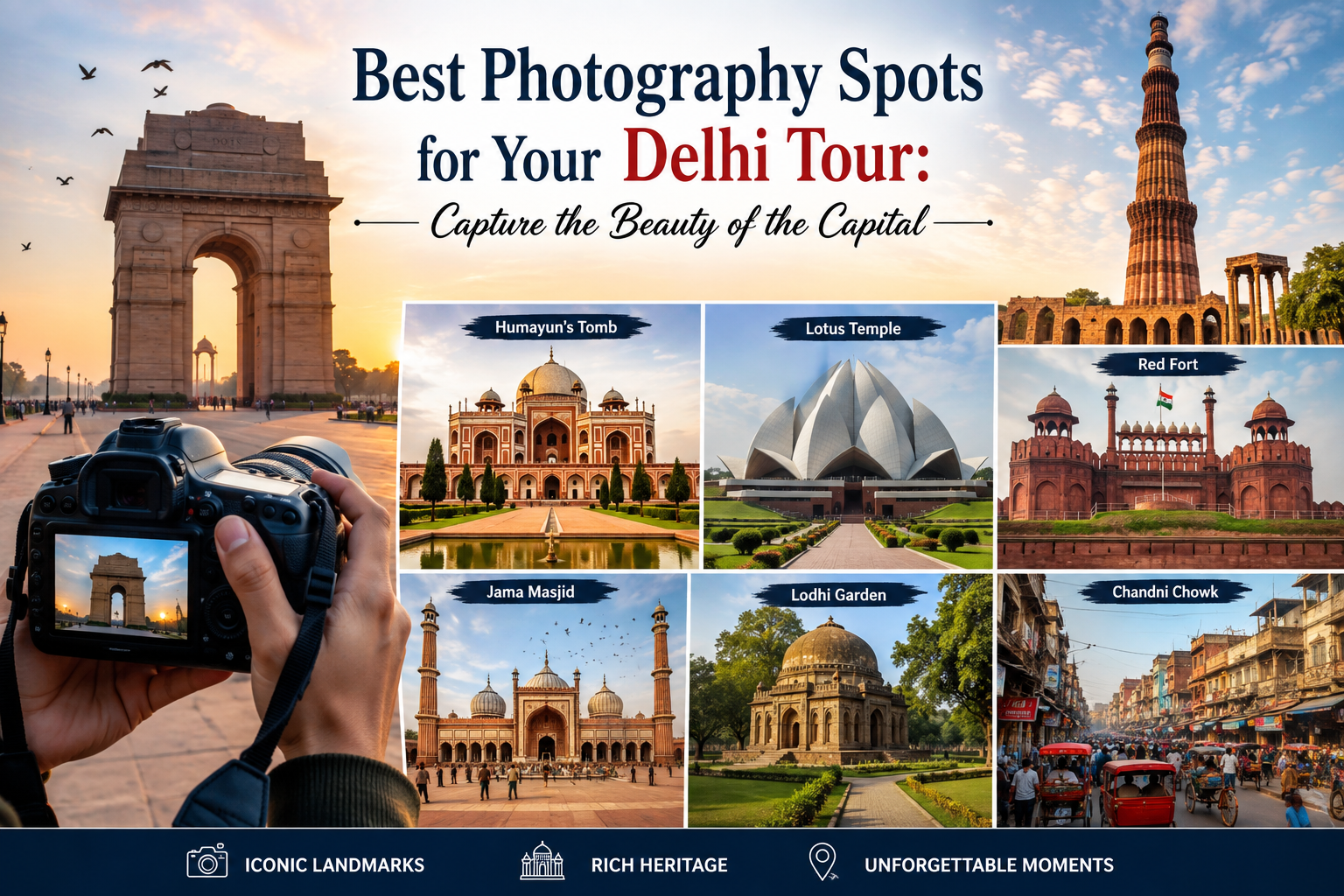
Best Photography Spots for Your Delhi Tour: Capture the Beauty of the Capital
Delhi is a dream destination for photography lovers. From grand Mughal monuments and historic forts to peaceful gardens, colorful markets, modern architecture, and lively streets, the city offers countless opportunities to capture memorable photographs. Whether you enjoy travel photography, architecture, portraits, street photography, or Instagram-worthy pictures, a Delhi tour can fill your camera roll with incredible moments.
Delhi Tourism itself highlights the city’s combination of heritage, gardens, culture, architecture, and modern urban life, making it an especially diverse destination for photographers.
If you are planning a Delhi tour and wondering where to take the best photographs, here are some of the most photogenic places you should add to your itinerary.
1. India Gate – A Classic Delhi Photography Spot
India Gate is one of the most recognizable landmarks in Delhi and an excellent place to begin your photography journey. The monument looks impressive from different angles, while the surrounding lawns provide opportunities for wide-angle photographs.
Early morning is ideal for peaceful photographs with fewer crowds. During the evening, the surrounding area becomes lively, giving you opportunities to capture the monument along with Delhi’s energetic atmosphere.
Photography Tips
- Visit early morning for softer light.
- Try wide-angle shots to include the surrounding lawns.
- Experiment with symmetrical compositions.
- Capture the monument from different distances.
- Evening photography can create a completely different mood.
The India Gate lawns are also recognized by Delhi Tourism as a popular evening location.
2. Humayun’s Tomb – Mughal Architecture at Its Best
Humayun’s Tomb is one of the finest places for architectural photography in Delhi. Its grand domes, red sandstone walls, geometric gardens, arches, and pathways provide endless compositions.
The symmetry of the monument makes it particularly attractive for photographers. Stand along the central pathway and use the gardens to create leading lines toward the main structure.
For portrait photography, the arches and landscaped surroundings can also provide elegant backgrounds.
Best Photography Ideas
- Capture the main tomb from the central garden pathway.
- Use arches as natural frames.
- Photograph architectural details.
- Try low-angle shots of the dome.
- Include people at a distance to show the monument’s scale.
Humayun’s Tomb is among the major destinations listed by official Delhi Tourism.
3. Qutub Minar – Perfect for Architectural Photography
No Delhi sightseeing tour is complete without seeing Qutub Minar. Its towering structure, detailed carvings, surrounding ruins, and historic atmosphere make it one of the best photography locations in Delhi.
Instead of taking only the standard front-facing photograph, walk around the complex and look for different perspectives. The surrounding monuments can help create interesting foregrounds.
Photography Tips for Qutub Minar
Try:
- Vertical compositions to emphasize its height.
- Close-ups of architectural details.
- Low-angle photographs.
- Framed shots through arches.
- Wide photographs showing the surrounding complex.
Qutub Minar is officially listed among Delhi’s most popular destinations and is included in Delhi Tourism’s sightseeing tours.
4. Lodhi Garden – Nature Meets Heritage
If you want something different from traditional monument photography, visit Lodhi Garden. The park combines greenery, pathways, historic tombs, trees, open lawns, and architectural details.
This makes it suitable for landscape, nature, architecture, and portrait photography.
Morning light can create a peaceful atmosphere, while the combination of old monuments and greenery provides beautiful compositions.
Delhi Tourism describes Lodhi Gardens as a popular recreational space where historic structures and landscaped surroundings come together.
What to Photograph
- Historic tombs surrounded by greenery
- Tree-lined pathways
- Architectural details
- Birds and nature
- Portraits against heritage backgrounds
- Morning landscapes
5. Red Fort – Capture the Grandeur of Old Delhi
The Red Fort is another must-visit photography location during a Delhi tour. Its enormous red sandstone walls immediately create a strong visual impression.
The fort also offers opportunities to photograph gates, arches, courtyards, decorative details, and historic architecture.
For a more atmospheric experience, combine your visit with a walk through Old Delhi. The contrast between the massive Mughal fort and the energetic streets around it can produce fascinating travel photographs.
Delhi Tourism includes the Red Fort among the city’s major attractions and sightseeing routes.
6. Jama Masjid – A Window Into Old Delhi
Jama Masjid is one of the most visually striking religious and architectural landmarks in Old Delhi. Its large courtyard, domes, minarets, steps, and surrounding streets offer many photographic possibilities.
The area around Jama Masjid is equally interesting. Street scenes, traditional shops, food stalls, pedestrians, and historic buildings can help you capture the character of Old Delhi.
Photography Ideas
Focus on:
- Architectural symmetry
- Wide shots of the courtyard
- Details of domes and arches
- Old Delhi street scenes
- Local markets and surrounding lanes
When photographing people, always be respectful and ask permission when a close-up portrait is involved.
7. Agrasen Ki Baoli – A Unique Architectural Frame
Located near Connaught Place, Agrasen Ki Baoli is one of Delhi’s most unusual photography locations. Its long staircase, repetitive arches, textured stone walls, and dramatic geometry create strong visual patterns.
Delhi Tourism describes Agrasen Ki Baoli as a historic stepwell near Hailey Road, making it an easily accessible heritage stop during a central Delhi itinerary.
Best Shots
- Symmetrical staircase photographs
- Top-down compositions
- Repeating arches
- Minimalist photographs
- Portraits using the staircase as a background
The repeating architectural patterns make this location particularly attractive for photographers who enjoy geometric compositions.
8. Lotus Temple – Modern Architectural Photography
The Lotus Temple offers a completely different photographic experience. Its distinctive petal-shaped structure stands out against the sky and surrounding landscape.
Try photographing the building from different distances rather than relying on one standard composition. The surrounding pools can also help create reflections.
Photography Tips
- Visit when the light is soft.
- Use the surrounding pools for reflections.
- Try symmetrical compositions.
- Photograph the structure against the sky.
- Explore different angles around the complex.
Lotus Temple is listed among Delhi Tourism’s major destinations and is included in official sightseeing tours.
9. Rashtrapati Bhavan and Raisina Hill
Rashtrapati Bhavan and the surrounding Raisina Hill area provide opportunities for grand architectural and cityscape photography.
The broad avenues, impressive government buildings, and formal architectural design create a strong sense of scale.
Because access and photography rules can vary by area and occasion, check current visitor information before planning a dedicated photography session. Delhi Tourism currently lists Rashtrapati Bhavan among its popular destinations and offers a Change of Guard-related tour experience.
10. Connaught Place – Modern Delhi and Street Photography
Connaught Place is ideal if you want to photograph the modern side of Delhi.
Its white colonial-style buildings, circular layout, busy streets, restaurants, shops, and pedestrians create a completely different visual atmosphere from Delhi’s historic monuments.
Try photographing the curved colonnades, people walking through the corridors, storefronts, and changing light throughout the day.
Great Photography Subjects
- Colonial-style architecture
- Street portraits
- Cafés and storefronts
- Busy intersections
- Evening lights
- Fashion and lifestyle photography
For photographers interested in documenting everyday Delhi, Connaught Place is an excellent stop.
11. Chandni Chowk – The Heart of Old Delhi Photography
For vibrant street photography, few places can match Chandni Chowk.
The streets are filled with movement, traditional shops, colorful products, historic architecture, food vendors, rickshaws, and local life. Every turn can present a completely different photograph.
Instead of focusing only on famous landmarks, look for small moments: a shopkeeper arranging products, a rickshaw moving through a narrow lane, colorful signs, or traditional food being prepared.
Street Photography Tips
- Keep your camera ready for spontaneous moments.
- Use a small lens for crowded streets.
- Be respectful when photographing people.
- Avoid blocking busy pathways.
- Look for layers and interesting foregrounds.
Delhi Tourism currently offers a Food Walk in Old Delhi and a Shahjahanabad heritage walk, reflecting the area’s importance as a cultural and heritage destination.
12. Hauz Khas Village – Heritage With a Contemporary Feel
Hauz Khas is another interesting photography location where historic architecture meets contemporary Delhi.
The area around the historic complex offers views of old structures, greenery, water, cafés, and urban surroundings. This mixture creates an interesting contrast between Delhi’s past and present.
It is especially suitable for lifestyle photography and photographs that combine heritage with modern city culture.
Delhi Tourism currently lists a Walk of Hauz Khas among its heritage experiences.
13. Mehrauli Archaeological Park – Hidden Heritage Photography
For photographers looking beyond the usual Delhi tourist attractions, Mehrauli Archaeological Park is worth exploring.
The area contains historic structures and archaeological remains surrounded by natural landscapes. This combination allows you to create photographs that feel more atmospheric and less conventional.
Look for:
- Old stone structures
- Arches and doorways
- Trees surrounding monuments
- Textured walls
- Light and shadow
- Quiet heritage scenes
Delhi Tourism currently offers a heritage walk focused on Mehrauli Archaeological Park.
14. Garden of Five Senses – Colorful and Creative Photography
The Garden of Five Senses is a good choice for nature and creative photography. Landscaped areas, plants, pathways, water features, and architectural elements provide plenty of variety.
Delhi Tourism describes the Garden of Five Senses as a 20-acre leisure space designed around sensory experiences, with numerous plant species and landscaped areas.
What You Can Photograph
- Flowers and plants
- Landscaped pathways
- Water features
- Sculptural details
- Architecture
- Portraits
- Nature close-ups
It is particularly useful if you want a break from monument photography during your Delhi itinerary.
15. Jantar Mantar – Geometric Photography
Jantar Mantar is perfect for photographers who enjoy unusual architecture and geometric shapes.
The giant astronomical instruments create bold curves, angles, shadows, and lines. Instead of photographing the complex only as a tourist attraction, experiment with close-up compositions.
Delhi Tourism notes that Jantar Mantar contains 13 architectural astronomy instruments, making it one of the city’s most distinctive heritage photography locations.
Best Time for Photography During a Delhi Tour
Choosing the right time can dramatically improve your photographs.
Early Morning
Early morning is excellent for:
- Fewer crowds
- Soft natural light
- Peaceful monuments
- Long shadows
- Landscape photography
Golden Hour
The period around sunrise and sunset produces softer, warmer light and can give monuments a more dramatic appearance.
Blue Hour and Evening
After sunset, Delhi’s illuminated monuments, streets, and modern buildings can create attractive city photographs.
However, always check the current opening hours and photography rules of individual attractions before planning your visit.
Photography Tips for Your Delhi Trip
You do not need expensive professional equipment to take memorable photographs in Delhi. A smartphone can produce excellent travel photographs when you use good composition and lighting.
1. Shoot During Soft Light
Harsh midday sunlight can create strong shadows. Whenever possible, photograph major monuments during early morning or late afternoon.
2. Look for Leading Lines
Roads, pathways, stairs, walls, and architectural lines can guide the viewer’s eye toward your subject.
3. Use Symmetry
Delhi’s monuments contain numerous symmetrical designs. Position yourself carefully and use the symmetry to create balanced photographs.
4. Try Different Perspectives
Don’t take every photograph from eye level. Try:
- Low angles
- High angles
- Close-ups
- Wide shots
- Reflections
- Framed compositions
5. Capture People and Culture
Delhi isn’t only about buildings. Its people, markets, food, festivals, streets, and everyday activities are equally important parts of the city’s identity.
6. Respect Photography Rules
Some heritage and religious locations may have specific photography restrictions. Always follow signs, instructions from staff, and local customs.
A Simple Delhi Photography Itinerary
If photography is one of your main priorities, you can organize your Delhi tour around different types of locations.
Day 1: Historic Delhi
Start with:
Red Fort → Jama Masjid → Chandni Chowk → Agrasen Ki Baoli → India Gate
This route gives you a mixture of Mughal architecture, street photography, heritage structures, and iconic city views.
Day 2: Mughal and Heritage Photography
Visit:
Humayun’s Tomb → Lodhi Garden → Qutub Minar → Mehrauli Archaeological Park
This day is ideal for architectural, landscape, and heritage photography.
Day 3: Modern Delhi
Explore:
Lotus Temple → Garden of Five Senses → Connaught Place → Rashtrapati Bhavan area
This combination lets you photograph modern architecture, gardens, urban life, and grand government architecture.
Why Delhi Is Perfect for Photography Lovers
The biggest advantage of photography in Delhi is variety. Within a relatively short distance, you can move from centuries-old monuments to modern buildings, from peaceful gardens to crowded markets, and from grand avenues to narrow historic streets.
Official Delhi Tourism highlights this mixture of heritage, gardens, culture, architecture, food, and modern city life as part of the Delhi experience.
That variety means a Delhi tour is not simply a sightseeing experience. It can become a visual journey through different periods of Indian history and contemporary life.
Final Thoughts
Delhi offers photography opportunities for almost every type of traveler. Whether you are interested in heritage photography, architectural photography, street photography, portrait photography, nature photography, or Instagram photography, the capital has something to offer.
From the monumental beauty of India Gate, Red Fort, Humayun’s Tomb, and Qutub Minar to the lively streets of Chandni Chowk and the geometric beauty of Agrasen Ki Baoli, every location tells a different story.
So, when planning your next Delhi tour, don’t just visit the city’s famous attractions—look at them through your camera lens. Explore different angles, experiment with light, capture everyday moments, and create photographs that tell the story of Delhi beyond the usual tourist postcard.