
·
Last Updated: September 22, 2026
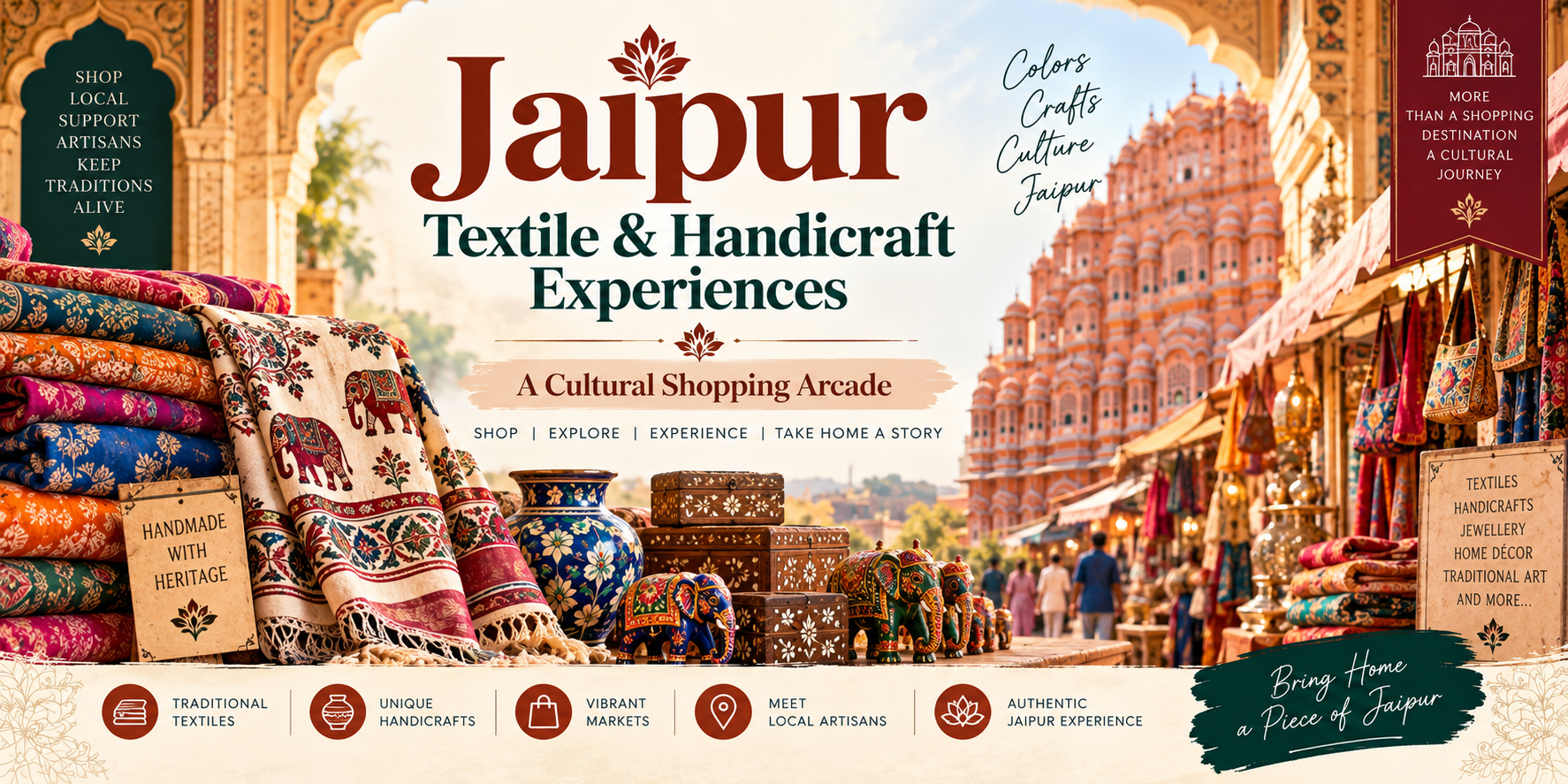
Jaipur is often introduced through its magnificent forts, royal palaces and pink-colored streets, but the city’s cultural identity extends far beyond architecture. Walk through its markets and craft districts, and another side of Jaipur begins to appear—one shaped by textiles, handmade objects, traditional patterns, jewelry, pottery and generations of artisan knowledge.
For travelers, shopping in Jaipur does not have to mean simply entering a store, choosing a souvenir and leaving. It can become an immersive cultural experience where you discover how fabrics are printed, how traditional designs are created, how pottery is decorated and how everyday objects become works of art.
A Jaipur textile and handicraft experience can therefore be planned as a cultural shopping journey rather than an ordinary shopping trip.
From the block-printed fabrics of Sanganer and Bagru to blue pottery, lac bangles, Jaipuri quilts, traditional footwear, jewelry and decorative crafts, Jaipur offers an impressive variety of handmade products. Rajasthan Tourism describes the state as a major destination for colorful arts and crafts, with textiles, pottery, jewelry, metalwork and other traditional products forming an important part of its cultural identity.
This guide explores how to experience that culture thoughtfully—from understanding the craft to exploring markets and choosing meaningful souvenirs.
What Makes Jaipur a Textile and Handicraft Destination?
Jaipur’s craft culture developed through a combination of regional traditions, royal patronage, trade and skilled artisan communities.
Different parts of Rajasthan became associated with different techniques and visual styles. Textiles, for example, developed distinctive patterns, colors and production methods. Rajasthan Tourism identifies Sanganer and Bagru for block printing, while Bandhej, Leheriya and lightweight Jaipuri quilts represent other important textile traditions of Rajasthan.
The result is a shopping environment where you can find products ranging from simple everyday fabrics to highly decorated objects.
What makes the experience interesting is that many crafts are not merely decorative.
They can be connected to:
- Clothing
- Household decoration
- Religious traditions
- Weddings and celebrations
- Personal accessories
- Traditional lifestyles
- Regional identity
A handmade textile can therefore tell a cultural story even before you know its full history.
Begin With the Textile Story
If textiles are your main interest, Jaipur gives you several ways to explore them.
Rather than beginning with a crowded market, consider first learning about the techniques behind the products.
This changes the way you shop.
Once you understand the difference between a hand block print, a tie-and-dye design and a machine-printed fabric, you can look at products with a more informed eye.
Sanganeri Block Printing
Sanganer is one of the most important places associated with textile block printing around Jaipur.
Rajasthan Tourism identifies Sanganer as a destination known for textile block printing, handmade paper and Jaipur blue pottery. It is located approximately 12 kilometers from Jaipur.
Sanganeri textiles are known for detailed printed patterns and colorful designs.
A traditional block-printing process involves wooden blocks carved with patterns. The artisan applies dye to the block and carefully presses it onto the fabric.
The process appears simple when watched from a distance.
In reality, consistent printing requires:
- Accurate alignment
- Controlled pressure
- Correct dye application
- Good timing
- Experience with the fabric
- Careful repetition
When multiple colors are used, different blocks may be required.
This is one reason handmade textiles can have subtle variations.
Those variations can be part of the character of a handmade product rather than a defect.
Bagru Printing
Bagru is another important name in Rajasthan’s textile tradition.
Rajasthan Tourism describes Bagru textiles as part of the state’s distinctive block-printing heritage, with recognizable patterns and earthy colors.
Travelers interested in traditional textiles can look for:
- Bagru-print fabrics
- Clothing
- Scarves
- Dupattas
- Home textiles
- Cushion covers
- Bedsheets
The important thing is to ask the seller about the technique instead of assuming that every fabric with a traditional-looking pattern has been produced in the same way.
Turn Shopping Into a Learning Experience
One of the best ways to make your Jaipur shopping trip different is to learn before buying.
You can visit a museum, speak with an artisan, observe a printing demonstration or simply ask questions at a reputable craft store.
The goal is not to become an expert.
It is simply to understand what you are looking at.
Ask questions such as:
Is this hand block printed?
Which region is this design associated with?
What fabric has been used?
How should it be washed?
How many colors were used?
Was the product made locally?
These questions can reveal details that are not obvious from the appearance of the product.
Visit the Anokhi Museum of Hand Printing
For travelers interested in textiles, the Anokhi Museum of Hand Printing near Amber provides a useful cultural introduction.
Rajasthan Tourism describes the museum as being housed in a restored haveli and displaying block-printed textiles along with images, tools and related objects. The museum is designed to provide an in-depth look at the complexity of hand printing traditions.
This makes it different from a normal shopping stop.
Instead of seeing hundreds of finished products, visitors can learn about:
- Printing blocks
- Textile patterns
- Craft tools
- Traditional methods
- Finished fabrics
- The development of hand printing
A visit here can make your later shopping experience more meaningful because you will recognize some of the techniques and patterns you encounter in the markets.
Explore the World of Bandhej and Leheriya
Not every traditional Rajasthani textile is block printed.
Bandhej, also known as Bandhani, uses a tie-and-dye approach.
Small sections of fabric are tied before dyeing, creating distinctive patterns when the material is opened.
Leheriya is another recognizable textile style associated with Rajasthan. Its patterns create flowing, wave-like visual lines.
These traditions are often seen in:
- Sarees
- Dupattas
- Turbans
- Scarves
- Traditional clothing
Rajasthan Tourism identifies Bandhej, Sanganeri and Bagru textiles, Leheriya and Jaipuri quilts among the state’s notable textile traditions.
For travelers, comparing these techniques can be more interesting than buying several products of the same type.
Discover the Story Behind Jaipuri Quilts
Jaipur’s lightweight quilts are another popular textile product.
They are attractive souvenirs because they combine practical use with colorful traditional designs.
You may find quilts in different:
- Colors
- Patterns
- Sizes
- Fabrics
- Stitching styles
Before purchasing one, check its:
- Size
- Weight
- Filling
- Stitching
- Fabric quality
- Washing instructions
A quilt is also a good example of how traditional craftsmanship can become part of modern home décor.
Move From Textiles to Pottery
After exploring fabrics, shift your attention to another famous Jaipur craft: blue pottery.
Blue pottery is particularly distinctive because its traditional composition differs from conventional clay pottery.
Rajasthan Tourism states that Jaipur blue pottery is made using quartz rather than clay, with materials including quartz, glaze-related ingredients, sodium bicarbonate and Multani mitti. Blue and turquoise colors are associated with copper and cobalt oxides.
Traditional designs often include:
- Flowers
- Birds
- Animals
- Decorative patterns
- Arabesque-inspired motifs
Products can include:
- Plates
- Bowls
- Vases
- Coasters
- Trays
- Tiles
- Soap dishes
- Decorative pieces
This makes blue pottery an excellent example of a craft that combines artistic decoration with household use.
Why Blue Pottery Makes an Interesting Souvenir
A souvenir becomes more meaningful when it has a story.
Blue pottery has several stories attached to it—its artistic influences, unusual material composition, decorative techniques and development as a Jaipur craft.
Rajasthan Tourism describes the tradition as having Persian and Afghan connections and notes that it became associated particularly with Jaipur.
When shopping for blue pottery, examine:
- Surface finish
- Painted details
- Shape
- Glazing
- Cracks or chips
- Overall construction
Because many pieces are fragile, ask the seller to pack them securely if you are traveling by train or airplane.
Explore Jaipur’s Jewelry Tradition
Jaipur’s craft experience does not end with textiles and pottery.
The city is also strongly associated with jewelry.
Rajasthan Tourism highlights Jaipur’s Kundan and Meenakari traditions and describes Rajasthan as an important center for jewelry and gem cutting.
Jewelry shopping can include:
- Kundan pieces
- Meenakari work
- Silver jewelry
- Traditional earrings
- Bangles
- Necklaces
- Fashion jewelry
- Gemstone products
However, jewelry requires a different shopping approach from textiles.
If you are considering an expensive purchase, do not rush.
Compare products and prices, ask for documentation and understand exactly what you are buying.
For valuable gemstones or precious-metal jewelry, proper invoices and relevant certification are especially important.
Experience the Color of Lac Bangles
Lac bangles provide a completely different shopping experience.
Their bright colors and decorative styles immediately stand out in traditional markets.
You can find:
- Simple lac bangles
- Decorative bangles
- Stone-studded designs
- Wedding-style sets
- Everyday designs
Because these products are relatively small and easy to pack, they are popular souvenirs.
When buying them, check the size and finishing carefully.
If you intend to wear them, make sure the size is comfortable before purchasing.
Add Traditional Footwear to Your Shopping Trail
Jaipur is also known for traditional footwear such as juttis and mojris.
These shoes can feature:
- Embroidery
- Decorative stitching
- Metallic details
- Traditional patterns
- Bright colors
- Leather construction
They can work as both souvenirs and practical purchases.
Try them on rather than relying only on the labeled size.
Walk around the store and check whether the footwear feels comfortable.
Discover Decorative Handicrafts
A Jaipur craft trail can also include wood, metal and decorative handicrafts.
Rajasthan’s broader handicraft tradition includes wooden products, metal crafts, terracotta and other handmade objects.
Depending on the market, you may see:
- Wooden boxes
- Decorative animals
- Small figurines
- Metal décor
- Photo frames
- Traditional toys
- Household accessories
- Decorative panels
These products can be particularly useful for travelers who want souvenirs that are not clothing.
The Cultural Shopping Arcade of Jaipur
The phrase “cultural shopping arcade” does not have to mean one particular shopping center.
Think of Jaipur itself as a connected cultural shopping environment.
Different areas offer different experiences.
Johari Bazaar
Johari Bazaar is closely associated with jewelry and traditional shopping.
It is particularly interesting if you want to explore Jaipur’s jewelry culture.
Bapu Bazaar
Bapu Bazaar offers a broad range of products, making it useful for travelers looking for:
- Textiles
- Footwear
- Souvenirs
- Handicrafts
- Traditional products
Nehru Bazaar
Nehru Bazaar is another colorful market where visitors can browse a variety of traditional goods.
MI Road
MI Road provides access to established stores and shopping options.
Rajasthan Tourism lists Rajasthali, the Rajasthan Government showroom on MI Road, among Jaipur’s important shopping destinations.
Badi Chaupar and Choti Chaupar
These areas around the historic Pink City provide opportunities to experience the traditional market atmosphere while exploring nearby streets and shops.
Rajasthan Tourism also lists these areas among Jaipur’s shopping locations.
Create Your Own Jaipur Craft Trail
Instead of trying to visit every market, create a route based on your interests.
Textile Trail
Start with:
Anokhi Museum → Textile-focused shopping → Sanganer
This route works well for travelers interested primarily in printing and fabrics.
Handicraft Trail
Try:
Pink City Markets → Blue Pottery Shops → Lac Bangles → Juttis
This provides a wider overview of Jaipur’s craft culture.
Jewelry Trail
Consider:
Johari Bazaar → Established jewelry stores → Traditional craft markets
Allow extra time for comparison if you are making an expensive purchase.
Complete Cultural Trail
For a broader experience:
Anokhi Museum → Amber area → Pink City → Bapu Bazaar → Johari Bazaar → MI Road
This gives you a combination of learning, sightseeing and shopping.
How to Recognize Quality Handmade Textiles
A colorful fabric is not automatically a high-quality fabric.
Before buying, look at:
Print Alignment
Hand block printing may show subtle variations. Examine whether the pattern appears carefully produced.
Fabric
Touch the material and check its weight, softness and weave.
Color
Look closely at the consistency and finish of the colors.
Stitching
For finished clothing and home textiles, examine seams and edges.
Washing Instructions
Ask the seller how the product should be washed and maintained.
The more expensive the product, the more carefully you should examine these details.
How to Shop Without Overpaying
Shopping in Jaipur can be exciting, but travelers should avoid making decisions too quickly.
A simple approach is:
Step 1: Decide Your Budget
Know how much you are comfortable spending.
Step 2: Compare
Look at similar products in at least two or three places.
Step 3: Ask Questions
Understand the material and production method.
Step 4: Check Quality
Inspect the product carefully.
Step 5: Negotiate Respectfully
Bargaining may be possible in traditional markets, but keep the conversation polite.
Step 6: Keep Receipts
Especially for expensive products.
This process can help you make more informed purchases without turning the experience into a stressful negotiation.
Shopping for International Travelers
International visitors may need to think about portability as well as appearance.
A beautiful handcrafted object is not very useful if it is too fragile or too large to transport.
Good travel-friendly options include:
- Scarves
- Small textiles
- Cushion covers
- Small blue pottery pieces
- Jewelry
- Bangles
- Small wooden crafts
- Compact decorative objects
For larger purchases, ask about shipping options and packaging.
For expensive jewelry or gemstones, retain all invoices and relevant documentation.
Responsible Craft Shopping in Jaipur
Shopping can also be a way to support traditional craftsmanship.
When possible, learn where a product comes from and how it was made.
Responsible shopping includes:
- Respecting artisans
- Asking before taking photographs
- Paying a fair price
- Avoiding restricted wildlife products
- Checking materials carefully
- Supporting genuine craft businesses
- Avoiding unnecessary purchases
Remember that handmade craftsmanship takes time.
A low price is not always the only measure of a good purchase.
Sometimes paying a fair amount for a well-made product gives you a better souvenir and contributes to the continuation of a craft tradition.
Turn a Shopping Trip Into a Cultural Experience
The biggest mistake travelers make is treating Jaipur’s markets like ordinary retail stores.
Instead, slow down.
Look at the patterns.
Watch artisans when demonstrations are available.
Ask questions.
Compare techniques.
Touch different fabrics.
Learn why one product is different from another.
Then buy something you genuinely appreciate.
This approach changes the meaning of shopping.
You are no longer simply purchasing an object.
You are taking home a small piece of the cultural experience.
A Half-Day Jaipur Textile and Handicraft Plan
If you have only half a day, try this itinerary.
9:00 AM – Textile Introduction
Start with a textile-focused museum or educational experience.
10:30 AM – Explore Hand Printing
Learn about blocks, patterns and traditional techniques.
12:00 PM – Lunch
Enjoy a traditional Rajasthani meal.
1:00 PM – Market Shopping
Explore one or two carefully selected shopping areas.
Focus on textiles, handicrafts and souvenirs.
3:00 PM – Blue Pottery
Look for a few carefully selected pieces.
Ask about packaging before purchasing.
This shorter route allows you to experience the craft culture without spending the entire day shopping.
A Full-Day Cultural Shopping Itinerary
For travelers with an entire day, create a slower route.
Morning
Begin around Amber with a textile or craft-related experience.
Late Morning
Explore hand-block printing and learn about textile techniques.
Afternoon
Return toward the Pink City and explore traditional markets.
Late Afternoon
Visit selected handicraft stores.
Evening
Finish around the historic market area and enjoy local food.
This combination gives you more than shopping—it combines craft, culture, food and the atmosphere of Jaipur’s historic neighborhoods.
What Should You Buy in Jaipur?
If you want a practical shopping checklist, consider:
For Clothing
- Sanganeri prints
- Bagru prints
- Bandhej
- Leheriya
- Dupattas
- Scarves
For Home
- Jaipuri quilts
- Cushion covers
- Bedsheets
- Blue pottery
- Decorative objects
For Accessories
- Lac bangles
- Juttis
- Mojris
- Traditional jewelry
For Small Souvenirs
- Coasters
- Small pottery
- Wooden boxes
- Decorative items
Choose products according to your luggage space and personal interests rather than buying something simply because it is marketed as a tourist souvenir.
Best Time for a Jaipur Shopping Experience
The cooler months are generally more comfortable for walking through outdoor markets and combining shopping with sightseeing.
During hot weather, consider visiting outdoor markets during the morning or later in the afternoon and taking a break during the hottest part of the day.
Market schedules can change, so check current information before visiting.
Rajasthan Tourism currently lists several major Jaipur shopping areas and notes that markets are generally closed on Sundays.
Photography and Artisan Etiquette
Craft experiences often provide excellent photography opportunities.
However, always be considerate.
Before photographing:
- An artisan
- A workshop
- A person’s face
- A private workspace
- A religious object
ask for permission where appropriate.
Avoid interrupting someone’s work simply to get a photograph.
If an artisan allows you to photograph a process, give them enough space to continue working naturally.
Why Handmade Products Make Better Travel Memories
A mass-produced souvenir can remind you that you visited Jaipur.
A handmade product can remind you how you experienced Jaipur.
A block-printed scarf can bring back memories of watching an artisan work.
A blue pottery plate can remind you of the colors and patterns of the Pink City.
A lac bangle can remind you of the energy of the markets.
A handmade quilt can become part of your home while carrying memories of Rajasthan.
This is what makes a cultural shopping experience different from ordinary retail tourism.
Frequently Asked Questions
What textiles is Jaipur famous for?
Jaipur and the surrounding region are strongly associated with Sanganeri and Bagru block printing, Bandhej, Leheriya and Jaipuri quilts.
Where can I experience traditional textile printing?
Sanganer is associated with textile block printing, while the Anokhi Museum of Hand Printing near Amber provides an educational introduction to block-printed textiles and traditional tools.
What handicrafts is Jaipur famous for?
Popular Jaipur crafts include textiles, blue pottery, lac bangles, jewelry, traditional footwear and decorative handicrafts.
What should I buy from Jaipur?
Popular choices include block-printed textiles, Jaipuri quilts, blue pottery, lac bangles, juttis, jewelry and small decorative handicrafts.
Is blue pottery made from clay?
Traditional Jaipur blue pottery is made from a quartz-based mixture rather than conventional clay.
Which Jaipur markets are popular for handicrafts?
Rajasthan Tourism lists Johari Bazaar, MI Road, Nehru Bazaar, Bapu Bazaar and the areas around Badi and Choti Chaupar among Jaipur’s shopping destinations.
Can I bargain in Jaipur markets?
Bargaining may be possible in traditional markets, although the approach varies between shops. It is best to negotiate politely and compare prices before purchasing.
Final Thoughts
A Jaipur textile and handicraft experience is much more than a day spent looking for souvenirs.
It is a journey through color, craftsmanship and local traditions.
Start with textiles and discover the precision of block printing. Visit a museum to understand the techniques behind the designs. Explore Sanganer to connect the finished products with a wider craft tradition. Return to Jaipur’s historic markets to discover jewelry, pottery, bangles, footwear and decorative objects.
Most importantly, slow down.
Do not judge a handmade product only by its price or appearance. Ask where it was made, understand the technique and look carefully at the quality.
Whether you return home with a hand-printed scarf, a colorful quilt, a small piece of blue pottery or a pair of traditional juttis, the best souvenir is one that reminds you of the experience behind it.
That is what makes Jaipur’s textile and handicraft culture so memorable: the shopping is not separate from the culture—it is one of the ways to experience it.