
·
Last Updated: September 22, 2026
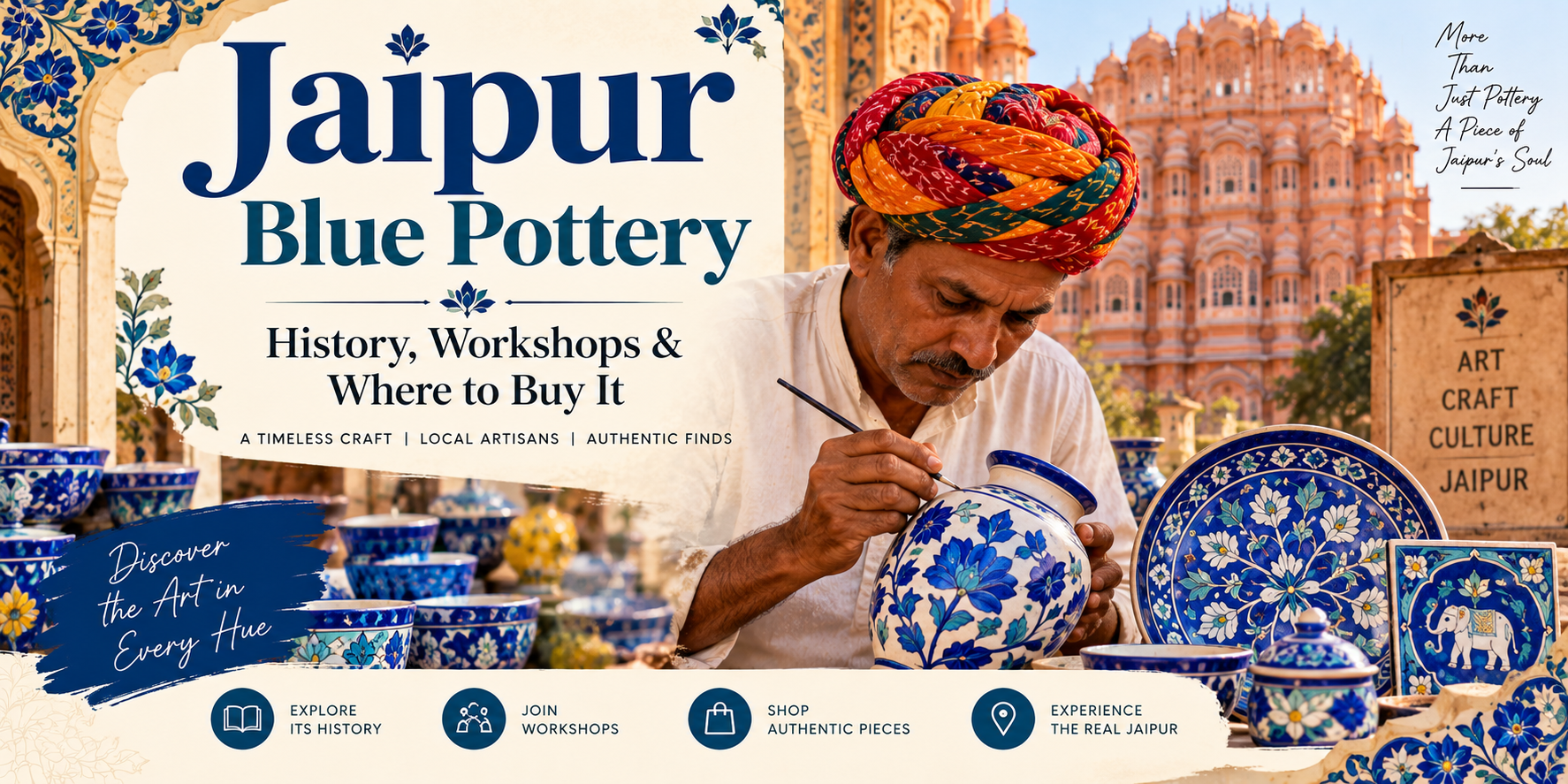
Jaipur is famous for its magnificent forts, royal palaces, colorful markets, traditional textiles, gemstones, and handcrafted products. Among all these artistic traditions, Jaipur Blue Pottery has a special identity.
With its distinctive blue, turquoise, white, and green patterns, blue pottery is one of the crafts most closely associated with the Pink City. Unlike conventional pottery, the traditional Jaipur variety is made primarily from quartz-based material rather than ordinary clay. It is glazed, decorated by hand, and fired at a relatively low temperature, giving the finished pieces their characteristic appearance.
For travelers, buying a finished blue pottery item is only part of the experience. Visiting a workshop and seeing how the material is prepared, shaped, painted, glazed, and fired can provide a much deeper understanding of the craft.
The tradition has an interesting history with influences from Central Asia, Persia, Afghanistan, and Mughal India before becoming strongly associated with Jaipur. Today, the craft continues to provide livelihoods for artisans in Jaipur and nearby areas.
This guide explores the history of Jaipur Blue Pottery, how it is made, where you can learn about the craft, what to buy, and how to choose authentic-looking pieces when shopping in Jaipur.
What Is Jaipur Blue Pottery?
Jaipur Blue Pottery is a distinctive glazed craft traditionally associated with Jaipur.
One of its most interesting characteristics is that it is not made from conventional clay. Official Rajasthan handicraft information describes the material as a quartz-based mixture containing ingredients such as quartz powder, glass, Multani Mitti or Fuller’s Earth, borax, gum, and water. Different descriptions of the traditional recipe can vary, particularly regarding the exact binding and chemical ingredients used.
The prepared material is shaped and then decorated before being glazed and fired.
Traditional designs commonly include:
- Floral patterns
- Birds
- Animals
- Leaves
- Geometric elements
- Arabesque-inspired motifs
- Decorative borders
The strongest visual association is with shades of blue and turquoise. Cobalt compounds are associated with deep blue tones, while copper compounds can produce green or turquoise shades.
The craft can be found in decorative and functional objects, although traditional Jaipur blue pottery is particularly well known for decorative pieces.
The History of Jaipur Blue Pottery
The history of Jaipur Blue Pottery is more international than its name might suggest.
The technique is generally described by Rajasthan’s official handicraft sources as having Turko-Persian origins. Its development involved the exchange of artistic and technical ideas across Central Asia, Persia, and the Indian subcontinent.
The blue-glaze tradition is associated with Mongol artisans who combined Chinese glazing knowledge with Persian decorative influences. The technique subsequently traveled west and east through different regions and eventually reached India.
During the Mughal period, glazed decorative techniques became increasingly established in India.
The craft eventually reached Jaipur, where it developed into a distinctive local tradition.
However, there are different accounts regarding the exact period when blue pottery became established in Jaipur. Rajasthan’s official handicraft source notes both the movement of the technique toward Jaipur during the 17th century and another account connecting its introduction to Jaipur with the early 19th century under Sawai Ram Singh II.
This variation in historical accounts is worth mentioning because craft traditions often develop gradually rather than arriving in a single identifiable moment.
The Jaipur Royal Connection
Jaipur’s royal patronage played an important role in the development of many traditional arts and crafts.
One account recorded by the Rajasthan government says that during the period of Sawai Ram Singh II, local artisans were sent to Delhi to learn the craft. Examples of older ceramic decoration can also be seen in historic Jaipur heritage contexts.
This connection between craftsmanship and royal patronage helped create an environment in which decorative arts could develop.
Jaipur’s rulers supported various artistic traditions, and crafts became part of the city’s cultural identity.
Over time, blue pottery became associated not only with royal and architectural decoration but also with objects that ordinary visitors could purchase.
The Revival of Jaipur Blue Pottery
Like many traditional crafts, Jaipur blue pottery faced periods when the craft became less prominent.
According to Rajasthan’s official handicraft information, by the 1950s the craft had almost disappeared from Jaipur.
Its revival is strongly associated with Kripal Singh Shekhawat, a muralist and painter, with support from patrons including Kamaladevi Chattopadhyay and Rajmata Gayatri Devi.
This revival was significant because it helped preserve a traditional craft while allowing artisans to adapt designs and products for modern markets.
Today, blue pottery is still produced in Jaipur and surrounding areas and remains an important part of the city’s handicraft identity.
Why Is It Called Blue Pottery?
The answer is simple: the craft is especially recognized for its striking blue decoration.
The blue shades are associated with cobalt compounds, while copper-based coloring can create green or turquoise effects. White is also an important part of the visual palette.
However, modern blue pottery is not necessarily limited to only blue and white.
Artisans may experiment with:
- Yellow
- Brown
- Green
- Turquoise
- White
- Dark blue
The traditional blue-and-white combination remains one of the most recognizable styles.
How Jaipur Blue Pottery Is Made
One of the best reasons to visit a blue pottery workshop is to see the craft’s production process.
The exact method can vary between artisans, but the traditional process involves several important stages.
1. Preparing the Material
The first step is preparing the quartz-based dough.
Unlike conventional pottery clay, Jaipur blue pottery traditionally uses powdered quartz along with other ingredients such as glass powder, Multani Mitti, borax, gum, and water.
The ingredients are carefully combined to create a workable material.
This is one of the features that makes Jaipur blue pottery different from ordinary clay pottery.
2. Shaping the Object
Once the material has been prepared, it is shaped into the desired form.
Depending on the product, artisans may create:
- Plates
- Bowls
- Vases
- Small pots
- Boxes
- Cups
- Decorative tiles
- Trays
- Coasters
- Soap dishes
Official Rajasthan sources list a wide range of blue pottery products, from vases and plates to trays, fruit bowls, door knobs, and glazed tiles.
3. Smoothing the Surface
The surface needs to be prepared carefully before decoration.
A smooth surface allows the decorative painting and glazing to appear more clearly.
This stage requires patience because imperfections can affect the finished product.
4. Creating the Design
The decorative design is then applied.
Traditional motifs can include:
- Flowers
- Birds
- Fish
- Leaves
- Animals
- Vines
- Arabesque patterns
Many designs have historical connections to Mughal and Persian decorative traditions.
Some artisans continue traditional patterns, while others create contemporary designs for modern homes.
5. Hand Painting
This is one of the most fascinating stages to watch.
Artisans carefully paint the designs onto the surface.
Fine brushes may be used to create detailed lines and decorative motifs.
Because the work is handmade, the character of each piece can vary slightly.
That individuality is one reason handmade blue pottery can feel different from mass-produced decorative ceramics.
6. Glazing
A glaze is applied to provide the characteristic smooth finish.
The glaze also helps protect the decorated surface.
When the piece is fired, the glaze develops into the glossy surface associated with Jaipur blue pottery.
7. Firing
The pieces are fired at a relatively low temperature compared with many conventional ceramic processes.
According to Rajasthan’s official handicraft information, this low firing contributes to the distinctive nature of the material but also means that traditional blue pottery can be relatively fragile.
This is important for travelers buying pieces to take home.
A beautiful large vase may look impressive in a shop, but transporting it internationally requires careful packaging.
Where Is Jaipur Blue Pottery Made?
Although the craft is strongly associated with Jaipur, it is not restricted to one location.
Official Rajasthan sources identify the craft as being practiced mainly in Jaipur, with additional activity in places including Sanganer, Mahalan, and Neota.
Sanganer is particularly interesting for travelers because it is already known for traditional crafts, including textile block printing and blue pottery. Rajasthan Tourism places Sanganer about 12 km from Jaipur in one of its travel features.
This makes it possible to combine several craft experiences in one excursion.
Blue Pottery Workshops in Jaipur
If your main goal is to understand how the craft is made, look for a workshop or artisan center rather than visiting only a souvenir shop.
A workshop visit can allow you to see:
- Material preparation
- Shaping
- Surface finishing
- Hand painting
- Glazing
- Firing
- Finished products
Not every workshop operates as a formal tourist attraction, so access can vary.
Always check in advance whether visitors are welcome.
Jaipur Blue Pottery Artisans
The Rajasthan government’s Handmade in Rajasthan portal documents individual blue pottery artisans and craft units.
For example, its artisan directory lists Jaipur Blue Pottery Art Centre on Amer Road and identifies its product as blue pottery.
Another government-listed artisan, Gopal Saini, is associated with a blue pottery unit in Jaipur near the Sanganer area.
These official artisan records are useful because they demonstrate that blue pottery is not simply a historical craft displayed in museums—it continues to be practiced by working artisans.
If you are planning a workshop visit, it is sensible to confirm current visiting arrangements directly before traveling because individual workshop hours and visitor access can change.
Where to Buy Jaipur Blue Pottery
There are several ways to shop for blue pottery in Jaipur.
1. Jaipur’s Traditional Markets
Jaipur’s markets offer a wide selection of handicrafts.
Rajasthan Tourism lists major shopping areas such as:
- Rajasthali on MI Road
- MI Road
- Johari Bazaar
- Nehru Bazaar
- Bapu Bazaar
- Badi Chaupar
- Choti Chaupar
The department identifies these as important shopping areas for Jaipur’s handicrafts and traditional products.
Not every shop in these markets specializes in blue pottery, so compare products and ask about the manufacturing process.
2. Hawa Mahal Bazaar
The area around Hawa Mahal is another place where travelers can find handicrafts and souvenirs.
A Rajasthan Tourism heritage-walk document notes that shops around Hawa Mahal Bazaar sell blue pottery along with puppets, textiles, terracotta, metal crafts, wood crafts, and other souvenirs.
This makes the area convenient if you are already sightseeing around Jaipur’s Old City.
3. Sanganer
Sanganer can be a particularly interesting option if you want to combine shopping with a cultural experience.
Rajasthan Tourism describes Sanganer as a place associated with handmade paper, textile block printing, and Jaipur blue pottery.
Rather than simply purchasing a finished product, visitors can use the opportunity to learn more about local craft traditions.
4. Government and Established Showrooms
For travelers who are concerned about quality or want a more structured shopping experience, established showrooms can be worth considering.
Rajasthan Tourism specifically identifies Rajasthali, the Rajasthan Government showroom on MI Road, among Jaipur’s recognized shopping destinations.
The advantage of shopping through an established outlet is that you can ask questions about the product, materials, pricing, packaging, and care.
What to Buy
Jaipur blue pottery is available in many forms.
Blue Pottery Plates
Decorative plates are among the most popular options.
They can be displayed on walls, shelves, or stands.
Vases
Blue pottery vases can make striking decorative pieces.
Because larger pieces can be fragile, ask about protective packaging before purchasing.
Bowls
Small bowls are practical souvenirs and easier to transport than large decorative objects.
Coasters
Coasters are compact and relatively easy to pack.
They are a useful option if you want to take home several small gifts.
Trays
Decorative trays can combine practical use with traditional design.
Small Boxes
Small boxes can be used for jewelry, keys, or other personal items.
Tiles
Hand-painted glazed tiles can be attractive decorative pieces for homes.
Official Rajasthan sources list these and several other products as examples of Jaipur blue pottery.
How to Choose Good Jaipur Blue Pottery
When shopping, do not select a piece only because it has a beautiful color.
Take a closer look.
Check the surface
Look for obvious cracks or major damage.
Examine the painting
Look at the details of the floral or animal motifs.
Check the glaze
The surface should have the finish expected for the particular product.
Inspect the edges
Check plates, bowls, and trays carefully around their edges.
Ask how it was made
If you want traditional craftsmanship, ask whether the piece is hand-painted and whether it was made using the traditional quartz-based technique.
Ask about care
Find out whether the item is intended for decorative use or everyday use.
Different products and modern variations may have different care requirements.
Is Jaipur Blue Pottery Fragile?
Yes, traditional Jaipur blue pottery can be relatively fragile.
The Rajasthan government’s handicraft information specifically notes that the low firing temperature contributes to its fragile nature.
This means travelers should think about transportation before buying.
If you are flying internationally, ask the seller to:
- Wrap the item securely
- Add protective layers
- Use a strong box
- Fill empty spaces
- Mark the package appropriately
For larger purchases, ask whether shipping is available.
Can Jaipur Blue Pottery Be Used Every Day?
There are different products and production methods, so you should ask the seller about the intended use of a particular piece.
Rajasthan Tourism describes blue pottery as suitable for everyday use and lists items such as plates, bowls, trays, and fruit bowls.
However, traditional Jaipur blue pottery can also be fragile, so the safest approach is to follow the manufacturer’s or artisan’s care instructions.
Do not assume that every decorative piece is suitable for food, extreme heat, microwaves, or dishwashers.
Jaipur Blue Pottery for International Travelers
For international visitors, blue pottery makes an especially interesting souvenir because it is:
- Distinctive
- Lightweight in smaller sizes
- Visually recognizable
- Connected to Jaipur’s heritage
- Available in many designs
- Suitable for home decoration
Small pieces such as coasters, boxes, and decorative plates are generally easier to transport than large vases.
If you are traveling through India for several weeks, consider how you will protect fragile purchases throughout the rest of your journey.
Tips for Buying Blue Pottery Without Overpaying
Shopping should be enjoyable rather than stressful.
Here are some useful tips.
Compare several shops
Prices can vary depending on design, size, workmanship, and seller.
Ask about the material
Traditional Jaipur blue pottery is quartz-based rather than conventional clay.
Look carefully at the painting
More detailed hand painting may require additional skill and time.
Ask whether the piece is handmade
Do not assume that every blue-and-white ceramic object is traditional Jaipur blue pottery.
Check for damage
Look carefully before purchasing.
Ask for proper packaging
Especially for international travel.
Keep your receipt
A bill or receipt can be useful for higher-value purchases.
Do not rush
Take time to compare designs and quality.
How to Recognize Traditional Jaipur Designs
There is no single design that defines every piece of Jaipur blue pottery.
However, traditional decoration commonly includes:
- Floral motifs
- Birds
- Animals
- Leaves
- Arabesque patterns
- Decorative borders
Rajasthan’s official sources specifically mention Mughal-era arabesque designs and animal and bird motifs.
Modern artisans may combine these traditional influences with contemporary patterns.
This means you can find both classic and modern pieces while shopping in Jaipur.
A Perfect Blue Pottery Day in Jaipur
If you are particularly interested in handicrafts, you can dedicate part of your Jaipur itinerary to blue pottery.
Morning
Begin with a heritage attraction such as Amber Fort.
Then explore the craft areas around Amer Road or another suitable artisan center.
Late Morning
Visit a blue pottery workshop if visitor access is available.
Spend time watching the artisans work.
Afternoon
Travel toward Sanganer and explore its craft traditions.
You can combine blue pottery with textile printing and other local handicrafts.
Evening
Return to Jaipur’s Old City.
Explore the markets around Hawa Mahal or other recognized shopping areas.
This creates a day that combines architecture, craftsmanship, shopping, and local culture.
Why Blue Pottery Is More Than a Souvenir
When you purchase Jaipur blue pottery, you are buying an object with a long cultural journey behind it.
Its history connects:
Central Asia → Persia → Mughal India → Jaipur → modern Rajasthan
The craft also demonstrates how artistic traditions can change when they move between cultures.
Jaipur artisans adopted an imported technique and developed it into a craft strongly associated with the city.
That transformation is part of what makes the tradition interesting.
Supporting Jaipur’s Craft Heritage
Traditional crafts survive when there is continued demand for skilled handmade products.
Visitors can support the craft in simple ways:
- Buy from genuine artisans or established craft outlets
- Ask about the production process
- Pay attention to quality rather than only price
- Treat workshop spaces respectfully
- Avoid demanding unrealistic discounts
- Share information about the craft with other travelers
- Take proper care of purchased pieces
Responsible shopping can help make cultural tourism more meaningful.
Frequently Asked Questions About Jaipur Blue Pottery
What is Jaipur Blue Pottery made from?
Traditional Jaipur blue pottery is made using a quartz-based mixture rather than ordinary clay. Ingredients described by Rajasthan’s official handicraft sources include quartz powder, glass, Multani Mitti, borax, gum, and water, although recipes can vary.
Why is Jaipur Blue Pottery blue?
The craft is strongly associated with blue because cobalt-based coloring produces deep blue shades, while copper compounds can contribute green and turquoise tones.
Where can I buy blue pottery in Jaipur?
Blue pottery can be found in Jaipur’s handicraft markets and shopping areas, including the Hawa Mahal area, MI Road, and other established markets. Rajasthan Tourism also identifies Rajasthali on MI Road as a government showroom and notes that blue pottery is available in Jaipur and nearby craft areas.
Can I see blue pottery being made?
Yes, visitors can look for artisan workshops and craft centers, although visitor access varies. The Rajasthan government handicraft directory lists blue pottery artisans and working units in Jaipur.
Is blue pottery made from clay?
Traditional Jaipur blue pottery is notable because it is made primarily from quartz-based material rather than conventional clay.
Is Jaipur Blue Pottery fragile?
Traditional blue pottery can be fragile because it is fired at a relatively low temperature. Careful packaging is especially important when carrying pieces during long-distance or international travel.
What are the best blue pottery souvenirs?
Popular choices include small plates, bowls, coasters, boxes, vases, trays, decorative tiles, and other hand-painted items.
Final Thoughts
Jaipur Blue Pottery is one of the city’s most recognizable traditional crafts, but its appeal goes far beyond its beautiful blue-and-white appearance.
Its history reflects centuries of cultural exchange between Central Asian, Persian, Mughal, and Rajasthani artistic traditions. Its production demonstrates the patience and precision of skilled artisans. And its continued presence in Jaipur shows how an old craft can adapt to modern life.
If you are visiting Jaipur, do not limit your experience to buying a finished souvenir.
Try to visit a workshop or artisan center and see how the craft is made. Explore Sanganer if your itinerary allows. Compare products in established shopping areas. Ask questions about materials and production. And choose a piece that you genuinely appreciate.
Whether you take home a small coaster, a decorative plate, a hand-painted box, or a larger vase, your purchase can serve as a lasting reminder of Jaipur’s artistic heritage.
Most importantly, look beyond the bright blue glaze and intricate patterns. Behind every piece is a process involving material preparation, shaping, painting, glazing, firing, and years of accumulated craft knowledge.
That is what makes Jaipur Blue Pottery more than a beautiful souvenir—it is a living part of Rajasthan’s cultural and artistic identity.