
·
Last Updated: August 27, 2026
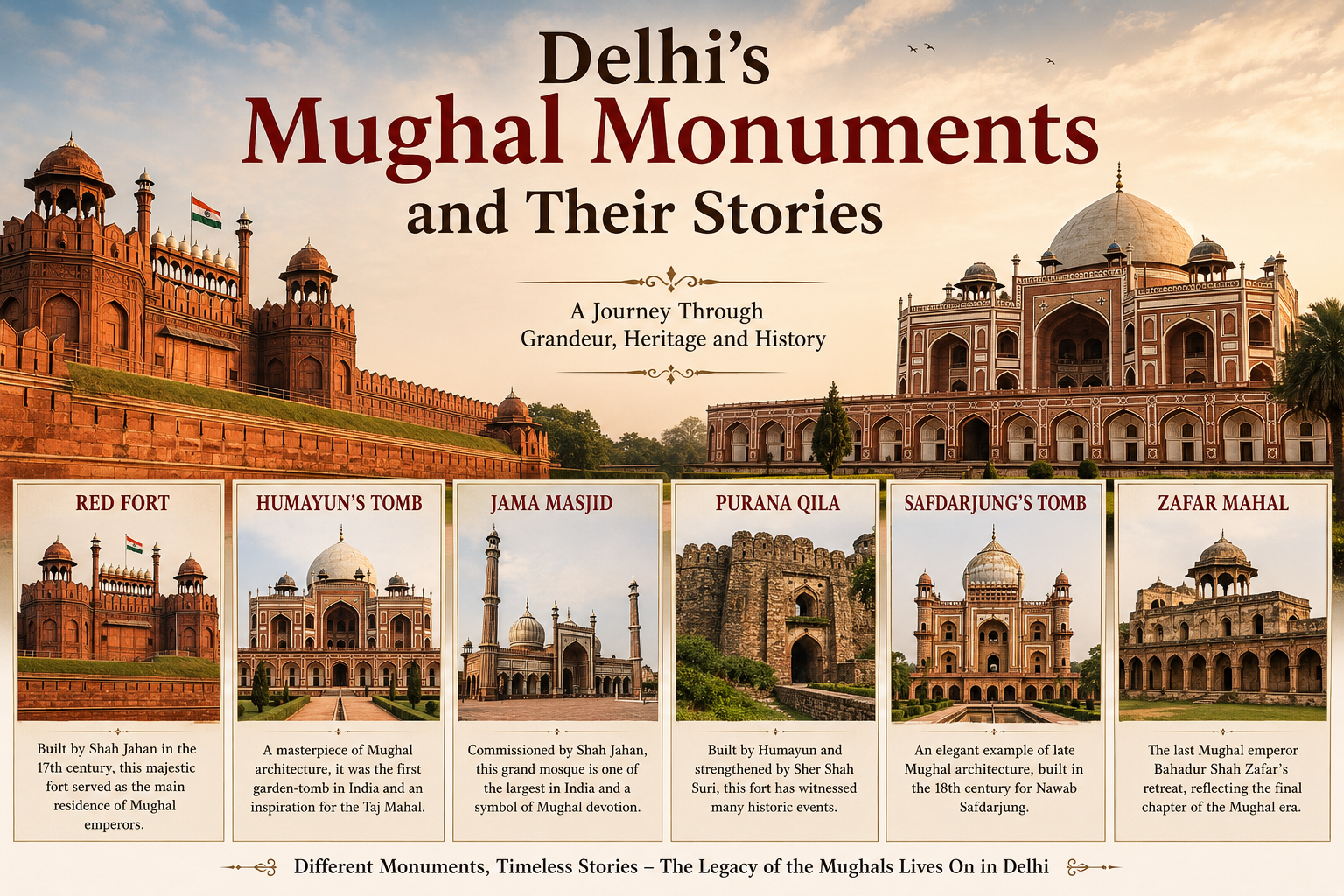
Delhi’s Mughal Monuments and Their Stories
Delhi is a city where centuries of history remain visible in its streets, monuments, gardens, and neighborhoods. Among the most fascinating chapters of Delhi’s past is the Mughal era, a period that transformed the city through grand architecture, royal complexes, mosques, tombs, gardens, and fortified settlements.
The Mughal monuments of Delhi are not simply beautiful structures. Each monument tells a story about emperors, battles, changing capitals, artistic traditions, religious life, royal ambitions, and the evolution of the city itself.
From the imposing walls of the Red Fort to the elegant tomb of Humayun and the atmospheric ruins of Purana Qila, Delhi’s Mughal heritage offers travelers an opportunity to understand how the city developed over several centuries.
If you are interested in history and architecture, exploring Delhi’s Mughal monuments and their stories is one of the best ways to discover the capital beyond its modern identity.
1. Red Fort – The Heart of Shahjahanabad
The Red Fort is perhaps the most recognizable Mughal monument in Delhi. Built by Emperor Shah Jahan in the 17th century, it became the center of his new imperial city, Shahjahanabad.
Shah Jahan is famous for commissioning the Taj Mahal in Agra, but his architectural ambitions extended far beyond it. When he shifted the Mughal capital from Agra to Delhi, he planned a magnificent fortified city along the Yamuna River.
The Red Fort became the emperor’s principal residence and the political heart of the Mughal Empire.
Its enormous red sandstone walls protected a collection of palaces, audience halls, gardens, mosques, and private residences. Inside, buildings such as the Diwan-i-Aam, where the emperor met the public, and the Diwan-i-Khas, used for private audiences, reveal the highly organized world of the Mughal court.
The famous Peacock Throne was once associated with the Mughal imperial court, reflecting the immense wealth and ceremonial grandeur of the period.
However, the story of the Red Fort did not end with the decline of the Mughal Empire. It later came under British control and became an important symbol during India’s independence movement.
Today, the Red Fort represents both Delhi’s Mughal past and India’s modern national identity.
Why the Red Fort matters
The monument helps visitors understand the political, architectural, and cultural ambitions of Shah Jahan. It also demonstrates how Mughal rulers used architecture to express power.
2. Humayun’s Tomb – The Beginning of a New Architectural Tradition
Located in Nizamuddin East, Humayun’s Tomb is one of the most significant Mughal monuments in Delhi.
Built in the 16th century for Mughal Emperor Humayun, the tomb was commissioned by his widow, Hamida Banu Begum. Persian architect Mirak Mirza Ghiyas is traditionally associated with its design.
The monument is particularly important because it introduced architectural ideas that later became more developed in Mughal architecture.
Set within a large charbagh, or four-part garden, the tomb combines red sandstone with white marble and features a large central dome. Its carefully planned geometry, symmetrical layout, arched entrances, and garden setting create a distinctive architectural composition.
The monument’s story is also connected with the Mughal dynasty’s difficult period following Humayun’s death. His reign had been interrupted by the rise of Sher Shah Suri, and the Mughals later regained power.
Humayun’s Tomb therefore represents both the memory of an emperor and the renewed confidence of the Mughal dynasty.
Why Humayun’s Tomb matters
It is often considered an important predecessor to later Mughal masterpieces, including the Taj Mahal. Its combination of Persian-inspired planning, Indian craftsmanship, gardens, and monumental architecture established an influential design tradition.
3. Purana Qila – A Fort With Layers of History
Purana Qila, or the Old Fort, is one of Delhi’s most intriguing historic sites because its story extends beyond the Mughal period.
Humayun is traditionally associated with the construction of the fort, while Sher Shah Suri also developed and strengthened the site during his rule.
The fort’s massive walls and gateways create an imposing appearance. Important structures within the complex include the Qila-i-Kuhna Mosque, associated with Sher Shah Suri, and the Sher Mandal, traditionally linked with Humayun.
Purana Qila is fascinating because it represents a period when political control of northern India changed rapidly.
Humayun’s return to power restored the Mughal dynasty, but his reign ended tragically. Historical accounts describe an accident involving the Sher Mandal, after which Humayun died in 1556.
The fort therefore carries stories of ambition, political conflict, architectural development, and tragedy.
Why Purana Qila matters
Unlike monuments that represent one ruler or one period, Purana Qila reflects the overlapping histories of the Mughals and Sur dynasty.
4. Jama Masjid – Shah Jahan’s Grand Mosque
Jama Masjid stands in the heart of Old Delhi and remains one of the most important Mughal-era religious monuments in the city.
Commissioned by Shah Jahan, the mosque was constructed during the development of Shahjahanabad. Its enormous courtyard, tall minarets, domes, gateways, and red sandstone-and-marble design demonstrate the scale of imperial Mughal architecture.
The mosque was designed to accommodate large gatherings and served as a major religious center for the growing imperial city.
Its location is particularly significant. The mosque stands close to the Red Fort and Chandni Chowk, forming part of the historic core of Shahjahanabad.
Even today, the surrounding streets provide a fascinating contrast between Mughal-era architecture and the lively commercial culture of modern Old Delhi.
Why Jama Masjid matters
Jama Masjid shows how religion, architecture, urban planning, and royal authority were interconnected during Shah Jahan’s reign.
5. Safdarjung’s Tomb – The Final Phase of Mughal Architecture
Although Safdarjung’s Tomb was constructed after the Mughal Empire had passed its peak, it is an important monument for understanding the later development of Mughal architecture.
The tomb was built in the 18th century for Safdarjung, a powerful noble and statesman associated with the Mughal court.
The monument features a large central dome, decorative arches, red and buff sandstone, and a formal garden layout.
Compared with earlier Mughal monuments, its architecture reflects a period when the empire’s political influence was declining. Yet the builders continued to use established Mughal architectural traditions.
This makes Safdarjung’s Tomb particularly valuable for understanding the transition from the grandeur of the early and high Mughal period to the more fragmented political landscape of 18th-century India.
Why Safdarjung’s Tomb matters
It provides a glimpse into the final stages of Mughal architectural traditions and shows how imperial design continued to influence monuments even as political power weakened.
6. Nizamuddin Dargah – A Spiritual Legacy Beside Mughal Heritage
The Nizamuddin area is one of the most historically significant parts of Delhi. At its heart is the shrine of Hazrat Nizamuddin Auliya, a revered Sufi saint.
The shrine itself predates the Mughal Empire, but its surrounding monuments and historical development became closely connected with successive Mughal rulers and Delhi’s Islamic cultural heritage.
Nearby stands Humayun’s Tomb, while the surrounding neighborhood contains numerous historic structures and tombs.
The area demonstrates an important feature of Delhi’s history: different periods often exist side by side. Sufi traditions, Mughal architecture, medieval monuments, and modern neighborhood life continue to overlap.
Visitors exploring the area can therefore experience history not simply through isolated monuments but through a living cultural landscape.
Why Nizamuddin matters
It helps explain the spiritual and cultural environment that shaped Delhi alongside its royal and political history.
7. Isa Khan’s Tomb – A Beautiful Pre-Mughal and Mughal-Era Landmark
Located near Humayun’s Tomb, Isa Khan’s Tomb is an elegant example of the architectural traditions that influenced later Mughal monuments.
The tomb dates to the 16th century and was constructed for Isa Khan Niyazi, a noble associated with the Sur period.
Its octagonal structure, decorative canopies, arched openings, and surrounding enclosure provide a fascinating contrast to the larger scale of Humayun’s Tomb.
The monument demonstrates that Mughal architecture did not emerge in isolation. It developed through interactions between Persian traditions, Indian craftsmanship, and architectural ideas already present in the subcontinent.
Why Isa Khan’s Tomb matters
It offers visitors a chance to understand the architectural transition between the pre-Mughal, Sur, and early Mughal periods.
8. Tomb of Abdul Rahim Khan-i-Khanan – A Monument to a Mughal Scholar
Another fascinating monument near Humayun’s Tomb is the tomb of Abdul Rahim Khan-i-Khanan, a prominent noble during the reign of Emperor Akbar.
Rahim was not only a military commander and court official but also a poet and scholar. He is widely remembered in Indian literary culture for his Hindi couplets.
His tomb combines architectural traditions associated with the Mughal period and provides an important reminder that Mughal history was not solely about emperors and battles.
The monument’s association with Rahim connects Delhi’s architectural heritage with India’s literary traditions.
Why Rahim’s Tomb matters
It represents the intellectual, literary, and cultural dimensions of the Mughal court.
9. Lal Bangla – A Lesser-Known Mughal-Era Landmark
Delhi contains many monuments that receive far less attention than the Red Fort or Humayun’s Tomb.
Lal Bangla is one such historic structure. Located near the Delhi Golf Club area, the monument is associated with the later Mughal period and is believed to contain the graves of members of the Mughal family.
Its relatively modest scale makes it easy to overlook, but this is precisely what makes lesser-known monuments interesting for heritage travelers.
They reveal that Delhi’s Mughal landscape extended far beyond the famous imperial monuments.
Why explore lesser-known Mughal monuments?
They provide quieter experiences and help visitors discover the less familiar stories of Delhi’s royal and residential past.
10. Zafar Mahal – The Story of Delhi’s Last Mughal Emperor
Zafar Mahal in Mehrauli is connected with Bahadur Shah Zafar, the last Mughal emperor.
Unlike the monumental architecture of Shah Jahan’s reign, Zafar Mahal belongs to the later period of Mughal history, when the dynasty’s political authority had significantly declined.
The complex was used by the later Mughal family as a retreat in Mehrauli. The structure and its unfinished elements provide a powerful reminder of how dramatically Mughal fortunes had changed.
Bahadur Shah Zafar himself became an important figure during the uprising of 1857. After the rebellion, he was captured and exiled to Rangoon, where he died.
Why Zafar Mahal matters
It tells the story of the final chapter of Mughal political power in Delhi and provides a striking contrast to the grandeur of Shah Jahan’s era.
11. Mehrauli Archaeological Park – Mughal Delhi Beyond the Famous Forts
Mehrauli Archaeological Park is one of the best areas for travelers who want to discover Delhi’s lesser-known heritage.
The park contains monuments from different periods, including structures associated with the Delhi Sultanate and later Mughal history.
Walking through the area reveals tombs, mosques, stepwells, gateways, and ruins surrounded by greenery.
The park demonstrates how Delhi’s historical landscape developed over centuries rather than being created by a single dynasty.
For travelers who have already visited the Red Fort and Humayun’s Tomb, Mehrauli offers a different and quieter perspective on Delhi’s architectural heritage.
12. Mughal Gardens and the Idea of Paradise
Mughal architecture was not limited to buildings. Gardens were an important part of imperial design.
The Mughal charbagh garden traditionally divided the landscape into four sections, often using pathways and water channels to create a carefully balanced environment.
The design was influenced by the Persian concept of a paradise garden. Water, greenery, symmetry, and architecture were combined to create spaces associated with beauty and tranquility.
Humayun’s Tomb provides one of the finest examples of this approach in Delhi.
These gardens were not merely decorative. They represented ideas about paradise, order, nature, and royal authority.
What Makes Delhi’s Mughal Monuments Special?
Delhi’s Mughal monuments are remarkable because they tell different stories from different stages of the empire.
Humayun’s Tomb represents the early development of Mughal architectural traditions.
Purana Qila reflects the political competition between the Sur dynasty and the Mughals.
Red Fort represents the height of Mughal imperial power under Shah Jahan.
Jama Masjid demonstrates the religious and urban ambitions of Shahjahanabad.
Safdarjung’s Tomb reflects the later continuation of Mughal architectural traditions.
Zafar Mahal represents the final chapter of the Mughal dynasty.
Together, these monuments create a historical timeline across Delhi.
Mughal Architecture in Delhi: Key Features
Travelers exploring these monuments will notice several recurring architectural elements.
Red Sandstone and White Marble
Mughal builders frequently combined red sandstone with white marble to create visual contrast and emphasize important architectural details.
Domes
Large domes became defining features of Mughal architecture, often placed above tombs and mosques.
Arches
Arched entrances and corridors are found throughout Mughal monuments, providing both structural and decorative functions.
Symmetry
Mughal architecture often emphasizes balanced layouts and carefully planned geometric arrangements.
Gardens
Formal gardens were particularly important around royal tombs and palaces.
Decorative Work
Stone carving, geometric patterns, calligraphy, inlay, and ornamental details added richness to Mughal structures.
Best Way to Explore Delhi’s Mughal Monuments
Instead of visiting monuments randomly, travelers can organize their sightseeing around historical areas.
Central and Old Delhi Route
Start with the Red Fort and continue toward Jama Masjid and the historic streets of Shahjahanabad.
Nizamuddin Heritage Route
Explore Humayun’s Tomb, Isa Khan’s Tomb, Abdul Rahim Khan-i-Khanan’s Tomb, and the surrounding Nizamuddin heritage area.
Mehrauli Heritage Route
Explore Zafar Mahal and the monuments of Mehrauli Archaeological Park to discover the later chapters of Delhi’s history.
This approach makes it easier to understand how Mughal architecture and political power changed over time.
Best Time to Visit Mughal Monuments in Delhi
The cooler months from October to March are generally comfortable for sightseeing in Delhi. Early mornings are particularly pleasant for outdoor monuments and photography.
Visitors should allow enough time at each site rather than rushing through several monuments in one day. Large complexes such as the Red Fort and Humayun’s Tomb can take considerable time to explore properly.
Comfortable shoes, drinking water, sun protection, and a camera can make a heritage tour more enjoyable.
Tips for Exploring Delhi’s Mughal Heritage
Learn the Story Before You Visit
Knowing a little about the emperor or historical period associated with a monument can make the experience much more meaningful.
Explore Beyond the Famous Sites
The Red Fort and Humayun’s Tomb are essential, but lesser-known monuments often provide some of the most interesting experiences.
Respect Religious Spaces
Several historic monuments remain active religious sites. Visitors should follow local customs and dress appropriately.
Take Time to Observe Architecture
Look closely at arches, domes, stonework, gardens, inscriptions, and decorative patterns. Small details often reveal more about Mughal craftsmanship than a quick visit does.
Consider a Heritage Walk
A guided heritage walk can help explain the connections between monuments, neighborhoods, historical figures, and architectural styles.
Final Thoughts
The story of Delhi’s Mughal monuments is really the story of a city constantly being transformed.
Humayun’s struggles, Akbar’s expanding empire, Shah Jahan’s magnificent Shahjahanabad, the later decline of Mughal power, and Bahadur Shah Zafar’s final years are all reflected in Delhi’s historic landscape.
The Red Fort tells a story of imperial grandeur. Humayun’s Tomb reveals the development of a new architectural tradition. Jama Masjid reflects the religious heart of Shahjahanabad. Purana Qila recalls political struggles, while Zafar Mahal provides a glimpse into the final days of Mughal authority.
Together, these monuments make Delhi one of India’s most fascinating destinations for history lovers.
If you look beyond the famous landmarks and explore the city’s lesser-known tombs, gardens, mosques, havelis, and archaeological sites, you will discover that Delhi’s Mughal heritage is not a single story—it is a collection of stories spread across centuries.