
·
Last Updated: September 21, 2026
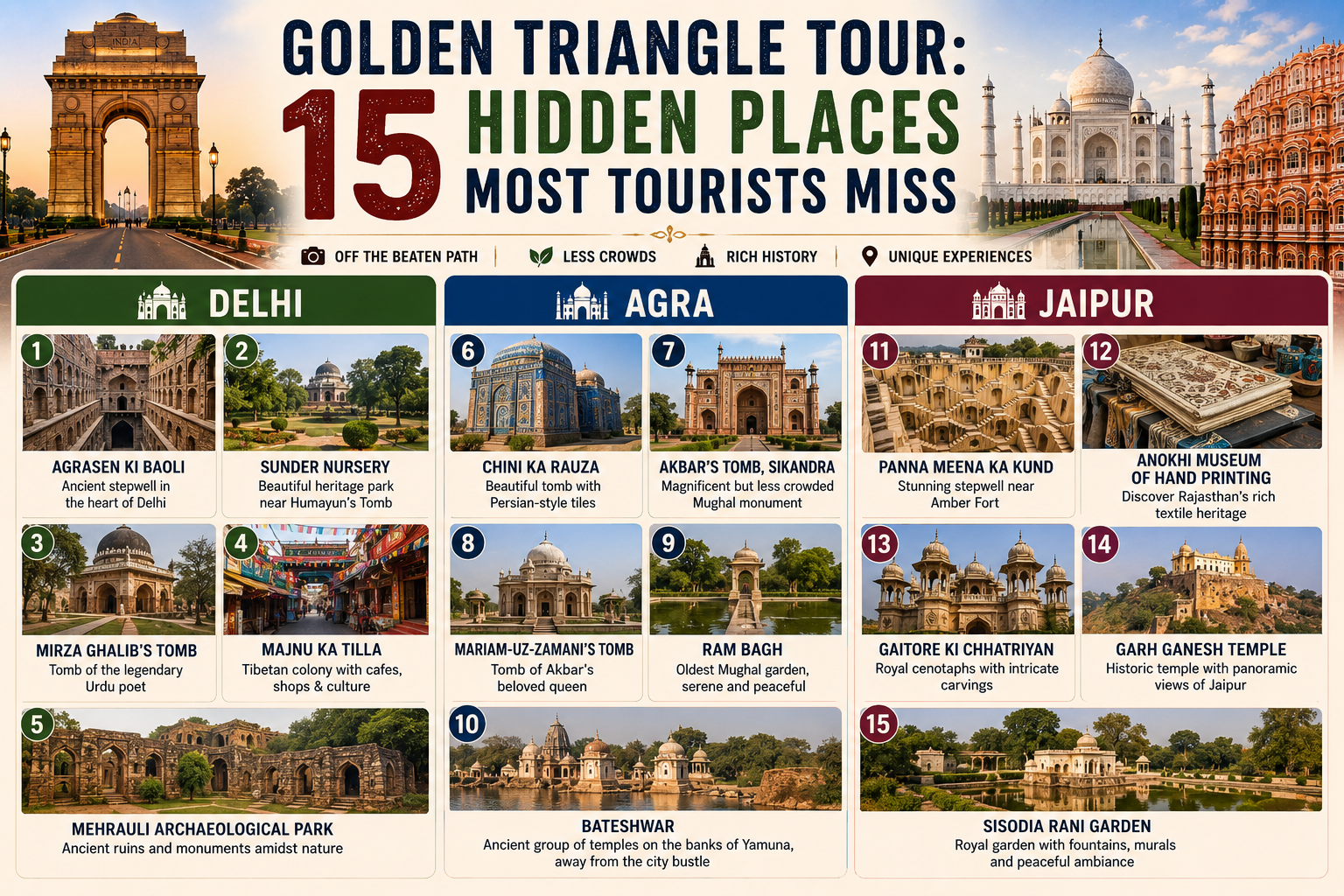
The Golden Triangle Tour is famous for three incredible cities—Delhi, Agra, and Jaipur. Millions of travelers visit these destinations every year to see landmarks such as the Taj Mahal, India Gate, Amber Fort, Hawa Mahal, and Qutub Minar.
But there is another side of the Golden Triangle that many visitors never discover.
Beyond the famous monuments are peaceful gardens, forgotten tombs, historic villages, ancient stepwells, colorful markets, quiet temples, and architectural treasures that often receive far fewer visitors. These lesser-known places can give your journey a more personal and authentic character.
If you want to explore beyond the usual sightseeing itinerary, this guide introduces 15 hidden and underrated places on the Golden Triangle Tour.
Why Explore Hidden Places on the Golden Triangle?
The major attractions deserve their popularity, but visiting lesser-known places has its own rewards.
You may find:
- Fewer crowds
- More peaceful surroundings
- Unique photography opportunities
- Local cultural experiences
- Interesting historical stories
- Traditional architecture
- Opportunities to explore at a slower pace
Adding a few hidden attractions to your itinerary can also help you see a different side of Delhi, Agra, and Jaipur.
Hidden Places in Delhi
Delhi has thousands of years of history, yet many travelers visit only its most famous monuments. Look beyond the standard tourist route and you will discover fascinating historical sites tucked away among modern neighborhoods.
1. Agrasen Ki Baoli
Located near the busy center of New Delhi, Agrasen Ki Baoli is a historic stepwell known for its long series of stone steps and striking architectural design.
The structure descends deep into the ground, creating a dramatic visual effect.
Its quiet atmosphere can feel surprisingly different from the busy streets surrounding it.
Why Visit?
Agrasen Ki Baoli is excellent for travelers interested in architecture, history, and photography.
Best for: Architecture, photography, and history.
2. Sunder Nursery
Sunder Nursery is a beautifully landscaped heritage area near Humayun’s Tomb.
It combines gardens, historic monuments, water features, pathways, and greenery.
Unlike a traditional monument visit, Sunder Nursery allows you to slow down and enjoy Delhi’s heritage in a more relaxed setting.
Why Visit?
It is ideal for travelers who want a break from the city’s traffic and crowds while still experiencing historic architecture.
Best for: Gardens, architecture, photography, and peaceful walks.
3. Mirza Ghalib’s Tomb
Hidden within the historic area of Nizamuddin, the tomb of famous Urdu poet Mirza Ghalib offers an opportunity to explore Delhi’s literary heritage.
The surrounding neighborhood is filled with history and cultural character.
A visit here can be combined with exploring the wider Nizamuddin area.
Why Visit?
It is a good choice for travelers interested in literature, poetry, and Delhi’s cultural history.
Best for: History, literature, and cultural exploration.
4. Majnu Ka Tilla
Majnu Ka Tilla offers a completely different atmosphere from Delhi’s grand Mughal monuments.
This lively neighborhood is known for Tibetan cultural influences, cafés, small shops, restaurants, and colorful streets.
It is a great place to experience a more contemporary side of Delhi.
Why Visit?
The narrow lanes and distinctive atmosphere provide interesting opportunities for street photography and food exploration.
Best for: Food, cafés, shopping, and street photography.
5. Mehrauli Archaeological Park
Mehrauli Archaeological Park is one of Delhi’s best options for travelers who want to explore historical architecture away from the city’s busiest attractions.
The area contains several historic structures surrounded by greenery.
It is particularly interesting because the landscape reveals layers of Delhi’s long architectural history.
Why Visit?
You can explore multiple historical structures in one area while enjoying a less crowded environment.
Best for: History, architecture, photography, and walking.
Hidden Places in Agra
Agra is dominated by the Taj Mahal, but the city has far more to offer than its most famous monument.
If you have extra time, consider exploring some of these lesser-known attractions.
6. Chini Ka Rauza
Chini Ka Rauza is a historic tomb located near the Yamuna River.
Its architecture is particularly interesting because of its decorative glazed tile work, which gives the monument a distinctive appearance.
Compared with Agra’s most famous attractions, it generally offers a much quieter experience.
Why Visit?
The colorful decorative details make it particularly attractive for photographers.
Best for: Architecture, history, and photography.
7. Akbar’s Tomb at Sikandra
Located on the outskirts of Agra, Akbar’s Tomb is an impressive Mughal-era monument surrounded by landscaped grounds.
The complex features a large gateway, decorative details, gardens, and the tomb itself.
It is often overshadowed by the Taj Mahal, which makes it a worthwhile addition for travelers interested in Mughal history.
Why Visit?
The monument offers a different architectural style from the Taj Mahal and usually provides a more relaxed sightseeing experience.
Best for: Mughal architecture, history, and photography.
8. Mariam-uz-Zamani’s Tomb
Located near Sikandra, this historic tomb is associated with Mariam-uz-Zamani, the wife of Mughal emperor Akbar.
The structure has a relatively understated appearance compared with Agra’s grander monuments.
Its historical connection and architectural character make it interesting for visitors who want to explore beyond the standard Agra itinerary.
Why Visit?
It provides a quieter historical experience and adds another layer to the story of the Mughal period.
Best for: History and architecture.
9. Ram Bagh
Ram Bagh is considered one of the oldest Mughal gardens in India.
The garden layout, water channels, greenery, and historical atmosphere make it a pleasant alternative to Agra’s crowded tourist sites.
It is associated with Babur, the founder of the Mughal Empire.
Why Visit?
The garden provides a more peaceful experience and offers an opportunity to understand the Mughal tradition of landscaped gardens.
Best for: Gardens, history, photography, and relaxation.
10. Bateshwar
Located outside central Agra, Bateshwar is a historic and religious site associated with a group of temples along the Yamuna River.
The area has a distinctly local atmosphere and is much less touristy than the Taj Mahal and Agra Fort.
Why Visit?
It is particularly suitable for travelers who have additional time and want to experience a quieter cultural landscape outside central Agra.
Best for: Culture, temples, photography, and local experiences.
Travel tip: Because Bateshwar is outside the main tourist center, plan transportation in advance.
Hidden Places in Jaipur
Jaipur’s Amber Fort, Hawa Mahal, and City Palace attract huge numbers of visitors. However, the Pink City also contains numerous lesser-known sites that reveal another side of Rajasthan’s history and architecture.
11. Panna Meena Ka Kund
Located close to Amber Fort, Panna Meena Ka Kund is a historic stepwell recognized for its geometric arrangement of stairs.
The repeating patterns create a fascinating visual composition.
Its proximity to Amber Fort makes it easy to include in a heritage-focused Jaipur itinerary.
Why Visit?
It offers a different architectural experience from Jaipur’s grand palaces and forts.
Best for: Architecture and photography.
12. Anokhi Museum of Hand Printing
Located near Amber, the Anokhi Museum focuses on the traditional craft of hand block printing.
Visitors can learn about the tools, techniques, designs, and processes used to create block-printed textiles.
Why Visit?
It provides insight into Rajasthan’s textile traditions rather than simply showcasing finished tourist products.
Best for: Art, crafts, textiles, and cultural learning.
13. Gaitore Ki Chhatriyan
Gaitore is a beautiful complex of royal cenotaphs located in a quieter part of Jaipur.
The structures feature intricate carvings, domes, pillars, and traditional Rajasthani architectural details.
The site is particularly attractive for photographers because of its combination of detailed stonework and peaceful surroundings.
Why Visit?
It offers a more intimate look at Jaipur’s royal architectural traditions.
Best for: Photography, architecture, and history.
14. Garh Ganesh Temple
Located on a hill near Jaipur, Garh Ganesh Temple provides both a cultural experience and elevated views of the surrounding city.
The temple is associated with Lord Ganesha and has a long-standing connection with Jaipur’s royal history.
Why Visit?
The climb and elevated location can provide interesting views while introducing travelers to an important local religious tradition.
Best for: Culture, views, and photography.
Travel tip: Dress respectfully and follow local temple customs.
15. Sisodia Rani Garden
Located outside the busiest parts of central Jaipur, Sisodia Rani Garden is a historic garden associated with Jaipur’s royal family.
The garden features terraces, fountains, pavilions, greenery, and decorative paintings.
It offers a calmer alternative to Jaipur’s major forts and palaces.
Why Visit?
The combination of gardens and historic architecture makes it an excellent place for a relaxing stop.
Best for: Gardens, architecture, photography, and couples.
Hidden Places on the Golden Triangle at a Glance
| Destination | Hidden Place | Best Experience |
|---|---|---|
| Delhi | Agrasen Ki Baoli | Architecture & photography |
| Delhi | Sunder Nursery | Gardens & heritage |
| Delhi | Mirza Ghalib’s Tomb | Literature & culture |
| Delhi | Majnu Ka Tilla | Food & street life |
| Delhi | Mehrauli Archaeological Park | History & photography |
| Agra | Chini Ka Rauza | Architecture |
| Agra | Akbar’s Tomb | Mughal history |
| Agra | Mariam-uz-Zamani’s Tomb | History |
| Agra | Ram Bagh | Gardens |
| Agra | Bateshwar | Culture & temples |
| Jaipur | Panna Meena Ka Kund | Stepwell architecture |
| Jaipur | Anokhi Museum | Traditional crafts |
| Jaipur | Gaitore | Royal architecture |
| Jaipur | Garh Ganesh Temple | Culture & city views |
| Jaipur | Sisodia Rani Garden | Gardens & relaxation |
How to Add Hidden Places to Your Golden Triangle Itinerary
You do not need to visit all 15 places to experience the lesser-known side of the Golden Triangle.
Instead, choose attractions based on your interests.
For History Lovers
Consider:
- Mehrauli Archaeological Park
- Akbar’s Tomb
- Chini Ka Rauza
- Gaitore
- Ram Bagh
For Photography Lovers
Consider:
- Agrasen Ki Baoli
- Sunder Nursery
- Chini Ka Rauza
- Panna Meena Ka Kund
- Gaitore
For Culture Lovers
Consider:
- Majnu Ka Tilla
- Bateshwar
- Anokhi Museum
- Garh Ganesh Temple
For Relaxation
Consider:
- Sunder Nursery
- Ram Bagh
- Sisodia Rani Garden
A 7-Day Hidden Gems Golden Triangle Itinerary
If you want to combine famous attractions with lesser-known places, the following plan can work well.
Day 1 – Delhi
Explore India Gate and other major landmarks before visiting Agrasen Ki Baoli.
Spend the evening experiencing Old Delhi’s food and streets.
Day 2 – Delhi
Visit Humayun’s Tomb and Sunder Nursery.
Later, explore Mehrauli Archaeological Park.
Day 3 – Delhi to Agra
Travel to Agra and visit Agra Fort.
If time allows, explore Chini Ka Rauza around the same day.
Day 4 – Agra
Visit the Taj Mahal early in the morning.
Later, explore Akbar’s Tomb and Mariam-uz-Zamani’s Tomb.
Day 5 – Agra to Jaipur
Travel toward Jaipur.
Depending on your route and schedule, consider visiting Fatehpur Sikri before continuing to Jaipur.
Day 6 – Jaipur
Visit Amber Fort, followed by Panna Meena Ka Kund.
Later, explore Gaitore and enjoy Jaipur’s local markets.
Day 7 – Jaipur
Visit Anokhi Museum and Sisodia Rani Garden.
Finish your trip with an evening view of Jaipur or a relaxed local dining experience.
Tips for Visiting Hidden Places
Check Opening Hours
Some lesser-known attractions have limited visiting hours or may follow different schedules from major tourist monuments.
Check current timings before making a special trip.
Plan Transportation
Not every hidden attraction is located in central tourist areas.
For places outside the city center, arrange transportation beforehand.
Allow Extra Time
Lesser-known places are often best enjoyed slowly. Avoid squeezing too many locations into one day.
Respect Local Customs
Some attractions are religious or located near residential communities. Dress appropriately and follow photography rules.
Carry Water and Essentials
Some lesser-known heritage sites may have fewer visitor facilities nearby than major tourist attractions.
Do Not Expect Large Tourist Facilities
A hidden attraction may not have the same restaurants, shops, guides, or visitor infrastructure found around major monuments.
That is part of the experience.
Best Time to Explore Hidden Places
The cooler months from October to March are generally comfortable for exploring Delhi, Agra, and Jaipur.
Early morning and late afternoon are particularly pleasant for outdoor sightseeing and photography.
During the hotter months, schedule outdoor attractions earlier in the morning or later in the afternoon.
Monsoon weather can bring rain and humidity but may also give gardens and landscapes a fresh appearance.
Always check local weather conditions before heading out.
Why Hidden Places Make Your Golden Triangle Tour Better
The famous monuments tell only part of the story.
A visit to the Taj Mahal shows you Mughal architectural grandeur. But exploring Chini Ka Rauza can reveal another aspect of Mughal-era craftsmanship.
Amber Fort demonstrates Jaipur’s royal history, while a visit to Gaitore can introduce you to the city’s beautifully carved royal cenotaphs.
Similarly, Delhi’s famous landmarks tell the story of imperial capitals, while places such as Mehrauli Archaeological Park reveal the many historical layers that exist beyond the city’s best-known attractions.
These smaller experiences can make your journey feel less like a checklist and more like an exploration.
Final Thoughts
The Golden Triangle Tour does not have to be limited to Delhi’s major landmarks, the Taj Mahal, Agra Fort, Amber Fort, and Hawa Mahal.
Hidden and underrated places such as Agrasen Ki Baoli, Sunder Nursery, Chini Ka Rauza, Ram Bagh, Panna Meena Ka Kund, Gaitore, and Sisodia Rani Garden offer travelers opportunities to discover quieter corners of India’s famous tourist circuit.
Whether you are interested in history, photography, architecture, food, crafts, gardens, or local culture, adding a few lesser-known attractions can make your Delhi–Agra–Jaipur journey more distinctive.
The best strategy is to combine the famous highlights with a handful of hidden gems. That way, you experience the landmarks you came to see while also discovering places that many visitors simply pass by.
Sometimes, the most memorable part of a Golden Triangle Tour is not the place everyone knows—it is the place you almost missed.