
·
Last Updated: August 31, 2026
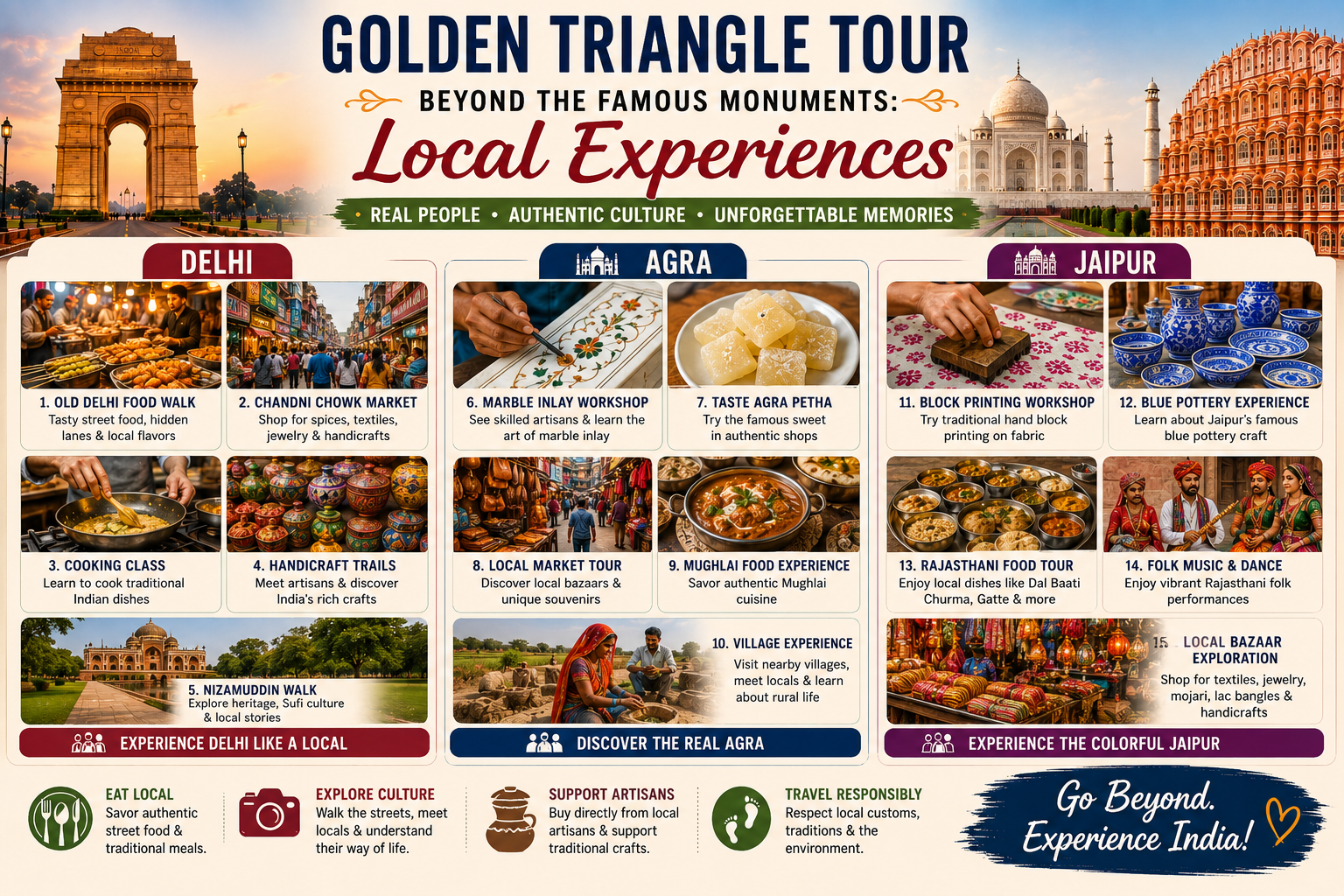
The Golden Triangle Tour is one of India’s most popular travel routes, connecting Delhi, Agra, and Jaipur. Most visitors come to see famous attractions such as the Taj Mahal, Amber Fort, Hawa Mahal, Qutub Minar, and India Gate.
But the Golden Triangle is much more than its monuments.
Behind the grand palaces and historic forts is an equally fascinating world of local markets, traditional food, artisan workshops, neighborhood walks, cultural performances, village experiences, and everyday life. Exploring these experiences can transform a standard sightseeing trip into a more personal journey through India.
If you want to experience the Golden Triangle beyond famous monuments, this guide will help you discover authentic and memorable things to do in Delhi, Agra, and Jaipur.
Why Explore Local Experiences on the Golden Triangle Tour?
Famous monuments tell you about India’s history, but local experiences allow you to connect with its living culture.
Instead of spending your entire trip moving from one attraction to another, leave some time to:
- Taste regional food
- Explore traditional markets
- Meet local artisans
- Learn Indian cooking
- Walk through historic neighborhoods
- Discover traditional crafts
- Experience local festivals
- Visit rural communities
- Enjoy cultural performances
- Observe everyday life
These activities can make your Golden Triangle journey feel more authentic and less like a checklist of tourist attractions.
Local Experiences in Delhi
Delhi is one of India’s most diverse cities. It combines ancient neighborhoods, Mughal-era heritage, modern districts, street markets, food traditions, and communities from across the country.
1. Take a Food Walk Through Old Delhi
One of the best ways to experience Delhi is through its food.
Old Delhi is famous for its busy lanes and traditional eateries. A food walk can introduce you to local favorites such as:
- Chole bhature
- Parathas
- Chaat
- Kebabs
- Biryani
- Jalebi
- Lassi
Rather than simply eating at a restaurant, a food walk allows you to experience the sights, sounds, smells, and energy of the neighborhood.
Why Try It?
Food provides an easy way to understand Delhi’s multicultural identity.
Best for: Food lovers, first-time visitors, and photographers.
2. Explore Chandni Chowk
Chandni Chowk is one of Delhi’s most famous traditional market areas.
The neighborhood is filled with shops, food stalls, historic buildings, religious sites, and narrow lanes.
You can browse:
- Indian textiles
- Spices
- Clothing
- Jewelry
- Traditional sweets
- Handicrafts
A walk through the area can feel like stepping into another side of Delhi.
Local Tip
The area can become extremely busy. Keep your belongings secure and allow plenty of time rather than trying to rush through the market.
3. Experience a Delhi Cooking Class
Food enthusiasts can take part in a cooking class to learn how traditional Indian dishes are prepared.
Depending on the experience, you may learn to prepare:
- Indian breads
- Dal
- Vegetable curries
- Paneer dishes
- Chutneys
- Indian desserts
A cooking class is particularly useful for travelers who want to take something home that cannot be packed in a suitcase—a new culinary skill.
4. Discover Delhi’s Handicrafts
Delhi is a gateway to crafts from many regions of India.
Visit craft markets or workshops to discover traditional:
- Textiles
- Pottery
- Metalwork
- Woodwork
- Paintings
- Embroidery
- Decorative items
If possible, choose products directly connected with established artisan communities.
This gives you an opportunity to understand how traditional crafts are made rather than simply seeing the finished product in a souvenir shop.
5. Explore Nizamuddin’s Cultural Side
The Nizamuddin area offers an opportunity to experience Delhi’s living heritage.
Beyond its historical monuments, the neighborhood has old lanes, traditional food, music, and a strong cultural atmosphere.
A guided heritage or neighborhood walk can help visitors understand the area’s history and traditions.
Best for:
Culture, history, photography, and travelers looking for a more intimate Delhi experience.
Local Experiences in Agra
Agra is best known for the Taj Mahal, but visitors who stay a little longer can discover a city with strong craft, food, and cultural traditions.
6. Visit a Marble Inlay Workshop
Agra has a long association with marble craftsmanship.
Artisans create decorative designs by placing small pieces of colored stone into marble.
The patterns may feature:
- Flowers
- Leaves
- Geometric shapes
- Traditional motifs
Visiting a genuine workshop can help you understand the skill and patience involved in producing these pieces.
What to Look For
Ask questions about the materials, craftsmanship, and production process before purchasing anything.
7. Taste Traditional Agra Petha
No visit to Agra is complete for many travelers without trying petha.
This translucent sweet is traditionally made using ash gourd and sugar and comes in several varieties.
You can try different flavors or purchase a properly packaged selection as an edible souvenir.
Why Try It?
It is a simple way to experience a food tradition closely associated with Agra.
8. Explore Agra’s Local Markets
Instead of spending all your shopping time around major tourist attractions, explore established local markets.
Depending on the area, you may find:
- Handicrafts
- Textiles
- Leather goods
- Marble products
- Traditional sweets
- Souvenirs
Take your time to compare products and prices before purchasing.
9. Enjoy a Local Mughlai Meal
Agra’s history as an important Mughal city is reflected in its cuisine.
A traditional meal may include dishes featuring aromatic spices, rich sauces, grilled foods, rice, and Indian breads.
If you enjoy non-vegetarian cuisine, Mughlai dishes can be a highlight.
Vegetarian travelers can also find plenty of North Indian and Mughlai-inspired vegetarian dishes.
10. Experience a Village Near Agra
Travelers with extra time can consider visiting a rural community around Agra through a responsible local experience.
A village visit can provide insight into:
- Rural lifestyles
- Traditional crafts
- Agriculture
- Local food
- Community traditions
Choose experiences that work with local communities respectfully and avoid treating residents simply as photographic subjects.
Local Experiences in Jaipur
Jaipur is perhaps the most colorful destination on the Golden Triangle when it comes to local cultural experiences.
The city combines royal traditions with active craft communities, markets, cuisine, textiles, jewelry, and folk arts.
11. Learn About Block Printing
Rajasthan is famous for its textile traditions, including hand block printing.
During a workshop, visitors can learn how artisans use carved wooden blocks to create repeating patterns on fabric.
The process can involve:
- Preparing the fabric
- Creating or selecting wooden blocks
- Applying natural or commercial dyes
- Stamping the design repeatedly
- Drying and finishing the fabric
Why Try It?
It provides a deeper understanding of the craftsmanship behind the colorful textiles found in Jaipur’s markets.
12. Visit a Blue Pottery Workshop
Blue pottery is one of Jaipur’s best-known traditional crafts.
A workshop visit can show you how decorative pieces are shaped, decorated, glazed, and finished.
Popular products include:
- Plates
- Bowls
- Vases
- Decorative tiles
- Small containers
If you purchase pottery, ask for secure packaging suitable for travel.
13. Take a Jaipur Food Tour
A Jaipur food tour is an excellent way to explore Rajasthani cuisine.
Try regional specialties such as:
- Dal baati churma
- Pyaaz kachori
- Mirchi vada
- Gatte ki sabzi
- Ker sangri
- Rajasthani thali
- Ghewar
- Lassi
A food tour can also introduce you to local eating customs and the stories behind traditional dishes.
14. Experience a Rajasthani Folk Performance
Traditional music and dance are an important part of Rajasthan’s cultural identity.
Depending on the venue and season, travelers may be able to experience performances featuring traditional instruments, folk songs, dance, and storytelling.
These performances are particularly enjoyable in the evening after a day of sightseeing.
Best for:
Culture, families, couples, and travelers interested in traditional arts.
15. Explore Jaipur’s Traditional Bazaars
Jaipur’s markets are an experience in themselves.
Explore areas known for:
- Jewelry
- Textiles
- Lac bangles
- Handicrafts
- Blue pottery
- Mojari
- Decorative items
The colors, sounds, and displays make these markets excellent places for street photography.
Remember to ask permission before taking close-up photographs of people.
Experience a Traditional Rajasthani Meal
A traditional Rajasthani meal can be one of the highlights of your Jaipur visit.
A thali may contain several dishes served together, giving travelers the opportunity to sample different flavors.
You might encounter:
- Dal
- Baati
- Churma
- Gatte
- Kadhi
- Vegetables
- Rotis
- Rice
- Pickles
- Chutneys
- Sweets
The exact dishes vary by restaurant and season.
The meal is not just about eating—it is an opportunity to experience the richness and variety of Rajasthan’s culinary traditions.
Meet Local Artisans
One of the best ways to go beyond traditional sightseeing is to meet people who continue local crafts.
Depending on the destination, you can discover artisans working with:
- Textiles
- Marble
- Pottery
- Wood
- Metal
- Jewelry
- Leather
- Paintings
When choosing an artisan experience, look for opportunities where craftspeople are fairly represented and where visitors can learn about the work without disrupting production.
Take a Heritage Walk
A heritage walk can reveal details that are easy to miss when exploring independently.
A knowledgeable local guide can explain:
- Architectural features
- Local traditions
- Historical neighborhoods
- Religious customs
- Stories behind buildings
- Traditional occupations
Delhi, Agra, and Jaipur each have neighborhoods where a walking tour can provide a completely different perspective from visiting major monuments.
Try a Local Market Instead of a Shopping Mall
Modern shopping centers can be convenient, but traditional markets offer a more immersive cultural experience.
You can observe:
- Local bargaining
- Traditional products
- Street food
- Artisan work
- Local clothing
- Everyday shopping habits
If you plan to purchase expensive items, compare prices and quality carefully.
Enjoy a Sunrise or Sunset Experience
Local experiences do not always require an organized activity.
Simply finding a peaceful place to watch the day begin or end can become a memorable part of your Golden Triangle journey.
Some popular possibilities include:
- Sunrise around the Taj Mahal
- Sunset views of the Taj Mahal from across the Yamuna
- Evening views of Jaipur from elevated areas
- Early morning walks in Delhi
- Sunset walks around heritage areas
Check current opening hours and access rules before visiting specific locations.
Connect With Local People Respectfully
One of the most rewarding aspects of travel is meeting people.
However, cultural interaction should always be respectful.
When interacting with local communities:
- Ask before taking photographs
- Respect religious customs
- Dress appropriately when required
- Avoid intrusive questions
- Support local businesses
- Pay fairly for services
- Follow photography restrictions
Responsible tourism creates better experiences for both visitors and residents.
Local Experiences for Different Types of Travelers
The Golden Triangle can be customized according to your interests.
For Food Lovers
Try Delhi street food, Agra Mughlai cuisine, and a traditional Rajasthani thali in Jaipur.
For Photography Lovers
Explore markets, artisan workshops, historic neighborhoods, and colorful streets.
For Families
Choose cooking classes, craft workshops, cultural performances, and food experiences suitable for all ages.
For Couples
Enjoy private dining experiences, sunset views, cultural performances, and relaxed market walks.
For Solo Travelers
Food walks, workshops, heritage tours, and group cultural experiences can provide opportunities to meet other travelers.
For Culture Enthusiasts
Focus on traditional crafts, local neighborhoods, music, dance, food, and community experiences.
How to Plan a Local-Experience Golden Triangle Tour
A balanced itinerary should combine famous attractions with local activities.
For example:
Day 1 – Delhi
Visit a major monument in the morning and explore Old Delhi’s food and markets in the evening.
Day 2 – Delhi
Take a heritage walk and participate in a cooking or craft experience.
Day 3 – Agra
Visit the Taj Mahal and explore Agra’s local food culture.
Day 4 – Agra
Visit a marble workshop and discover lesser-known parts of the city.
Day 5 – Jaipur
Travel to Jaipur and explore a local market in the evening.
Day 6 – Jaipur
Visit Amber Fort followed by a block-printing or blue-pottery experience.
Day 7 – Jaipur
Enjoy a Rajasthani food experience and traditional cultural performance before departure.
This itinerary leaves room for the famous attractions while making local culture an important part of the trip.
Tips for Authentic Golden Triangle Experiences
Choose Local Operators
When possible, choose established local guides, artisans, workshops, and community-based experiences.
Avoid Overpacked Itineraries
Trying to visit too many attractions can leave little time for genuine cultural experiences.
Research Before Booking
Check recent reviews and understand exactly what an experience includes.
Respect Photography Rules
Not every person, religious site, or workshop should be photographed without permission.
Support Local Businesses
Eating at local restaurants, purchasing directly from artisans, and joining locally operated experiences can help your spending reach the community.
Stay Flexible
Some of the best travel memories happen unexpectedly.
Leave a little free time in your schedule to explore a market, stop at a café, talk to a local guide, or discover an interesting neighborhood.
Famous Monuments vs Local Experiences
| Traditional Sightseeing | Local Experience |
|---|---|
| Visit the Taj Mahal | Taste Agra’s local cuisine |
| See Amber Fort | Join a traditional craft workshop |
| Visit Qutub Minar | Explore a Delhi neighborhood |
| See Hawa Mahal | Shop in Jaipur’s local bazaars |
| Visit Agra Fort | Discover marble craftsmanship |
| Explore City Palace | Enjoy a Rajasthani food experience |
The ideal Golden Triangle Tour does not require choosing between the two.
Combine them.
Why Local Experiences Make the Trip More Memorable
A photograph of the Taj Mahal can remind you where you traveled.
But learning how an artisan creates a marble inlay, tasting a dish for the first time, watching a traditional performance, or walking through a lively neighborhood can remind you how the journey felt.
These experiences create personal memories that are often impossible to capture in a standard sightseeing itinerary.
They also help travelers understand that Delhi, Agra, and Jaipur are not simply tourist destinations. They are living cities where people continue to practice traditions, create art, prepare regional food, celebrate festivals, and build communities.
Final Thoughts
The Golden Triangle Tour beyond famous monuments offers a deeper way to experience India.
Delhi invites you to explore food, markets, neighborhoods, crafts, and cultural traditions. Agra provides opportunities to discover marble craftsmanship, Mughlai cuisine, local markets, and rural life beyond the Taj Mahal. Jaipur introduces travelers to Rajasthani food, textiles, pottery, jewelry, folk arts, and colorful bazaars.
The famous monuments should certainly remain part of your itinerary, but do not let them become the entire journey.
Spend an afternoon learning a craft. Join a local food walk. Explore a traditional market. Taste a regional dish. Watch a cultural performance. Talk to a local guide.
These simple experiences can turn your Delhi–Agra–Jaipur Golden Triangle Tour from a sightseeing trip into a genuine cultural adventure.
See the monuments, but experience the places.