
·
Last Updated: September 22, 2026
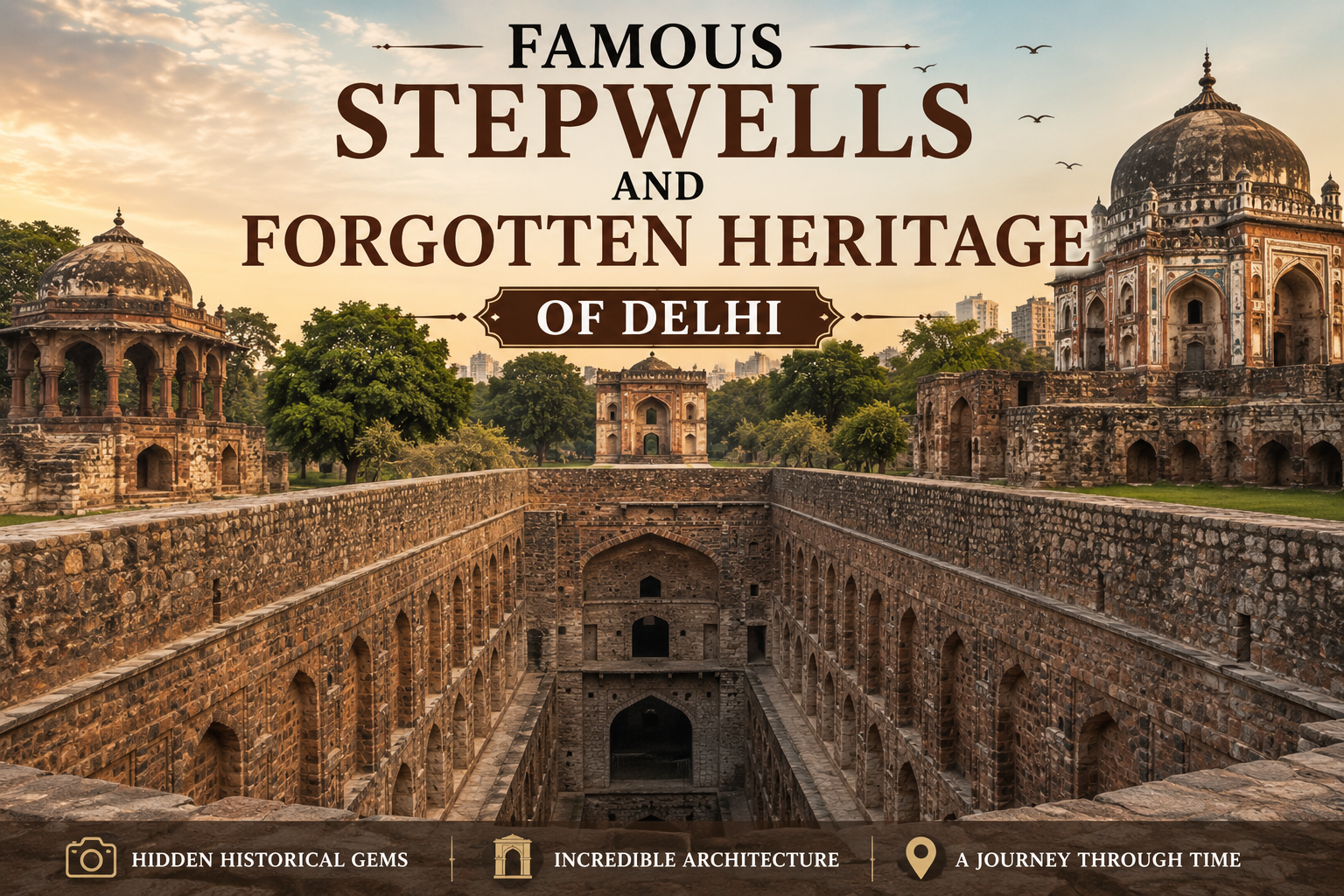
Famous Stepwells and Forgotten Heritage of Delhi
Delhi is often introduced to travelers through its most famous landmarks—the Red Fort, India Gate, Qutub Minar, Humayun’s Tomb, and Jama Masjid. But beyond these celebrated attractions lies another Delhi: a city of hidden courtyards, ancient ruins, forgotten tombs, historic gates, baolis, and architectural treasures that many visitors pass without noticing.
Among the most fascinating examples are Delhi’s stepwells, traditionally known as baolis or baoris. These remarkable structures were designed to provide access to groundwater while also serving as important social and architectural spaces. Their descending flights of steps, underground chambers, arches, and stone corridors reveal the engineering skills and architectural imagination of earlier periods.
Today, Delhi’s stepwells form an intriguing part of the city’s lesser-known heritage. Some are located surprisingly close to major tourist attractions, while others are tucked away among modern neighborhoods and busy streets.
Exploring these places offers a different way to experience Delhi. Instead of following only the conventional tourist route, visitors can discover forgotten corners that reveal how people lived, traveled, worshipped, and managed water in earlier centuries.
If you are interested in history, architecture, photography, archaeology, or simply discovering unusual places, a journey through Delhi’s famous stepwells and forgotten heritage can be one of the most rewarding experiences in the capital.
What Is a Stepwell?
A stepwell is a traditional water structure built with descending steps that allow people to reach the water level as it changes throughout the year.
Unlike a simple well, a stepwell was designed as an architectural space. Depending on its size and period, it could contain staircases, pillars, arches, galleries, underground rooms, platforms, and decorative stonework.
Stepwells were particularly important in areas where access to water changed according to the seasons.
The architectural design allowed people to descend deeper into the structure when the water level dropped.
But stepwells were not only functional.
They could also become places where people gathered, rested, met travelers, or carried out daily activities.
This combination of engineering, architecture, and community life makes India’s historic stepwells particularly fascinating.
Why Delhi’s Stepwells Are Worth Visiting
Delhi’s heritage is often associated with enormous monuments. Stepwells tell a different story.
They show how architecture was used to solve practical problems.
A massive fort demonstrates political power. A grand tomb demonstrates architectural ambition. A stepwell demonstrates how communities adapted to their environment.
For modern travelers, visiting these structures can provide insights into:
- Traditional water management
- Medieval architecture
- Delhi’s urban history
- Stone construction techniques
- Historic community spaces
- Archaeological conservation
- The evolution of Delhi’s neighborhoods
They also provide excellent opportunities for photography because of their geometric staircases, shadows, arches, and underground spaces.
1. Agrasen Ki Baoli – Delhi’s Most Famous Stepwell
When discussing famous stepwells in Delhi, Agrasen Ki Baoli is usually the first name that comes to mind.
Located near Connaught Place and Jantar Mantar, this historic structure is surprisingly easy to miss from the surrounding modern city.
From the street, the entrance may appear relatively modest. But once you enter and begin descending the staircase, the character of the structure becomes clear.
Long rows of stone steps lead downward between high walls, creating a dramatic architectural perspective.
The lower sections contain arched openings and recessed spaces that make the baoli particularly interesting for photographers.
What Makes Agrasen Ki Baoli Special?
Its location is one of its biggest attractions.
The stepwell sits within one of central Delhi’s busiest urban areas, yet entering it can feel like stepping into another era.
The contrast between the modern city outside and the historic structure inside makes the experience memorable.
Visitors can observe:
- Long symmetrical staircases
- Repeated arches
- Stone walls
- Underground chambers
- Geometric architectural patterns
- Changing light and shadows
For tourists visiting Connaught Place or Jantar Mantar, Agrasen Ki Baoli can be an excellent short heritage stop.
2. Rajon Ki Baoli – A Hidden Gem in Mehrauli
If Agrasen Ki Baoli is Delhi’s best-known stepwell, Rajon Ki Baoli offers a more secluded heritage experience.
Located within the Mehrauli Archaeological Park area, Rajon Ki Baoli is surrounded by a remarkable collection of historic monuments.
The structure is associated with the Lodi period and is known for its multi-level design, stone steps, arched galleries, and architectural details.
The setting is particularly important.
Instead of standing alone among modern buildings, the baoli forms part of a wider historic landscape.
This makes Mehrauli an excellent destination for travelers who want to explore Delhi’s lesser-known heritage.
3. Gandhak Ki Baoli – One of Delhi’s Historic Water Structures
Another important stepwell in Mehrauli is Gandhak Ki Baoli.
The structure is traditionally associated with the Sultanate period and represents the importance of water infrastructure in historic Delhi.
Its architecture is less monumental than some of the city’s famous landmarks, but that is precisely what makes it interesting.
The baoli provides a glimpse into the practical side of medieval urban life.
Travelers exploring the Mehrauli Archaeological Park can include Gandhak Ki Baoli along with other nearby ruins and monuments.
4. Mehrauli Archaeological Park – A Journey Through Forgotten Delhi
If you want to explore Delhi’s forgotten heritage, Mehrauli Archaeological Park should be high on your list.
The park covers a large historic landscape containing numerous monuments and archaeological remains.
Here, you can encounter tombs, mosques, stepwells, gateways, walls, and other structures representing different periods of Delhi’s history.
What makes Mehrauli particularly fascinating is the layering of history.
The area has been associated with several phases of Delhi’s development, and monuments from different periods can be found relatively close together.
Instead of seeing history as a sequence of isolated monuments, Mehrauli allows you to experience it as a landscape.
What Can You Discover Here?
Depending on your route, you may encounter:
- Rajon Ki Baoli
- Gandhak Ki Baoli
- Jamali Kamali
- Balban’s Tomb
- Metcalfe’s structures
- Historic mosques
- Tombs
- Old walls
- Ruins and gateways
For travelers who enjoy walking and photography, this can become one of the most rewarding heritage experiences in Delhi.
5. Jamali Kamali – Poetry, Architecture and Mystery
Located in Mehrauli Archaeological Park, Jamali Kamali is another fascinating piece of Delhi’s lesser-known heritage.
The complex contains a mosque and tomb associated with Jamali, a poet and Sufi figure connected with the Mughal period.
The architecture is notable for its decorative details, arches, domes, and red sandstone elements.
Compared with Delhi’s major monuments, the complex feels more intimate.
Its artistic details reward visitors who take the time to look closely.
The surrounding archaeological park also makes it possible to combine the visit with other historic structures.
6. Balban’s Tomb – A Forgotten Monument with Historic Importance
Another remarkable monument in Mehrauli is the tomb traditionally associated with Ghiyas ud din Balban, a ruler of the Delhi Sultanate.
Today, the site appears largely as ruins.
But these ruins are historically significant because they represent an important stage in the development of Indo-Islamic architecture in the Indian subcontinent.
Visitors can observe the remains of arches, walls, and structural elements while imagining how the complex may have looked centuries ago.
Unlike polished modern attractions, ruined monuments require visitors to use their imagination.
That is part of their appeal.
7. Wazirabad Baoli and Delhi’s Lesser-Known Water Heritage
Delhi’s historic water systems extended far beyond the most famous baolis.
Various old wells, baolis, tanks, and water structures existed throughout the city and surrounding settlements.
Many have disappeared, been modified, or become difficult to recognize because of urban development.
These lesser-known structures demonstrate that water management was a central part of life in historical Delhi.
The city’s relationship with water can also be understood through historic reservoirs such as the Hauz Khas reservoir and other traditional water bodies.
8. Hauz Khas – Where Water and History Meet
Hauz Khas provides another fascinating example of Delhi’s historic relationship with water.
The complex developed around a large medieval reservoir and includes historic structures overlooking the water body.
Today, the area combines heritage, greenery, cafés, urban culture, and modern Delhi.
This contrast makes Hauz Khas particularly interesting.
You can explore the historic complex, walk around the reservoir, and then experience the modern neighborhood nearby.
For travelers interested in Delhi’s evolution, Hauz Khas demonstrates how a historic water system can remain part of a living urban landscape.
9. Feroz Shah Kotla – Ruins Beneath the Modern City
Feroz Shah Kotla is another destination that reveals Delhi’s layers of history.
Built in the 14th century by Sultan Firoz Shah Tughlaq, the complex contains ruins, courtyards, walls, underground spaces, and the famous Ashokan pillar relocated to the site.
The contrast between the archaeological complex and the modern city surrounding it is striking.
Visitors can walk through the ruins while traffic and contemporary buildings remain visible beyond the walls.
This is one of the defining characteristics of Delhi’s heritage.
The old and new city exist side by side.
10. Tughlaqabad Fort – A Monumental Forgotten City
Tughlaqabad Fort is one of Delhi’s most dramatic historical sites.
The enormous fortified complex was built during the reign of Ghiyasuddin Tughlaq and is known for its massive stone walls, gateways, ruined structures, and rugged landscape.
Walking through Tughlaqabad can feel very different from visiting Delhi’s polished tourist attractions.
The scale of the ruins gives visitors a sense of the ambitions behind the original city.
The fort is especially impressive for photographers because of its massive walls and dramatic landscape.
11. Purana Qila – More Than a Fort
Purana Qila is one of Delhi’s major historic forts, but its importance extends beyond the visible walls.
The site has long been associated with layers of Delhi’s ancient and medieval history.
Inside the complex, visitors can explore monumental gateways, walls, mosques, and other structures.
Its location near the heart of modern Delhi makes it another excellent example of how historical landscapes survive within the contemporary capital.
12. The Forgotten Tombs of Mehrauli
Mehrauli is particularly rich in tombs that receive far less attention than Humayun’s Tomb.
Some are grand, while others are modest structures partially surrounded by vegetation and modern development.
Walking through the archaeological park can therefore feel like discovering history rather than simply visiting a famous monument.
This makes a guided heritage walk particularly valuable.
A local guide can explain who the structures belonged to, how the neighborhood developed, and why certain monuments are important.
13. Delhi’s Forgotten Heritage Is Not Really Forgotten
The phrase “forgotten heritage” does not necessarily mean that nobody knows these monuments exist.
Rather, many of them receive much less attention than Delhi’s internationally famous attractions.
Millions of visitors may photograph Qutub Minar, while comparatively fewer spend time exploring smaller monuments nearby.
The same is true of the city’s baolis, old tombs, ruins, mosques, and historic neighborhoods.
For curious travelers, this creates an opportunity.
You can go beyond the standard Delhi itinerary and discover a side of the city that many visitors never experience.
14. Why Stepwells Are Important Today
Historic stepwells also have modern relevance.
As cities around the world face growing concerns about water management, traditional systems of collecting, storing, and accessing water have become increasingly interesting.
Stepwells demonstrate how earlier communities designed structures around seasonal changes in water availability.
Although modern cities require completely different infrastructure, studying historic water systems can still help us understand the relationship between architecture, climate, and community needs.
15. Stepwells as Architectural Masterpieces
One of the most fascinating aspects of Delhi’s baolis is their geometry.
A stepwell often appears simple from above, but descending into it reveals carefully planned proportions.
The repetition of:
- Steps
- Arches
- Columns
- Openings
- Platforms
- Shadows
creates a strong visual rhythm.
This makes stepwells particularly popular among photographers and architecture enthusiasts.
The changing light throughout the day can also dramatically alter the appearance of the structure.
16. Best Time to Explore Delhi’s Forgotten Heritage
The best time to explore outdoor heritage sites is generally during the cooler months.
Winter
October through March is usually the most comfortable period for long heritage walks.
The cooler temperatures make walking much easier.
Summer
During the hotter months, early morning is preferable.
Avoid long outdoor walks in the middle of the day whenever possible.
Monsoon
The monsoon can make historic landscapes greener and more atmospheric, but wet surfaces may make some areas slippery.
Always follow site-specific safety instructions.
17. A Perfect Forgotten Heritage Day in Delhi
If you want to dedicate an entire day to lesser-known Delhi heritage, consider a route such as:
Morning – Mehrauli Archaeological Park
Begin with Rajon Ki Baoli and Gandhak Ki Baoli.
Continue toward Jamali Kamali and other monuments.
Midday – Mehrauli
Take a break for lunch.
Afternoon – Qutub Minar Area
Explore additional heritage sites around Mehrauli.
Late Afternoon – Hauz Khas
Visit the historic reservoir and surrounding complex.
Evening – Central Delhi
Finish your day around Agrasen Ki Baoli and Connaught Place.
This route provides a fascinating contrast between medieval ruins, traditional water architecture, historic monuments, and modern Delhi.
18. How to Explore These Places Responsibly
Heritage sites require care.
When visiting old monuments:
- Do not climb fragile structures.
- Avoid touching delicate carvings.
- Do not litter.
- Follow official entry rules.
- Respect religious sites.
- Avoid damaging plants or historic surfaces.
- Follow photography restrictions.
- Stay within permitted areas.
Many of these structures have survived for centuries.
Preserving them for future generations is everyone’s responsibility.
19. Why a Private Heritage Tour Can Be Worth It
Exploring Delhi’s lesser-known heritage sites independently can be rewarding, but it can also be challenging.
Some monuments are difficult to identify, and historical information may not be available on-site.
A private guide can transform the experience by explaining the stories behind each structure.
Instead of seeing an old stone building, you begin to understand its historical context.
A private driver can also make it easier to connect several heritage sites spread across different parts of Delhi.
This is especially useful for international tourists or families who want a comfortable sightseeing experience without spending too much time figuring out transportation between locations.
20. Delhi’s Heritage Is a Story of Layers
Perhaps the most fascinating thing about Delhi is that the city has never been just one city.
Different rulers, communities, builders, travelers, and residents have contributed to its landscape over centuries.
You can see evidence of this history in:
- Ancient settlements
- Sultanate monuments
- Mughal architecture
- Colonial buildings
- Traditional markets
- Religious structures
- Historic water systems
- Modern urban development
The result is a city where the past is constantly visible.
Sometimes it appears as a magnificent monument.
Sometimes it appears as a staircase disappearing underground.
And sometimes it is simply a ruined wall hidden behind trees.
Final Thoughts
Exploring the famous stepwells and forgotten heritage of Delhi offers a completely different perspective on India’s capital.
Agrasen Ki Baoli reveals the city’s historic water architecture in the middle of modern central Delhi. Rajon Ki Baoli and Gandhak Ki Baoli introduce travelers to Mehrauli’s remarkable archaeological landscape. Hauz Khas demonstrates the relationship between water and medieval urban development, while Tughlaqabad and Feroz Shah Kotla reveal the scale of Delhi’s historic cities.
These places may not always receive the same attention as the Red Fort or Qutub Minar, but they are essential for anyone who wants to understand the deeper story of Delhi.
The next time you plan a Delhi sightseeing tour, leave some space in your itinerary for the lesser-known places.
Walk through an old archaeological park.
Descend into a historic baoli.
Stand among the ruins of an ancient fort.
Look beyond the famous monuments.
Because sometimes the most fascinating stories of Delhi are hidden just beneath the surface—and waiting to be discovered.