
·
Last Updated: August 31, 2026
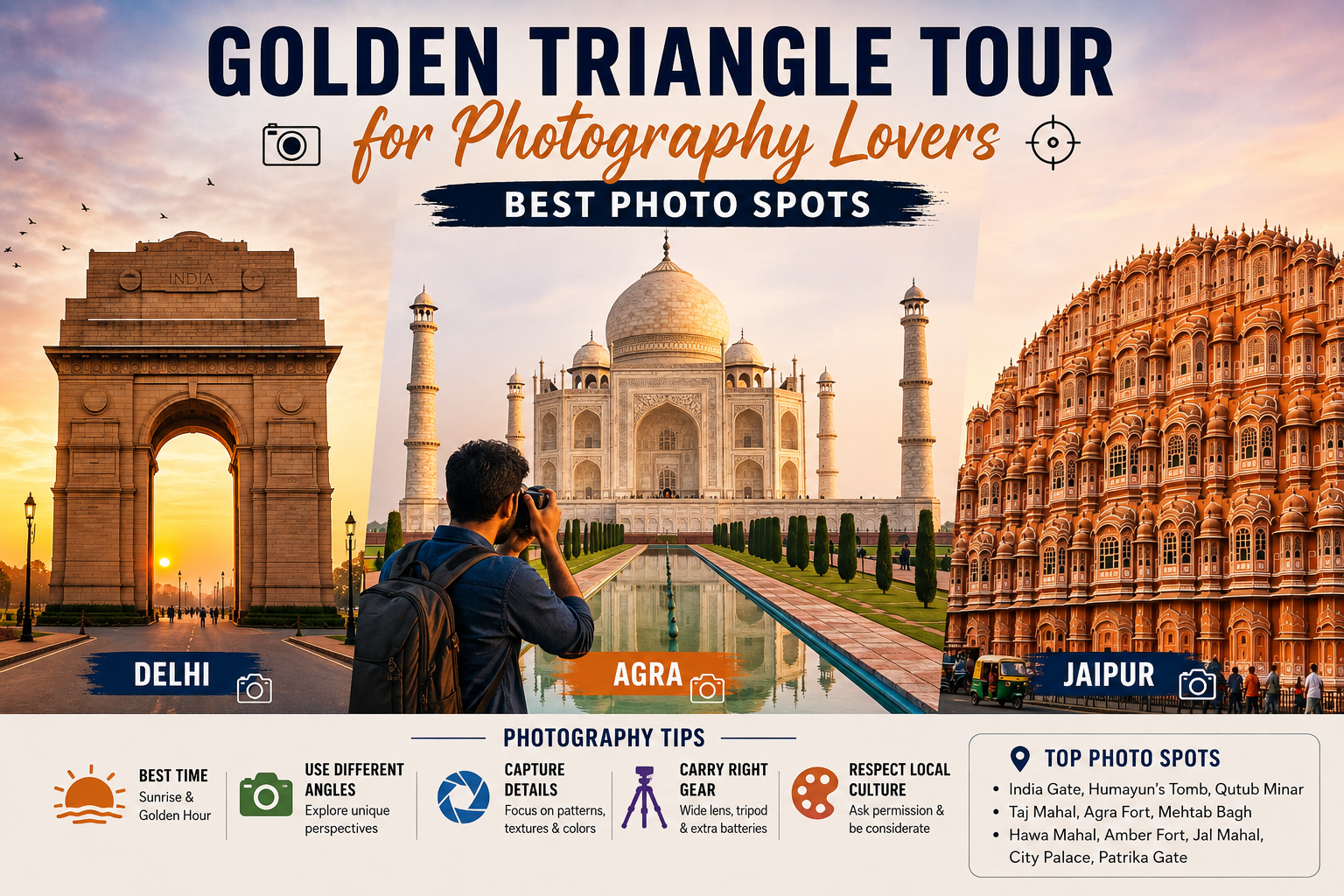
India’s Golden Triangle is a dream destination for photography lovers. Connecting Delhi, Agra, and Jaipur, this iconic travel route offers an incredible mix of historic monuments, royal architecture, colorful markets, traditional culture, street life, and beautiful landscapes.
From the grand avenues of Delhi to the timeless beauty of the Taj Mahal and the colorful streets of Jaipur, every destination provides a different photographic experience. Whether you use a professional camera, mirrorless setup, smartphone, or action camera, the Golden Triangle gives you countless opportunities to capture memorable images.
If you are planning a Golden Triangle Tour for photography lovers, choosing the right locations and visiting them at the right time can make a major difference. This guide covers the best photo spots in Delhi, Agra, and Jaipur, along with photography tips to help you capture India’s heritage at its best.
Why the Golden Triangle Is Perfect for Photography
The Golden Triangle combines three very different visual environments within one journey.
Delhi offers historic architecture, modern cityscapes, colorful streets, and fascinating human-interest photography.
Agra is famous for Mughal architecture, with the Taj Mahal providing some of India’s most recognizable photographic compositions.
Jaipur brings together royal palaces, massive forts, colorful bazaars, traditional crafts, and the distinctive architecture of Rajasthan.
The variety makes the route especially attractive to photographers who want to create a diverse travel portfolio without covering a huge geographical area.
Best Photography Spots in Delhi
Delhi should be the first stop on your Golden Triangle photography journey. The city combines centuries-old monuments with modern streets and vibrant neighborhoods.
1. India Gate
India Gate is one of Delhi’s most recognizable landmarks and a popular location for architectural and city photography.
For a dramatic image, visit around sunrise when the surroundings are relatively peaceful. Evening is another excellent time because the monument is illuminated and the surrounding area becomes lively.
Photography tip: Use the surrounding pathways and trees to create leading lines toward the monument.
2. Humayun’s Tomb
Humayun’s Tomb is one of Delhi’s most impressive examples of Mughal architecture. Its symmetrical design, large dome, arches, gardens, and red sandstone provide plenty of opportunities for architectural photography.
The garden pathways can help create balanced compositions, while the central structure works beautifully for symmetrical photographs.
Best time: Early morning or late afternoon.
Best shots: Symmetry, architectural details, wide-angle compositions, and garden perspectives.
3. Qutub Minar
The towering Qutub Minar is another must-visit location for photography lovers.
Instead of photographing only the entire tower, explore the surrounding complex for interesting architectural details. Arches, stone carvings, columns, shadows, and textures can create unique images.
Try changing your perspective rather than taking the same standard photograph seen everywhere.
Photography tip: Look upward and use the surrounding structures to frame the minaret.
4. Jama Masjid and Old Delhi
Old Delhi is perfect for photographers interested in street photography and cultural scenes.
The area around Jama Masjid provides opportunities to photograph historic architecture, busy streets, food vendors, shops, rickshaws, and everyday city life.
Remember that street photography should be respectful. Avoid intrusive photographs, especially when photographing people closely.
Best for: Street photography, food photography, architecture, and cultural storytelling.
5. Lodhi Garden
For travelers looking for a quieter photography location, Lodhi Garden offers historic tombs surrounded by greenery.
Early morning light can create beautiful shadows and soft highlights across the gardens and monuments.
It is particularly suitable for photographers who enjoy combining architecture with nature.
Best Photography Spots in Agra
Agra is the heart of the Golden Triangle for many photography enthusiasts. The city is home to the Taj Mahal, but there are several other locations worth adding to your photography itinerary.
6. Taj Mahal
No Golden Triangle photography tour would be complete without photographing the Taj Mahal.
The monument looks different throughout the day as sunlight changes the appearance of its white marble.
Sunrise is one of the most popular times for photography because the softer light can create a calm atmosphere around the monument.
The classic frontal composition is beautiful, but photographers should explore different perspectives.
Try photographing:
- The Taj Mahal through architectural arches
- Reflections in the water channels
- Close-up marble details
- Side perspectives
- Garden pathways
- The monument from across the Yamuna River
Photography tip: Arrive early so you have enough time to find a good composition before crowds become heavier.
7. Mehtab Bagh
Located across the Yamuna River from the Taj Mahal, Mehtab Bagh offers a completely different perspective.
The location is especially interesting around sunset when changing light can create warm tones around the Taj Mahal.
Instead of the traditional close-up view, you can capture the monument within a wider landscape.
Best for: Sunset photography, landscape compositions, silhouettes, and long-distance views.
8. Agra Fort
Agra Fort provides countless photography opportunities because of its massive walls, courtyards, gateways, domes, arches, and intricate details.
Look for compositions that combine architectural layers. Doorways and arches can be used as natural frames.
Photography tip: Do not focus only on famous viewpoints. Explore smaller architectural details that can give your photographs a more original appearance.
9. Itmad-ud-Daulah’s Tomb
Often called the “Baby Taj,” Itmad-ud-Daulah’s Tomb is a beautiful location for detailed architectural photography.
The monument features delicate marble work, decorative patterns, geometric designs, and attractive garden surroundings.
It is an excellent place to practice close-up photography and symmetrical compositions.
Best Photography Spots in Jaipur
Jaipur is arguably one of the most colorful stops on the Golden Triangle route.
The city’s pink architecture, royal palaces, historic forts, colorful markets, and traditional crafts make it ideal for travel and street photographers.
10. Hawa Mahal
Hawa Mahal is one of Jaipur’s most famous landmarks and an essential stop for photographers.
Its honeycomb-like facade contains numerous windows and decorative details, creating a distinctive visual pattern.
The best-known view is from the street opposite the monument. However, photographers should also explore nearby viewpoints and cafes that offer elevated perspectives.
Best time: Morning.
Photography tip: Use a longer focal length from across the street to capture the facade without excessive distortion.
11. Amber Fort
Amber Fort is one of Jaipur’s most rewarding photography locations.
The combination of sandstone walls, courtyards, gateways, gardens, decorative interiors, and surrounding hills provides many different compositions.
Look for:
- Symmetrical corridors
- Palace doors
- Courtyard perspectives
- Decorative walls
- Hilltop landscapes
- Architectural patterns
Early morning or late afternoon generally provides more attractive light than harsh midday conditions.
12. City Palace
Jaipur’s City Palace combines traditional Rajasthani and Mughal-inspired architectural elements.
The colorful doors and decorative courtyards are particularly popular with photographers.
Peacock-inspired designs, painted surfaces, ornate entrances, and geometric patterns provide excellent opportunities for detail photography.
Photography tip: Use architectural elements as frames around people or other subjects to add depth to your images.
13. Jal Mahal
Jal Mahal, or the Water Palace, creates a striking composition because the palace appears to float in the middle of Man Sagar Lake.
The location works especially well during sunrise and sunset.
On calm days, reflections on the water can add symmetry to the composition.
Best for: Landscape photography, reflections, silhouettes, and wide-angle images.
14. Patrika Gate
Patrika Gate is a favorite among photographers because of its colorful painted interiors and elaborate architectural patterns.
The repeating arches and vibrant artwork make it particularly suitable for symmetry and detail photography.
Try standing in the center and composing the image along the central axis.
Photography tip: Symmetry is the key here. Keep your camera level and carefully align the central perspective.
Best Time to Photograph the Golden Triangle
Light is one of the most important elements in travel photography.
Sunrise
Sunrise provides soft light, cooler tones, fewer crowds, and peaceful surroundings.
It is particularly useful for photographing the Taj Mahal, India Gate, Hawa Mahal, and Jal Mahal.
Golden Hour
The period shortly after sunrise and before sunset is often called the golden hour. Warm, softer light can give buildings and landscapes an attractive appearance.
Midday
Bright midday sunlight can create strong shadows and high contrast. Instead of avoiding photography completely, use this time for indoor architecture, details, markets, museums, or shaded areas.
Sunset
Sunset can provide warm colors and dramatic skies. Locations such as Mehtab Bagh and Jal Mahal can be particularly interesting during this period.
Golden Triangle Photography Tips
Carry the Right Equipment
You do not need expensive equipment to capture great travel photographs.
A basic setup can include:
- Mirrorless or DSLR camera
- Wide-angle lens
- Standard zoom lens
- Telephoto lens if available
- Extra batteries
- Memory cards
- Small tripod where permitted
- Lens cleaning cloth
- Power bank for your smartphone
Smartphone cameras can also produce excellent travel photographs, especially when you focus on composition and lighting.
Photograph Architecture From Different Angles
Historic monuments are often photographed from the same popular viewpoints.
To make your images more distinctive, change your position.
Try:
- Low-angle photographs
- Side perspectives
- Reflections
- Framing through arches
- Close-up details
- Wide environmental shots
- Layered compositions
A small change in your position can completely transform a familiar landmark.
Use Leading Lines
India’s historic monuments are full of natural leading lines.
Pathways, walls, arches, staircases, corridors, and water channels can guide the viewer’s eye toward your main subject.
The Taj Mahal gardens, for example, provide strong lines that naturally direct attention toward the monument.
Capture Details, Not Just Famous Landmarks
One common mistake during a Golden Triangle photography tour is photographing only the major monuments.
Look for smaller visual stories.
Photograph:
- Door handles
- Stone carvings
- Palace windows
- Traditional textiles
- Local crafts
- Food
- Market displays
- Architectural textures
- Colorful walls
- Decorative patterns
These details can make your travel album feel more personal and authentic.
Respect Local Culture While Taking Photographs
Photography should always be approached respectfully.
Ask permission before taking close-up portraits of people, particularly in markets and residential areas.
Follow photography restrictions at monuments, museums, religious sites, and protected areas. Some locations may restrict tripods, flash photography, or photography in specific sections.
Being respectful not only helps protect cultural heritage but also creates better interactions with local communities.
Golden Triangle Photography Itinerary
If photography is your main priority, consider spending around 7 days on the route.
Day 1 – Delhi
India Gate, Humayun’s Tomb, and Old Delhi.
Day 2 – Delhi
Qutub Minar, Lodhi Garden, and additional street photography.
Day 3 – Delhi to Agra
Travel to Agra and explore Agra Fort around the afternoon or evening.
Day 4 – Agra
Sunrise at the Taj Mahal, followed by Itmad-ud-Daulah and other local photography spots.
Day 5 – Agra to Jaipur
Visit Fatehpur Sikri along the way and continue to Jaipur.
Day 6 – Jaipur
Amber Fort, City Palace, Hawa Mahal, and local streets.
Day 7 – Jaipur
Jal Mahal, Patrika Gate, markets, and final photography sessions.
This itinerary allows photographers enough time to revisit important locations during better lighting conditions.
Best Photography Themes on a Golden Triangle Tour
The Golden Triangle is not just about monuments. You can create an entire visual story around different themes.
Architecture Photography
Capture the domes, arches, facades, courtyards, and intricate details of India’s historic monuments.
Street Photography
Delhi and Jaipur provide excellent opportunities to capture everyday life, markets, transportation, food, and local activity.
Portrait Photography
With permission, local people can become an important part of your travel story.
Food Photography
From Delhi’s street food to Rajasthan’s traditional cuisine, food provides colorful and culturally rich subjects.
Landscape Photography
The gardens around the Taj Mahal, Yamuna River views, Jaipur’s hills, and Jal Mahal offer opportunities for landscape compositions.
Final Thoughts
A Golden Triangle Tour for photography lovers offers much more than a collection of famous monuments. It is an opportunity to document India’s architecture, colors, traditions, people, food, and everyday life through your own creative perspective.
Delhi provides energetic urban and street photography, Agra offers timeless Mughal architecture, and Jaipur adds vibrant colors and royal heritage. By visiting popular attractions during favorable lighting conditions and looking beyond the standard viewpoints, you can create photographs that feel distinctive and meaningful.
Remember that great travel photography is not only about having an expensive camera. Good light, thoughtful composition, patience, and respect for the people and places you photograph are what turn an ordinary travel snapshot into a memorable image.
So pack your camera, keep your itinerary flexible, and get ready to capture the unforgettable visual journey of Delhi, Agra, and Jaipur on a Golden Triangle Tour.