
·
Last Updated: September 22, 2026
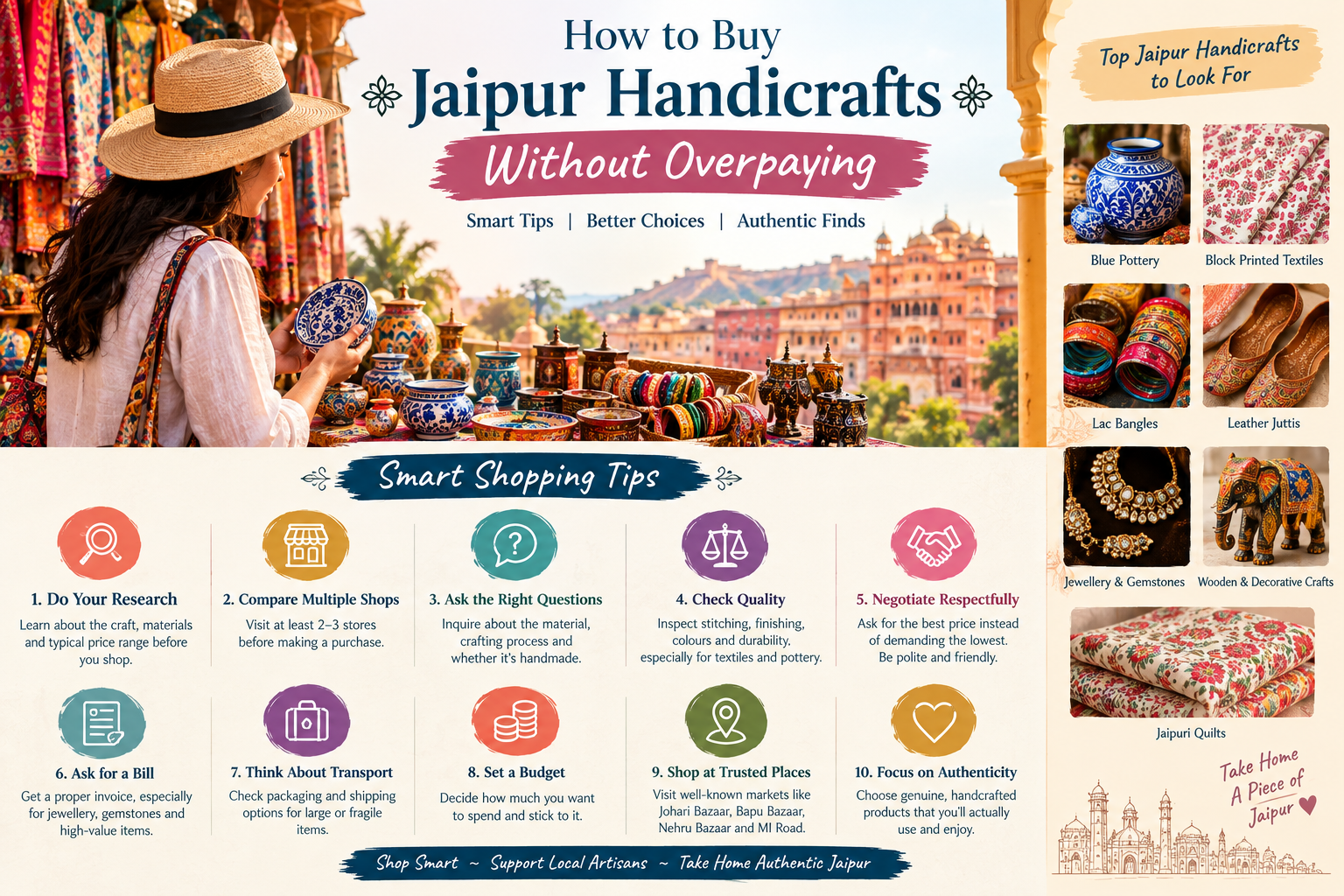
Jaipur is one of India’s most fascinating destinations for traditional handicrafts, textiles, jewellery, pottery and decorative products. Known as the Pink City, Jaipur combines royal architecture with a long tradition of craftsmanship, making shopping an important part of many Rajasthan trips.
From colorful blue pottery and block-printed fabrics to lac bangles, leather juttis, traditional textiles and handmade decorative items, Jaipur’s markets offer an enormous variety of products. Rajasthan Tourism specifically highlights Sanganeri and Bagru textiles, Jaipuri quilts, blue pottery, jewellery, lac bangles and traditional crafts among the products associated with Jaipur and Rajasthan.
But there is one question many travelers have before entering Jaipur’s busy bazaars:
How can you buy Jaipur handicrafts without paying more than necessary?
The answer is not simply to bargain aggressively.
A better approach is to understand what you are buying, compare similar products, ask about materials and workmanship, visit more than one shop, and decide what quality level fits your budget.
This guide explains how to shop for Jaipur handicrafts confidently while avoiding common mistakes and unnecessary spending.
Why Jaipur Is Famous for Handicrafts
Jaipur’s connection with traditional crafts is closely linked to Rajasthan’s artistic and royal heritage.
The city and surrounding regions have developed distinctive traditions involving textiles, jewellery, pottery, wood, metal, leather and decorative arts.
Rajasthan Tourism describes Jaipur as a major shopping destination and highlights markets such as Johari Bazaar, Bapu Bazaar, Nehru Bazaar, MI Road and the areas around Badi Chaupar and Choti Chaupar.
The variety is one of Jaipur’s biggest attractions.
You can find inexpensive souvenirs alongside expensive handmade products. Two items that look similar from a distance may differ significantly in material, finishing, workmanship and production method.
That is why understanding the product is often more useful than simply trying to negotiate the lowest possible price.
What Jaipur Handicrafts Can You Buy?
Before discussing prices, it helps to know the main categories.
1. Blue Pottery
Blue pottery is one of Jaipur’s most recognizable traditional crafts.
Unlike conventional pottery, Jaipur blue pottery is traditionally made using a quartz-based mixture rather than ordinary clay. Rajasthan Tourism notes that the craft came to Rajasthan through Persian and Afghan influences and became particularly associated with Jaipur.
Common products include:
- Plates
- Bowls
- Vases
- Trays
- Coasters
- Soap dishes
- Decorative tiles
- Door knobs
- Small decorative objects
Because many pieces are hand-decorated, prices can vary according to size, design, detail and finishing.
When shopping, inspect the piece carefully for cracks, chips, uneven glazing or damaged edges.
2. Sanganeri Block Prints
Sanganer, near Jaipur, is well known for block printing.
Traditional block printing involves applying designs to fabric using carved wooden blocks. Rajasthan Tourism identifies Sanganer and Bagru among the important textile-printing traditions of Rajasthan.
You may find:
- Sarees
- Dupattas
- Shirts
- Kurtis
- Bed covers
- Table linen
- Scarves
- Cushion covers
When comparing prices, look beyond the printed design.
Check the fabric quality, print clarity, color consistency and finishing.
Two fabrics may have similar patterns but very different materials.
3. Bagru Prints
Bagru printing is another traditional textile technique associated with Rajasthan.
Bagru textiles are often recognized for their earthy colors and distinctive block-printed patterns.
If you are interested in traditional textile craftsmanship, learning the difference between Sanganeri and Bagru printing can make shopping more interesting.
Instead of asking only:
“What is the price?”
ask:
“What fabric is this, and how is it printed?”
Understanding the product gives you a better basis for comparing prices.
4. Jaipuri Quilts
Jaipuri quilts are popular souvenirs because they are lightweight and relatively easy to carry compared with heavier handicrafts.
Rajasthan Tourism lists lightweight Jaipuri quilts among Rajasthan’s notable textile products.
When buying a quilt, check:
- Fabric
- Filling
- Stitching
- Weight
- Size
- Finishing
- Pattern quality
Do not assume that a very lightweight quilt is automatically better.
Instead, compare several pieces and examine the construction.
5. Lac Bangles
Lac bangles are another traditional Rajasthan craft.
They are colorful, lightweight and widely associated with Rajasthan’s traditional jewellery culture.
You can find simple bangles as well as heavily decorated designs.
Prices may vary considerably depending on decoration, materials and workmanship.
If you are buying several sets, compare similar designs from multiple shops before deciding.
6. Leather Juttis
Traditional Rajasthani juttis are popular footwear souvenirs.
They come in many designs, colors and levels of decoration.
When buying juttis, pay attention to comfort rather than appearance alone.
Try both shoes on and walk around for a moment.
Check:
- Stitching
- Sole construction
- Interior comfort
- Decorative finishing
- Size
- Leather or material quality
A beautiful pair that is uncomfortable may not be a good purchase.
7. Jewellery and Gemstones
Jewellery is one of Jaipur’s most famous shopping categories.
Rajasthan Tourism highlights Jaipur’s association with Kundan and Meenakari jewellery and the state’s wider gemstone-cutting and jewellery industry.
This category requires much more care than ordinary souvenirs.
If you are considering expensive gemstones or jewellery, do not make a purchase simply because a salesperson says the stone is rare or valuable.
Ask for documentation, invoices and relevant certifications where applicable.
For expensive purchases, consider getting an independent professional opinion before making a final decision.
The goal is not to negotiate the lowest possible price. The goal is to understand exactly what you are purchasing.
How to Avoid Overpaying for Jaipur Handicrafts
Now comes the most important part.
1. Research the Product Before Shopping
Spend a few minutes researching the craft you want to buy.
For example, if you want blue pottery, understand its basic characteristics before entering the market.
If you want block-printed textiles, learn the difference between common printing traditions.
If you want jewellery, understand the difference between costume jewellery, silver, gold and gemstone products.
Rajasthan Tourism provides useful background information about many traditional crafts, including blue pottery, textiles, metalwork, carpets and jewellery.
A little knowledge makes it easier to compare products.
2. Don’t Buy From the First Shop
This is one of the simplest ways to avoid unnecessary spending.
If you see something you like, note its price and continue looking.
Visit two or three shops selling similar products.
You may discover that:
- The same type of product has different prices.
- One shop offers better finishing.
- Another has more variety.
- A slightly more expensive product may have noticeably better quality.
Comparison shopping is especially useful in popular tourist markets.
3. Understand That Bargaining Is Part of Some Markets
Bargaining is common in many traditional Indian markets, but it should be done respectfully.
Do not assume that every product has a huge hidden markup.
A handmade product requires time, materials and skill.
Instead of immediately offering an extremely low price, ask:
“Is this your best price?”
If you are buying multiple items, you can ask whether the shop can offer a combined price.
For example:
“If I buy three pieces, can you offer a better price?”
This approach is usually more constructive than aggressively criticizing the seller’s original price.
4. Compare Like With Like
This is extremely important.
A ₹500 textile and a ₹1,500 textile may look similar when hanging next to each other.
But they may have differences in:
- Fabric
- Thickness
- Printing method
- Finishing
- Size
- Workmanship
- Durability
Therefore, comparing only the final price can be misleading.
Compare similar products with similar specifications.
This gives you a much better idea of whether a price is reasonable.
5. Ask About the Material
One of the easiest ways to make a better purchase is to ask simple questions.
For textiles:
“What fabric is this?”
For jewellery:
“What metal or stone is this?”
For pottery:
“How is this made?”
For leather goods:
“What material is used?”
For handmade products:
“Is this handmade or machine-produced?”
You don’t need to be an expert.
Simply asking these questions encourages you to focus on the actual product rather than the sales pitch.
6. Inspect the Product Carefully
Never rush into a purchase simply because you are excited about the design.
Take a moment to inspect it.
For pottery
Look for:
- Cracks
- Chips
- Uneven surfaces
- Damaged edges
- Poor glazing
For textiles
Check:
- Loose threads
- Stains
- Uneven printing
- Fabric quality
- Stitching
For jewellery
Check:
- Clasps
- Stone settings
- Surface finishing
- Hallmarks where relevant
- Documentation for valuable purchases
For wooden products
Check:
- Cracks
- Splits
- Loose joints
- Finishing
- Surface quality
Careful inspection can prevent disappointment later.
7. Don’t Let a Sales Story Decide Your Purchase
Tourist markets can be energetic and persuasive.
A seller may describe an item as:
- Royal
- Rare
- Antique
- Handmade
- Exclusive
- Special
- Museum quality
These descriptions should not automatically determine the value of an item.
Ask practical questions instead.
What is it made from?
How was it produced?
What is its size?
Is it handmade?
Does it come with documentation?
What is the return or exchange policy?
The product should ultimately be judged on its actual characteristics.
8. Be Particularly Careful With “Antique” Products
If someone tells you that an object is hundreds of years old, do not assume that it is genuinely antique.
Authenticating antiques can require specialist knowledge.
If you are purchasing something expensive because you believe it is an antique, ask for appropriate documentation and consider professional authentication.
For an ordinary souvenir, there is little reason to pay a large premium simply because a seller describes it as “old.”
9. Be Careful With Gemstones
Gemstones require special attention.
Jaipur has a major jewellery and gemstone industry, and Rajasthan Tourism highlights the city’s importance in jewellery and gem-related craftsmanship.
However, tourists should distinguish between buying a decorative souvenir and making a significant gemstone investment.
If the price is substantial:
- Ask exactly what stone you are buying.
- Ask whether it is natural, treated or synthetic.
- Request appropriate certification.
- Get a detailed invoice.
- Compare with another reputable seller.
- Consider independent verification.
Never purchase an expensive gemstone purely because someone promises that it will increase dramatically in value.
10. Visit Established Shopping Areas
Jaipur has several well-known shopping areas.
Rajasthan Tourism identifies places such as Johari Bazaar, Bapu Bazaar, Nehru Bazaar, MI Road, Badi Chaupar and Choti Chaupar as shopping areas for handicrafts and traditional products.
Each area can offer a different shopping atmosphere.
Johari Bazaar
Known particularly for jewellery and gemstones.
Bapu Bazaar
Popular for textiles, souvenirs, traditional products and colorful shopping.
Nehru Bazaar
Known for a range of traditional goods and colorful local products.
MI Road
Offers a mixture of established shops, showrooms and traditional products.
Badi Chaupar and Choti Chaupar
Located within the historic Pink City area and surrounded by traditional markets.
You do not need to visit every market.
Choose the area that matches the product you want.
11. Consider Government-Run or Established Showrooms
If your priority is a more structured shopping experience rather than bargaining, consider established showrooms.
Rajasthan Tourism lists Rajasthali, the Rajasthan Government showroom on MI Road, among Jaipur’s shopping destinations.
A showroom environment may not always offer the same bargaining experience as a traditional bazaar, but it can be useful for travelers who prefer clearer product information and a more organized buying process.
Compare the experience with traditional markets and choose according to your priorities.
12. Visit a Craft Museum Before Buying
If you are particularly interested in textiles, visiting a craft-focused museum can help you understand the difference between traditional and modern production.
The Anokhi Museum of Hand Printing near Amber showcases block-printed textiles along with images, tools and related objects that explain the printing tradition. Rajasthan Tourism specifically highlights the museum as a place to understand the complexity of the craft.
Learning about a craft before shopping can make you a more informed buyer.
You begin to recognize patterns, techniques and workmanship instead of choosing only based on color.
13. Shop in Sanganer for Textile Interests
Sanganer is located close to Jaipur and is strongly associated with textile block printing.
Rajasthan Tourism identifies Sanganer as a place known for handmade paper, textile block printing and blue pottery.
If textiles are your main shopping goal, exploring the craft tradition closer to its production area can be an interesting experience.
You may also gain a better understanding of how printed fabrics are produced.
14. Don’t Shop When You’re in a Hurry
One of the easiest ways to overpay is to shop immediately before leaving Jaipur.
When you have only 30 minutes before your train or flight, you have little time to compare prices.
You are more likely to accept the first offer simply because you need to finish quickly.
Instead, plan your shopping earlier in the itinerary.
This gives you time to:
- Compare products
- Return to a shop
- Negotiate calmly
- Check quality
- Pack your purchases properly
15. Set a Shopping Budget
Before entering the market, decide how much you want to spend.
For example:
Souvenirs: ₹1,000–₹2,000
Textiles: ₹2,000–₹5,000
Decorative handicrafts: ₹2,000–₹5,000
Premium jewellery: A separate budget based on the specific product
These are not fixed market prices. They are simply examples of how you might divide your personal shopping budget.
Actual prices can vary significantly depending on materials, craftsmanship, size and seller.
A budget also helps prevent impulse purchases.
16. Don’t Confuse Cheap With Good Value
A common mistake is assuming that the cheapest product is automatically the best deal.
Suppose one handmade textile costs ₹1,000 and another costs ₹1,500.
If the second product uses better fabric, has more detailed printing and better finishing, the additional ₹500 may represent a meaningful difference in quality.
Good value means getting a product that matches its price and your expectations.
The goal is not always to spend the least.
The goal is to buy intelligently.
17. Ask for a Proper Bill
For inexpensive souvenirs, a simple receipt may be sufficient.
For expensive purchases, particularly jewellery, gemstones or high-value handicrafts, ask for a detailed invoice.
The invoice should clearly identify what you purchased and the amount paid.
Keep documentation until you return home.
This is especially important if you need to resolve a problem with the purchase later.
18. Think About Transport Before Buying Large Items
A beautiful large handicraft may look perfect in the market.
But how will you take it home?
Before buying large pottery, furniture, paintings or decorative objects, ask about:
- Packaging
- Shipping
- Delivery time
- Shipping charges
- Insurance
- Damage protection
For travelers flying home, packaging is particularly important.
A smaller, well-packed handicraft may be more practical than a large fragile object.
19. Choose Authenticity Over Tourist Hype
One of the best ways to shop thoughtfully is to focus on craftsmanship.
A product does not need to be expensive to be meaningful.
A small block-printed textile, blue pottery piece, lac bangle or handmade decorative item can carry a strong connection to Rajasthan’s craft traditions.
Rajasthan Tourism emphasizes the diversity of the state’s crafts, including textiles, pottery, jewellery, metalwork, stonework and other handmade products.
Instead of asking:
“What is the most expensive thing I can buy?”
ask:
“Which craft represents Jaipur that I will actually enjoy using or displaying?”
That question can lead to much better souvenirs.
Common Jaipur Handicraft Shopping Mistakes
Mistake 1: Buying immediately
You see something beautiful and purchase it without checking other shops.
Better approach: Compare first.
Mistake 2: Bargaining without understanding quality
You focus entirely on getting the lowest price.
Better approach: Compare quality and price together.
Mistake 3: Buying expensive jewellery without documentation
A verbal guarantee is not enough for a high-value purchase.
Better approach: Request appropriate documentation and consider independent verification.
Mistake 4: Believing every “handmade” claim
Not every product marketed to tourists is necessarily produced entirely by hand.
Better approach: Ask how the product is made.
Mistake 5: Buying too much
Jaipur markets can be overwhelming because there are so many colorful products.
Better approach: Make a shopping list before you start.
A Simple Jaipur Handicraft Shopping Strategy
Here is an easy method you can follow.
Step 1: Choose your product
Decide whether you want:
- Textiles
- Pottery
- Jewellery
- Home décor
- Leather goods
- Souvenirs
Step 2: Research
Learn the basic characteristics of the product.
Step 3: Visit two or three sellers
Do not decide immediately.
Step 4: Compare quality
Look at materials, finishing and workmanship.
Step 5: Ask questions
Find out how the product was made and what materials were used.
Step 6: Negotiate respectfully
Ask for the best price rather than demanding an unrealistic discount.
Step 7: Inspect before paying
Check the product carefully.
Step 8: Get a receipt
Especially for expensive purchases.
Step 9: Pack carefully
Protect fragile or delicate products.
Step 10: Keep your purchase documentation
Store invoices and certificates safely until you return home.
Best Jaipur Handicrafts to Buy as Souvenirs
If you have limited luggage space, choose small items.
Good options include:
Blue pottery coasters
Small, decorative and easy to pack.
Block-printed scarves
Lightweight and practical.
Lac bangles
Colorful and easy to carry.
Small textiles
Dupattas, scarves and cushion covers can make useful souvenirs.
Small decorative handicrafts
Look for compact handmade objects representing Rajasthan’s artistic traditions.
Traditional juttis
A practical souvenir if you find a comfortable pair.
Small pottery pieces
Choose well-packed items that can survive your journey home.
Jaipur Handicrafts Shopping Tips for Foreign Tourists
International travelers should take a little extra care when purchasing valuable goods.
Always keep receipts for expensive purchases.
If buying jewellery or gemstones, ask for appropriate documentation.
Check airline baggage restrictions before buying large or fragile products.
For valuable purchases, consider shipping through a reputable service rather than carrying fragile objects in checked luggage.
Most importantly, do not allow a seller to pressure you into making a purchase immediately.
It is completely reasonable to say:
“I will think about it and come back.”
If the product is genuinely right for you, you can return after comparing alternatives.
A Better Way to Think About Bargaining
Bargaining should not become a competition between the buyer and seller.
Remember that handmade products require time, materials, skill and labor.
A reasonable negotiation can benefit both sides.
Start by asking the seller for their best price.
If you are purchasing several products, ask whether they can offer a package price.
If the price still does not fit your budget, simply thank the seller and continue shopping.
You do not have to buy everything you like.
That mindset is one of the easiest ways to avoid overspending.
Final Thoughts
Buying Jaipur handicrafts can be one of the most enjoyable parts of a Rajasthan trip.
The city offers an extraordinary range of traditional products, from blue pottery and block-printed textiles to lac bangles, leather juttis, jewellery and decorative crafts. Rajasthan Tourism specifically recognizes Jaipur’s markets and craft traditions as an important part of the city’s visitor experience.
The key to avoiding overpayment is not simply bargaining harder.
Instead, become an informed shopper.
Research the product.
Compare several sellers.
Understand the material.
Inspect the workmanship.
Ask questions.
Negotiate respectfully.
Request documentation for expensive purchases.
And most importantly, take your time.
Markets such as Johari Bazaar, Bapu Bazaar, Nehru Bazaar and the traditional shopping areas around the Pink City can be exciting and colorful, but you do not need to buy something from the first shop you enter.
If you are looking for textiles, exploring Sanganer can also give you a closer connection to Jaipur’s printing traditions, while the Anokhi Museum of Hand Printing can help you understand the craft behind traditional block-printed textiles.
Ultimately, the best souvenir is not necessarily the cheapest one.
It is the product whose quality, craftsmanship, price and usefulness make sense to you.
With a little research and patience, you can enjoy Jaipur’s colorful shopping culture, support traditional craftsmanship and return home with beautiful souvenirs without feeling that you paid more than you should have.