
·
Last Updated: September 22, 2026
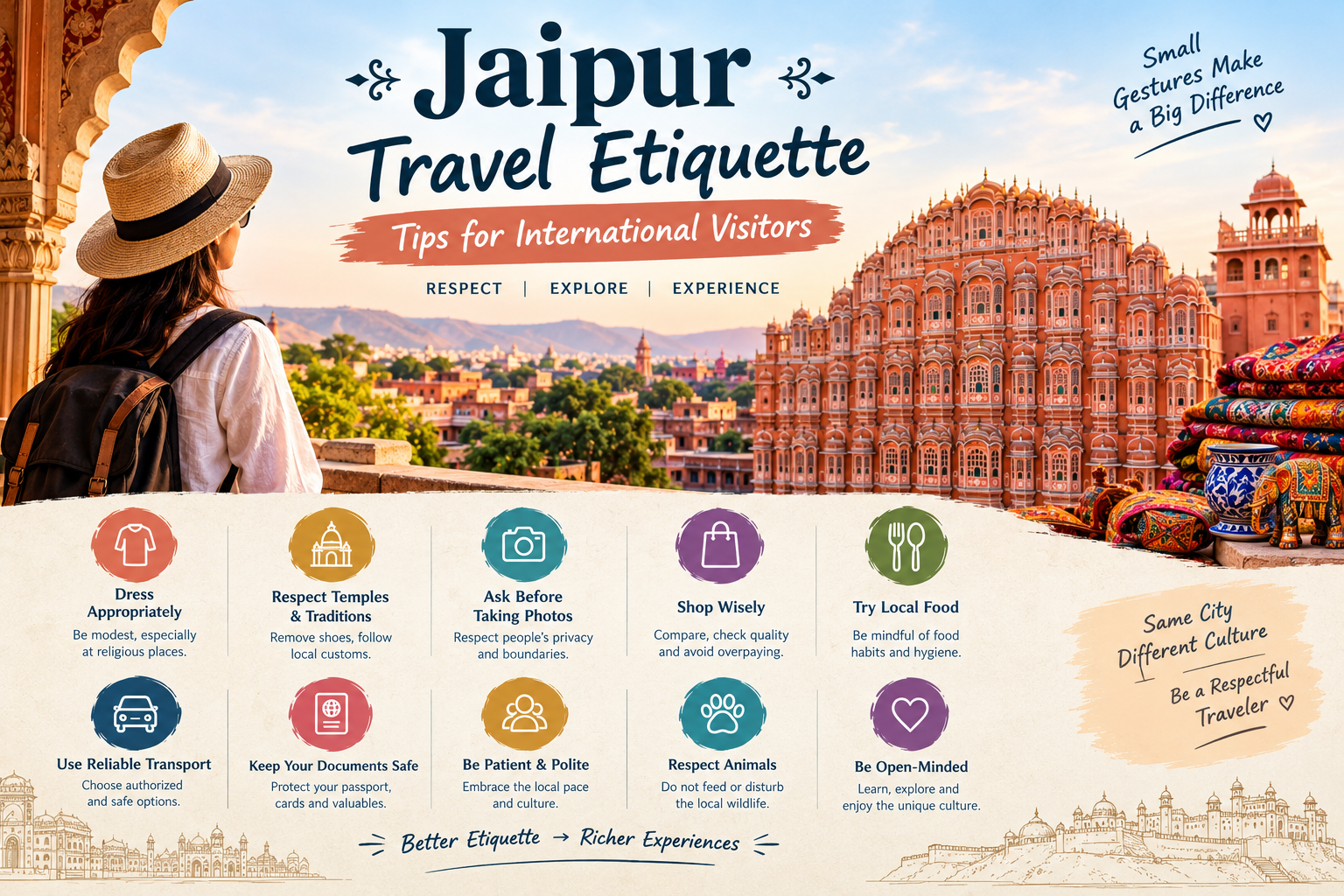
Jaipur is one of India’s most fascinating destinations for international travelers. Known as the Pink City, Jaipur combines grand palaces, historic forts, colorful bazaars, traditional crafts, temples, delicious food, and a lively local culture. From the magnificent Amber Fort and City Palace to the detailed architecture of Hawa Mahal and the astronomical instruments of Jantar Mantar, the city offers an experience that goes far beyond sightseeing.
For first-time international visitors, however, understanding local customs can make a big difference. Jaipur travel etiquette is not about following complicated rules. It is mainly about showing respect for local traditions, religious places, people, food, photography, personal space, and everyday customs.
India is culturally diverse, and customs can vary between families, communities, religious sites, and regions. You do not need to know every tradition before arriving. A respectful attitude, patience, and willingness to observe local behavior will take you a long way.
This guide explains the most useful Jaipur travel etiquette tips for international visitors so you can explore the city comfortably while respecting its culture and people.
Why Jaipur Travel Etiquette Matters
Jaipur is a modern city, but its historic neighborhoods and traditional communities remain closely connected to cultural and religious practices.
Visitors may encounter temples, shrines, markets, family-owned businesses, heritage buildings, religious ceremonies, and local celebrations during an ordinary day of sightseeing. What may seem normal from a visitor’s home country may have a different meaning in Jaipur.
For example, entering a temple with shoes may be considered inappropriate, while modest clothing is generally more suitable at religious sites. Photography may also be restricted in certain places.
The best approach is simple: observe first, ask when unsure, and respect the answer.
Rajasthan Tourism specifically advises international tourists to dress according to local cultural sensibilities and recommends using authorized transportation, reputable shops, and proper receipts when shopping.
1. Dress Respectfully in Jaipur
One of the easiest ways to follow good Jaipur travel etiquette is to dress appropriately, especially when visiting religious or traditional places.
Jaipur is accustomed to international tourists, so visitors do not need to wear traditional Indian clothing. Comfortable Western clothing is perfectly normal in hotels, restaurants, shopping areas, and many tourist attractions.
However, when visiting temples, mosques, religious sites, or traditional neighborhoods, modest clothing is a better choice.
Good clothing choices include:
- Lightweight trousers
- Long skirts or dresses
- Shirts and tops that cover the shoulders
- Comfortable cotton clothing
- Scarves or shawls when needed
- Comfortable footwear for walking
During the hot months, breathable fabrics such as cotton and linen can be particularly comfortable.
For women, carrying a lightweight scarf can be useful because it can provide additional coverage when entering certain religious places.
The goal is not to completely change your personal style. It is simply to recognize that different places have different expectations.
2. Remove Your Shoes When Required
Removing footwear before entering a place of worship is an important part of Indian religious etiquette.
In many temples and other religious spaces, visitors are expected to leave their shoes outside. Incredible India also advises travelers that removing footwear is customary at certain places of worship and recommends appropriate dress.
Look for signs or observe what other visitors are doing.
If everyone is removing their shoes, follow the practice.
Helpful tip
Wear footwear that is easy to remove and put back on if you are planning to visit several temples during your Jaipur sightseeing tour.
Some religious sites may have designated areas for footwear. Follow the instructions provided by staff or temple authorities rather than leaving shoes randomly outside.
3. Be Respectful Inside Temples
Temples are places of worship rather than simply tourist attractions.
You are welcome to appreciate the architecture, artwork, traditions, and atmosphere, but remember that local people may be visiting for religious reasons.
Avoid:
- Talking loudly
- Laughing excessively
- Touching religious objects without permission
- Blocking worshippers
- Ignoring signs
- Entering restricted areas
- Using flash photography where it is prohibited
If you are unsure about what you can or cannot do, quietly ask a staff member or guide.
A respectful visitor does not need to understand every religious practice. Showing consideration is what matters most.
4. Ask Before Photographing People
Jaipur is extremely photogenic. Colorful markets, traditional clothing, historic architecture, street scenes, and local artisans can make wonderful travel photographs.
However, photographing people is different from photographing buildings.
Always consider asking before taking a close-up portrait of someone.
A simple:
“May I take a photo?”
is usually enough.
You can also use a friendly gesture to indicate your intention.
If someone says no, smile and respect their decision.
This is especially important when photographing children, religious ceremonies, private activities, workers, or people in sensitive situations.
5. Follow Photography Rules at Monuments
Many Jaipur attractions are historic or protected sites. Photography policies can vary from one attraction to another.
Some areas may allow photography but restrict flash photography. Certain rooms or objects may have separate rules.
Popular Jaipur attractions include:
- Amber Fort
- Hawa Mahal
- City Palace
- Jantar Mantar
- Albert Hall Museum
- Gaitore
- Jal Mahal viewpoints
- Religious temples
Rajasthan Tourism identifies Jaipur’s major heritage attractions, including Hawa Mahal, Jantar Mantar, Gaitore, and several temples and historic locations.
Before taking photographs, look for signs and follow instructions from staff.
Do not climb barriers or touch historic structures simply to get a better photograph.
6. Learn a Few Simple Hindi Words
You can travel through Jaipur without speaking Hindi, especially in tourist areas. English is widely used in Indian tourism and is commonly understood in hotels and many visitor-oriented businesses.
Still, learning a few Hindi words can make everyday interactions more pleasant.
Useful words and phrases
Namaste – Hello / respectful greeting
Dhanyavaad – Thank you
Kripya – Please
Haan – Yes
Nahi – No
Kitna hai? – How much is it?
Theek hai – Okay
Maaf kijiye – Excuse me / sorry
You do not need perfect pronunciation. Even a small effort can create a friendly interaction.
7. Understand Greeting Customs
“Namaste” is a familiar and respectful Indian greeting.
You may see people greeting one another with their hands together near the chest. Visitors can use the same gesture if they feel comfortable.
A handshake is also common in professional and tourist environments, but it is better to follow the other person’s lead.
Avoid assuming that everyone wants physical contact.
Being aware of personal and cultural boundaries is an important part of good Jaipur travel etiquette.
8. Be Patient in Busy Markets
Jaipur’s markets can be colorful, crowded, noisy, and energetic.
Popular shopping areas may include:
- Johari Bazaar
- Bapu Bazaar
- Nehru Bazaar
- MI Road
- Markets around the old city
Rajasthan Tourism lists several of these areas among Jaipur’s shopping destinations.
During busy periods, streets can feel very different from the quieter shopping environments that some international travelers may be accustomed to.
Try not to become frustrated by crowds.
Keep your belongings close, allow people to pass, and avoid stopping in the middle of narrow walkways.
If a shop is crowded, wait patiently rather than pushing forward.
9. Understand Bargaining Culture
Bargaining can be part of shopping in some Jaipur markets, particularly for certain handicrafts, textiles, souvenirs, and other products.
However, bargaining should be friendly rather than aggressive.
Instead of immediately demanding a very low price, ask:
“What is your best price?”
You can compare prices at different shops before making a decision.
Remember that handmade products may involve considerable time and skill. The cheapest possible price is not necessarily the fairest price.
Rajasthan Tourism advises visitors to prefer reputable or recognized shops and government emporiums, and to insist on receiving a bill for purchases.
10. Be Careful When Buying Jewelry and Gemstones
Jaipur is internationally known for gems and jewelry, making shopping an important part of many visitors’ experiences.
However, expensive purchases require more care than buying a small souvenir.
If you are considering gemstones or valuable jewelry:
- Compare products
- Ask about materials
- Request documentation where appropriate
- Get a detailed bill
- Avoid pressure to purchase immediately
- Use reputable sellers
- Understand return or exchange conditions
- Do not make a major purchase simply because someone says it is a “special tourist deal”
Rajasthan Tourism recommends buying from recognized shops and obtaining proper bills for purchases.
If you are unfamiliar with gemstones, take your time before spending a significant amount of money.
11. Use Authorized Transportation
Transportation is an important part of Jaipur travel etiquette and general travel awareness.
Rajasthan Tourism recommends using prepaid taxi or auto-rickshaw services where available, government-approved travel agencies, RTDC transport services, and aggregator apps. It also advises negotiating the fare in advance when a prepaid service is unavailable.
Before beginning a private sightseeing trip, confirm:
- Total price
- Duration
- Places included
- Additional charges
- Waiting charges, if applicable
- Whether parking fees are included
Do not feel pressured to accept unsolicited transportation offers.
If someone approaches you with an unusually cheap or “free” ride, it is better to verify the offer before accepting it.
12. Be Careful With Unsolicited Shopping Recommendations
While exploring Jaipur, you may meet drivers, guides, or other people who recommend particular shops.
A recommendation is not automatically a problem, but you should make your own purchasing decision.
Do not feel obligated to buy something simply because someone brought you to a shop.
Rajasthan Tourism specifically advises tourists not to let drivers pressure them into additional shopping and recommends avoiding unknown persons for shopping assistance.
If you want to shop for handicrafts, research the type of product beforehand and choose stores based on your own preferences.
13. Keep Your Passport and Valuables Safe
Your passport is one of your most important travel documents.
Keep it secure and avoid handing it over casually to strangers.
Rajasthan Tourism advises foreign tourists to protect passports and valuable belongings and not give them to strangers, shopkeepers, or hotel staff.
Practical habits include:
- Use a secure hotel safe when appropriate
- Carry only the cash you need
- Keep copies of important documents
- Use a secure bag in crowded areas
- Avoid displaying large amounts of cash
- Keep your phone secure in busy markets
These are simple habits that can make your trip more comfortable.
14. Respect Local Food Customs
Jaipur is a fantastic destination for food lovers.
You may encounter dishes such as:
- Dal baati churma
- Gatte ki sabzi
- Ker sangri
- Laal maas
- Pyaaz kachori
- Mirchi bada
- Ghewar
- Lassi
Not every dish will suit every traveler, so introduce new foods gradually if you have a sensitive stomach.
If you have food allergies or dietary restrictions, clearly communicate them to restaurants and hotels. Rajasthan Tourism’s travel guidance also recommends informing hotels or restaurants about allergies and food habits before ordering.
When eating street food, choose busy and established vendors where food turnover appears high and preparation areas look clean.
15. Avoid Wasting Food
Indian hospitality can sometimes involve generous portions or offers of additional food.
If someone offers you food, you do not need to accept more than you can comfortably eat.
It is perfectly acceptable to politely say:
“No, thank you. I am full.”
At restaurants, order according to your appetite when possible.
Respecting food is a simple but meaningful part of responsible travel.
16. Respect Religious Ceremonies
You may encounter religious ceremonies while walking around Jaipur.
If you see a ceremony taking place, avoid treating it like a performance.
Do not walk through the middle of a ceremony just to reach another location.
If you want to observe, stand at an appropriate distance and follow the behavior of people around you.
Photography should be approached carefully, particularly during private or deeply religious moments.
When in doubt, ask whether photography is permitted.
17. Be Respectful With Local Animals
Cows, dogs, monkeys, and other animals can be seen in parts of Jaipur and Rajasthan.
International visitors sometimes find this surprising.
Avoid feeding animals unless you know that doing so is permitted and safe.
Do not tease, chase, touch, or attempt to photograph animals at very close range.
Monkeys in particular should be treated cautiously. Keep food and personal belongings secure and avoid trying to interact with them.
Respecting animals also helps you avoid unnecessary problems during sightseeing.
18. Be Mindful of Personal Space
Crowded Indian cities can feel different from cities where people generally maintain larger personal distances.
In markets, public transport, monuments, and busy streets, you may occasionally find yourself standing closer to other people than you are used to.
Try to remain calm and patient.
At the same time, you are always allowed to establish reasonable personal boundaries.
If someone makes you uncomfortable, move away and seek assistance from staff, security personnel, your hotel, or your travel provider.
19. Don’t Assume Every Indian Tradition Applies Everywhere
India is not culturally uniform.
Jaipur has its own Rajasthani traditions, but even within Jaipur, customs can vary between communities and individuals.
Avoid making broad assumptions such as:
“Everyone in India does this.”
Instead, think of your trip as an opportunity to observe and learn.
Ask questions respectfully.
A curious traveler is usually welcomed more warmly than someone who assumes they already understand everything.
20. Respect Historic Buildings
Jaipur’s architecture is one of its greatest attractions.
The city’s historic character can be seen in palaces, forts, gates, markets, temples, observatories, and old-city buildings. Rajasthan Tourism describes Jaipur as a historic planned city established in 1727 and highlights attractions including Hawa Mahal and Jantar Mantar.
When visiting heritage sites:
- Do not scratch or write on walls
- Do not climb restricted structures
- Do not remove stones or architectural pieces
- Do not touch delicate artwork unnecessarily
- Follow barriers and signs
- Dispose of waste properly
A photograph should never come at the cost of damaging a historic place.
21. Ask Before Touching Traditional Crafts
Jaipur is famous for handicrafts, textiles, jewelry, blue pottery, block printing, leather products, and other traditional goods.
When visiting artisan workshops or stores, ask before handling delicate products.
This is especially important for:
- Hand-painted pottery
- Fine textiles
- Jewelry
- Antique-looking objects
- Handmade decorations
- Delicate artwork
Treating merchandise carefully shows respect for the artisan and the shopkeeper.
22. Be Polite When Saying No
You may receive invitations to enter shops, offers from drivers, or suggestions from vendors during your trip.
You do not have to accept every offer.
A simple:
“No, thank you.”
is enough.
There is no need to argue or become rude.
If someone continues to insist, repeat your response and walk away.
Politeness and firmness can exist together.
23. Don’t Compare Everything With Your Home Country
One of the most important lessons for international travelers is to avoid constantly comparing local life with what they are accustomed to at home.
Traffic, noise, street activity, meal schedules, shopping experiences, and social customs may all feel different.
Instead of immediately judging something as “wrong” or “strange,” try to understand why it works differently.
Travel becomes much more rewarding when differences are approached with curiosity.
24. Respect Local Photography Subjects
Jaipur’s traditional markets and old neighborhoods offer countless opportunities for street photography.
However, remember that people are not tourist attractions.
Avoid photographing people in embarrassing, private, or sensitive situations.
If someone notices you taking their picture and appears uncomfortable, stop or offer to delete the image if appropriate.
When photographing artisans at work, asking permission is particularly respectful.
25. Follow Hotel and Restaurant Rules
International hotels in Jaipur generally have familiar hospitality standards, but individual properties can have their own rules.
Pay attention to:
- Check-in requirements
- Identification requirements
- Smoking restrictions
- Pool rules
- Dress codes
- Restaurant policies
- Noise restrictions
- Photography rules
If you are staying at a heritage property, remember that you are staying inside a historic environment. Treat furniture, artwork, architecture, and decorative objects carefully.
26. Travel Responsibly During Festivals
Jaipur hosts festivals and cultural celebrations throughout the year.
During festivals, streets and attractions may become particularly busy.
If you participate in a celebration:
- Follow local instructions
- Respect religious practices
- Avoid pushing through crowds
- Keep valuables secure
- Ask before photographing ceremonies
- Do not interfere with performers or worshippers
- Follow temporary restrictions
Festivals are wonderful opportunities to understand local culture, but they should be experienced respectfully rather than treated simply as entertainment.
27. What International Visitors Should Avoid
A quick list of things to avoid can make Jaipur travel etiquette easier to remember.
Avoid:
- Entering temples with shoes when footwear is prohibited
- Wearing very revealing clothing at religious sites
- Touching religious objects without permission
- Photographing people without considering their privacy
- Climbing protected monuments
- Bargaining aggressively
- Buying expensive jewelry under pressure
- Accepting suspicious free rides
- Giving your passport to strangers
- Signing blank bills or documents
- Allowing drivers to pressure you into shopping
- Feeding or teasing animals
- Blocking narrow market lanes
- Ignoring signs at monuments
- Assuming every local custom is the same
These simple precautions can prevent many uncomfortable situations.
A Simple Jaipur Etiquette Checklist
Before leaving your hotel, remember these ten points:
1. Dress appropriately
Carry a scarf or modest clothing for religious places.
2. Carry comfortable footwear
You may need to remove your shoes at temples.
3. Ask before photographing people
Respect privacy and personal boundaries.
4. Follow monument rules
Observe photography and access restrictions.
5. Bargain politely
Keep shopping conversations friendly.
6. Compare before buying
Especially for handicrafts, jewelry, and gemstones.
7. Keep documents secure
Protect your passport, cards, and valuables.
8. Use reliable transportation
Confirm fares and routes before starting your journey.
9. Be patient
Crowds, traffic, and busy markets are part of city life.
10. Stay curious
Observe, ask questions, and respect differences.
A Perfect Mindset for Your Jaipur Trip
The best way to approach Jaipur is with an open mind.
You do not need to memorize every Indian custom before arriving. You simply need to be respectful, observant, and willing to adapt.
If you are entering a temple, look at what others are doing.
If you are unsure whether photography is allowed, ask.
If someone does not want their photograph taken, respect the answer.
If you do not understand a local tradition, ask your guide or a knowledgeable local person.
If a shopping experience feels too aggressive, politely leave.
Small decisions like these can make a major difference to your travel experience.
Final Thoughts: Enjoy Jaipur With Respect
Jaipur is more than a collection of forts, palaces, markets, and monuments. It is a living city where history, religion, craftsmanship, food, business, and everyday life exist side by side.
For international visitors, understanding Jaipur travel etiquette makes it easier to experience this culture respectfully and confidently.
Dress appropriately when visiting religious places, remove footwear when required, ask before photographing people, follow heritage-site rules, shop carefully, use reliable transportation, protect your belongings, and remain patient in crowded areas.
Most importantly, do not worry about making a small cultural mistake. Travelers are visitors, and nobody expects you to know everything. A genuine effort to show respect is often more important than perfect knowledge.
Come to Jaipur with curiosity rather than assumptions. Take time to speak with local people, appreciate traditional crafts, explore historic neighborhoods, taste the regional cuisine, and understand the stories behind the city’s famous architecture.
When you respect the place you visit, you do more than simply see Jaipur—you experience it in a more meaningful way.