
·
Last Updated: August 18, 2026
When visitors think about Agra, they usually think of the Taj Mahal.
The white marble monument attracts people from around the world. However, the Taj Mahal was once part of a much larger landscape.
During the Mughal period, gardens played an important role in Agra.
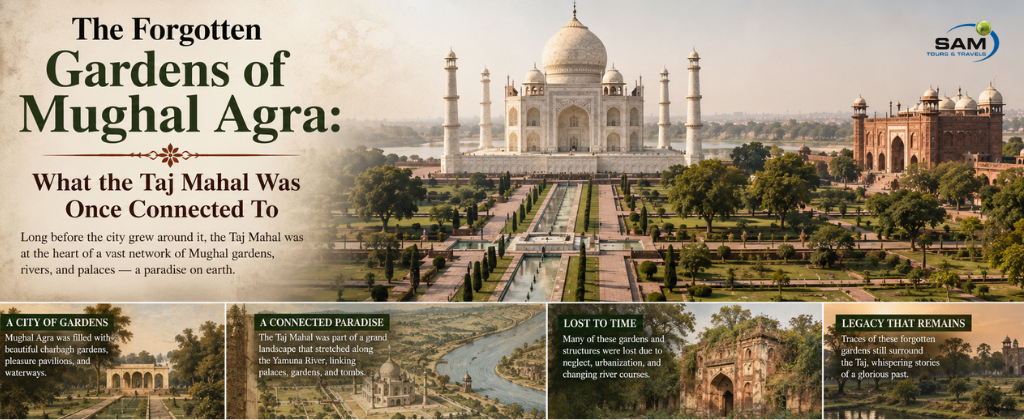
The Taj Mahal was not simply a building standing alone. It was connected to a wider world of gardens, water, rivers, palaces, roads, and royal spaces.
Many of these historic landscapes have changed over time.
Some disappeared completely.
Others survive only through historical records and archaeological remains.
Together, they reveal a different story of Mughal Agra.
Agra Was Once a City of Gardens
The Mughals had a strong love for gardens.
They designed gardens as places of beauty, relaxation, and reflection.
These gardens often included:
- Trees
- Flowers
- Water channels
- Fountains
- Pavilions
- Walking paths
The garden was more than a decorative space.
It was an important part of Mughal life.
Agra developed many gardens along the Yamuna River.
The river provided water and also created beautiful views.
As a result, the landscape around Agra became an important part of Mughal architecture.
The Taj Mahal Was Part of a Larger Landscape
Today, visitors mainly focus on the Taj Mahal itself.
However, the monument was designed as part of a carefully planned environment.
The gardens, water features, river, and surrounding structures all contributed to the overall experience.
The Taj Mahal did not exist in isolation.
Its position beside the Yamuna River was also important.
The river created a natural setting for the monument.
It also connected the Taj Mahal with other parts of Mughal Agra.
The Yamuna River Was a Major Connection
The Yamuna River played an important role in the development of Agra.
Many Mughal buildings and gardens were built near its banks.
The river provided water.
It also created a beautiful landscape for royal gardens and monuments.
The Taj Mahal’s location beside the Yamuna was therefore not accidental.
The river formed part of the larger visual and cultural setting.
From different locations along the river, visitors could experience the monument from different viewpoints.
Mehtab Bagh and the Riverfront Landscape
Mehtab Bagh is one of the best-known gardens connected with the landscape around the Taj Mahal.
The garden lies across the Yamuna River.
From this area, visitors can enjoy a different view of the monument.
The garden also shows how Mughal planners used the river and landscape together.
The Taj Mahal was not only designed to be viewed from the main entrance.
Its relationship with the river created another important visual experience.
Today, Mehtab Bagh helps visitors understand the wider landscape of the Taj Mahal.
Mughal Gardens Were Designed for Experience
A Mughal garden was not simply a collection of plants.
It was carefully planned.
The designers considered:
- Water
- Shade
- Movement
- Views
- Symmetry
- Architecture
Visitors moved through these spaces.
They experienced different views as they walked.
A garden could create a sense of peace and order.
Therefore, the landscape around a monument was just as important as the structure itself.
Water Was at the Heart of Mughal Gardens
Water played a central role in Mughal garden design.
Channels and pools created movement and reflection.
They also helped cool the surroundings.
In a hot climate, water added comfort to garden spaces.
At the u, the reflecting pool creates one of the monument’s most famous views.
The image of the white marble building reflected in the water is instantly recognisable.
This design shows the close connection between architecture and landscape.
The Gardens Created a Sense of Order
Mughal gardens often followed carefully planned layouts.
Paths and water channels created clear lines.
Trees and plants helped frame important views.
This planning created a sense of balance.
The Taj Mahal also reflects this approach.
The gardens guide the visitor towards the monument.
As a result, the journey through the garden becomes part of the experience.
The visitor does not see everything at once.
Instead, the monument slowly becomes the focus of attention.
Agra’s Royal Gardens Were Once More Extensive
During the Mughal period, Agra had many gardens and royal estates.
The city was an important imperial centre.
Royal families, nobles, and wealthy residents created gardens along the Yamuna.
These spaces formed a green landscape around the city.
Over time, many of these gardens disappeared.
Urban growth changed the landscape.
Some gardens were damaged or forgotten.
Others changed completely.
As a result, modern Agra looks very different from Mughal Agra.
Why Did Many Gardens Disappear?
Historic landscapes can disappear for many reasons.
Cities grow.
Buildings replace open spaces.
Water systems change.
Political conditions also influence the future of gardens and estates.
Over hundreds of years, these changes can transform an entire city.
Therefore, the gardens that once surrounded Mughal Agra did not all survive.
Some remain only in historical descriptions.
Others can be understood through archaeological research.
The Taj Mahal’s Landscape Has Also Changed
The Taj Mahal remains remarkably impressive.
However, its surroundings have changed over time.
The river has changed.
The city has expanded.
Modern roads and buildings now surround parts of the historic landscape.
The number of visitors has also increased greatly.
Therefore, the experience of visiting the Taj Mahal today is different from the experience of visitors centuries ago.
The monument remains.
However, the wider environment continues to change.
A Forgotten Connection Between Monuments and Nature
The story of Mughal gardens reminds us of an important idea.
Historic monuments were often designed together with nature.
Buildings, water, trees, and open spaces worked together.
The Taj Mahal is a powerful example of this connection.
Its beauty does not come only from its marble architecture.
The gardens and river also play an important role.
Without the surrounding landscape, the monument would create a different experience.
Why These Forgotten Gardens Still Matter
The lost gardens of Agra are important for several reasons.
First, they help us understand Mughal design.
Second, they reveal how people used natural landscapes.
Third, they show how cities change over time.
Most importantly, they help us see the Taj Mahal in a wider context.
The monument was not an isolated masterpiece.
It was part of a larger cultural landscape.
Exploring Agra Beyond the Taj Mahal
A visit to Agra can begin with the Taj Mahal.
However, travellers can discover much more.
The city contains many stories connected with Mughal history.
The Yamuna River, historic gardens, old neighbourhoods, and nearby monuments all add to the experience.
By exploring these connections, visitors can understand Agra more deeply.
The Taj Mahal is the most famous part of the city’s history.
However, it is only one part of a much larger story.
Final Thoughts
The Taj Mahal was once connected to a wider landscape of gardens, water, rivers, and royal spaces.
Many of these gardens have disappeared.
However, their influence can still be seen in the way the Taj Mahal was designed.
The monument’s relationship with the Yamuna River and its carefully planned gardens remains an important part of its identity.
When you visit the Taj Mahal, look beyond the white marble.
Think about the landscape that once surrounded it.
Imagine the gardens, waterways, trees, and royal spaces that shaped Mughal Agra.
The Taj Mahal is a masterpiece of architecture.
However, its full story becomes even more fascinating when we remember the forgotten gardens and landscapes that once formed part of its world.