
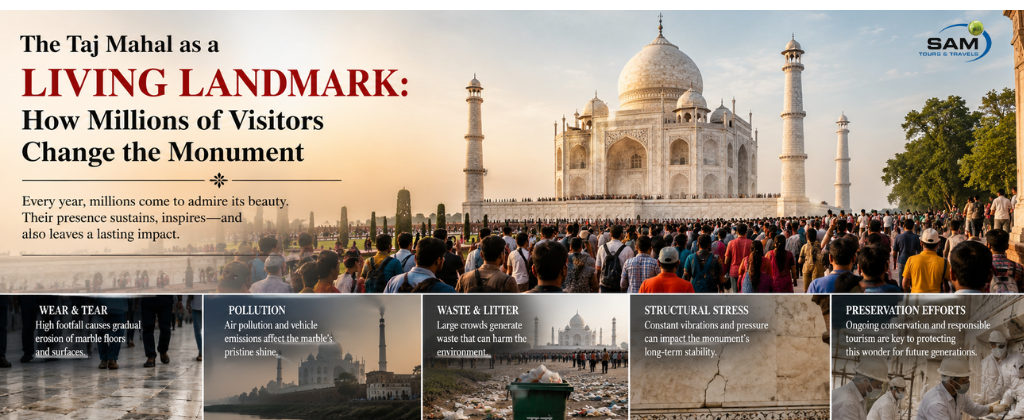
·
Last Updated: August 18, 2026
The Taj Mahal is more than a historic building.
It is also a living landmark.
Every year, millions of people visit Agra to see its famous white marble dome, beautiful gardens, and detailed architecture.
Each visitor brings a different story.
Some come with family. Others arrive with friends or partners. Many visitors come alone to experience the monument in person.
However, all these visitors have one thing in common.
They become part of the Taj Mahal’s ongoing story.
A Monument That Never Stops Meeting People
The Taj Mahal has stood for centuries.
During this time, millions of people have walked through its gardens and admired its architecture.
The monument has seen visitors from different countries, cultures, and generations.
A child who visits today may return many years later with their own family.
As a result, the Taj Mahal continues to connect with new generations.
Its history belongs to the past.
However, its visitor experience continues in the present.
Every Visitor Leaves a Small Impression
Visitors do not physically change the Taj Mahal in the same way that builders or architects did.
However, their presence affects the monument in many ways.
Large numbers of visitors create constant movement around the site.
People walk through the gardens. They use pathways. They gather at popular viewpoints.
Over time, this activity creates challenges for the management and preservation teams.
Therefore, protecting the Taj Mahal requires careful planning.
Footsteps and Constant Movement
Millions of visitors mean millions of footsteps.
People walk across the gardens and visit different parts of the complex.
The movement may seem small when viewed individually.
However, the total impact becomes significant over time.
This is why visitor pathways and designated areas are important.
They help control movement and protect sensitive parts of the monument.
By following these routes, visitors can enjoy the Taj Mahal while also helping protect it.
The Pressure of Tourism
Tourism brings many benefits to Agra.
Visitors support hotels, restaurants, guides, transport services, and local businesses.
The Taj Mahal also creates employment for many people.
However, large-scale tourism can create pressure on historic sites.
More visitors mean more:
- Foot traffic
- Waste
- Noise
- Transportation
- Demand for services
Therefore, tourism must grow responsibly.
The goal is not to stop people from visiting the Taj Mahal.
Instead, the goal is to help people visit without damaging the monument.
The Monument and Its Surroundings
The Taj Mahal does not exist separately from its surroundings.
The gardens, pathways, river, and nearby areas all contribute to the visitor experience.
As visitor numbers increase, the surrounding areas also experience more activity.
Hotels, roads, shops, and transport services support the tourism industry.
As a result, the entire city of Agra becomes connected to the monument.
The Taj Mahal influences the city.
At the same time, the city influences the way visitors experience the Taj Mahal.
Visitors Change the Experience of the Monument
Every visitor sees the Taj Mahal differently.
One person may focus on the architecture.
Another may notice the gardens.
Someone else may remember the first moment they saw the monument.
Therefore, the Taj Mahal creates a different experience for every visitor.
The monument remains the same.
However, the personal memories connected to it continue to grow.
Millions of people have already created memories at the Taj Mahal.
Millions more will do so in the future.
Photography Has Changed the Way People Experience the Taj Mahal
Today, photography plays an important role in tourism.
Visitors take photographs of the monument from different angles.
They capture family moments, travel memories, and personal experiences.
Social media has also changed the way people share these photographs.
A visitor may take a photograph at the Taj Mahal in the morning.
Within minutes, that image can reach people around the world.
As a result, one visit can inspire many others to travel to Agra.
The Search for the Perfect Photograph
Many visitors arrive with a photograph in mind.
They may want to capture the famous front view.
Others look for a unique angle.
Some prefer photographs with the gardens. Others want the monument reflected in the water.
This search for the perfect photograph affects visitor movement.
Popular viewpoints can become crowded.
Therefore, visitors should remain patient and respectful.
The Taj Mahal offers many beautiful views.
There is no need for everyone to stand in exactly the same place.
Visitors Also Help Keep the Monument Relevant
A historic monument can become distant from modern life.
However, the Taj Mahal remains part of today’s culture.
People continue to talk about it.
They photograph it.
They write about it.
They share their experiences.
As a result, the monument remains relevant to new generations.
Visitors help keep the Taj Mahal alive in the public imagination.
The Role of Responsible Visitors
Visitors have an important role in protecting the Taj Mahal.
Small actions can make a difference.
Responsible visitors should:
- Follow official instructions.
- Stay within permitted areas.
- Avoid touching the monument.
- Keep the surroundings clean.
- Respect other visitors.
- Follow photography rules.
- Avoid damaging plants or structures.
These actions may seem simple.
However, millions of people following simple rules can create a significant positive impact.
Why Preservation Matters
The Taj Mahal cannot be replaced.
Once historic material is damaged, it may be impossible to restore it exactly.
Therefore, preservation is essential.
Experts and conservation teams work to protect the monument.
They monitor the structure and manage visitor activity.
They also take steps to reduce the impact of pollution and environmental changes.
However, preservation is not the responsibility of experts alone.
Visitors also play an important role.
The Taj Mahal Belongs to Many Generations
The Taj Mahal belongs to history.
However, it also belongs to the present.
Most importantly, it belongs to future generations.
A visitor today has the opportunity to see something that people have admired for centuries.
Future visitors should have the same opportunity.
This is why responsible tourism matters.
The choices people make today can influence the experience of visitors many years from now.
A Living Landmark, Not Just a Historic Monument
The Taj Mahal is often described as a monument from the past.
That description is correct.
However, it does not tell the complete story.
The Taj Mahal continues to welcome visitors every day.
People continue to admire it, photograph it, and share their experiences.
Therefore, the monument remains connected to modern life.
Its history may be centuries old.
Its visitor story continues to grow every day.
How Visitors Become Part of the Taj Mahal’s Story
Every visit adds another personal story to the monument’s long history.
A family may remember their first trip to Agra.
A traveller may remember seeing the Taj Mahal for the first time.
A photographer may remember the light on the marble.
These memories become part of the wider human connection with the monument.
The Taj Mahal remains physically in one place.
However, its story travels with every visitor.
Final Thoughts
The Taj Mahal is more than white marble, domes, gardens, and history.
It is also a place shaped by the people who visit it.
Millions of visitors have walked through its gardens.
Millions more will continue to arrive.
Their presence creates challenges.
However, it also keeps the monument connected to the modern world.
The Taj Mahal remains a living landmark because people continue to experience it.
Every visitor becomes a small part of its ongoing story.
Therefore, the next time you visit the Taj Mahal, remember one important thing.
You are not only visiting history.
You are also becoming part of the history that continues to grow around it.