
·
Last Updated: September 22, 2026
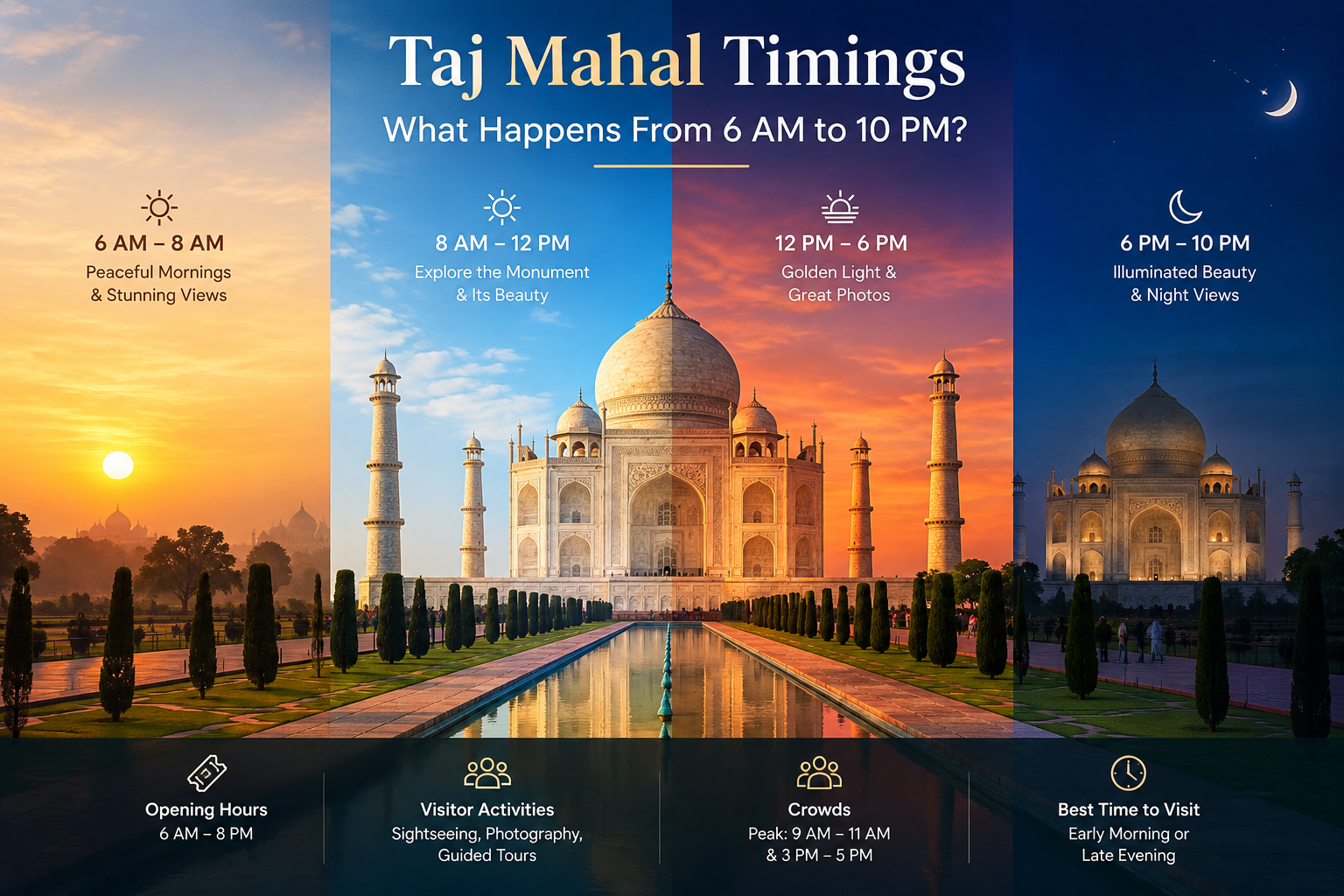
What Happens to the Taj Mahal Between 6 AM and 10 PM?
The Taj Mahal is one of the most remarkable monuments in India, but its appearance and atmosphere change dramatically throughout the day. From the soft colors of early morning to the bright daylight of noon, the warm glow of sunset and the special atmosphere of permitted night viewing, every period offers a different way to experience this iconic monument.
Many travelers planning a visit to Agra wonder what actually happens at the Taj Mahal between 6 AM and 10 PM. Does the monument remain open throughout the day? When is the best time to enter? Can visitors see the Taj Mahal at night? What changes between sunrise, afternoon, sunset and moonlight?
The answer is more interesting than simply looking at opening hours.
The Taj Mahal normally opens around 30 minutes before sunrise and closes around 30 minutes after sunset on regular visiting days. It is closed to general visitors every Friday. Night viewing is a separate experience available only on specific nights around the full moon and requires a separate ticket.
This guide explains what you can expect at different times of the day and how to plan your Taj Mahal visit for the experience you want.
Taj Mahal Timings at a Glance
Before looking at the experience hour by hour, it is important to understand the basic visiting schedule.
On normal visiting days, the Taj Mahal opens approximately 30 minutes before sunrise and closes approximately 30 minutes after sunset. The exact clock time therefore changes throughout the year because sunrise and sunset vary by season. The monument is closed for general viewing on Fridays.
This means that a traveler should not assume that the Taj Mahal is open from exactly 6 AM until 10 PM every day.
A simple way to understand the day is:
- Early morning: Entry begins before sunrise.
- Morning: Visitors explore the monument, gardens and architectural details.
- Afternoon: The marble looks brighter under stronger sunlight.
- Late afternoon: The light gradually becomes softer.
- Sunset period: The monument takes on warmer tones.
- After normal closing: Regular daytime visitors must leave.
- Night viewing: Available separately on selected full-moon-related nights.
The official Taj Mahal website states that night viewing is available on five nights around the full moon: the full-moon night, two nights before it and two nights after it.
6 AM to 8 AM: The Taj Mahal at Sunrise
Early morning is one of the most popular periods to experience the Taj Mahal.
Depending on the season, sunrise can occur around the time that the monument opens or shortly afterward. Visitors arriving early can watch the sky gradually brighten while the white marble structure begins to stand out against the morning light.
One of the most noticeable changes is the color of the marble.
The Taj Mahal is built primarily from white marble, and natural light can make the surface appear different throughout the day. During early morning, the monument may appear soft, pale and slightly pinkish as sunlight begins to illuminate its domes, minarets and decorative details.
The official Taj Mahal FAQ also notes that the monument’s appearance changes as sunlight alters its color during the day. It specifically identifies sunrise as a preferred time for many visitors because of the early light and generally cooler conditions.
Why visit the Taj Mahal early?
There are several practical reasons.
First, early morning temperatures can be more comfortable, particularly during the hotter months.
Second, arriving early can help visitors avoid some of the heavier crowds that develop later in the day. The official tourism information also notes that early morning can be useful for visitors hoping to avoid heat and crowds.
Third, the morning atmosphere can be excellent for photography. The reflecting pool, gardens and symmetrical architecture create strong compositions when the light is soft.
For photographers, sunrise also provides a chance to capture the Taj Mahal before the harsher midday sunlight becomes dominant.
8 AM to 11 AM: Exploring the Monument
As morning progresses, the Taj Mahal becomes brighter and more clearly defined.
This is an excellent period for travelers who want to spend time studying the architecture rather than simply taking a quick photograph.
The main mausoleum, four minarets, mosque, guest house and formal Mughal-style gardens form the central experience. The long reflecting pool creates the famous symmetrical view toward the monument.
Visitors can walk through the designated areas, observe the marble craftsmanship and explore the surrounding complex.
The Taj Mahal is also known for its detailed decorative work, including marble inlay and calligraphy. Looking closely at these details can make the visit much more meaningful than simply photographing the monument from the main entrance.
Visit the Taj Mahal Museum
The Taj Mahal complex also has a museum. According to the official Taj Mahal tourism website, the museum opens from 10 AM to 5 PM and entry is free.
Therefore, travelers who arrive early can combine their monument visit with the museum once it opens.
This is especially useful for visitors interested in Mughal history, architecture and the story behind the monument.
11 AM to 2 PM: Bright Daylight at the Taj Mahal
Around late morning and midday, the Taj Mahal is exposed to stronger sunlight.
The atmosphere becomes very different from sunrise.
Instead of the soft and subtle appearance of early morning, the marble can look much brighter and more reflective. Architectural details, domes, minarets and garden pathways become strongly defined.
This period can be useful for travelers who want clear visibility of the monument and its architectural details.
However, the experience can also be more demanding during hot weather.
Agra experiences significant heat during the summer months, so visitors traveling during hotter periods should consider carrying water and planning their sightseeing accordingly. Water bottles are permitted inside, according to the official visitor guidance.
What should you carry?
Visitors should avoid carrying unnecessary items because security checks are conducted at the monument.
The official guidance advises against bringing large bags and lists several prohibited items. Eating and smoking are prohibited inside the Taj Mahal, and drones are strictly prohibited in and around the monument.
Planning a lighter visit can make the entry process easier.
2 PM to 4 PM: A Different Side of the Taj Mahal
The afternoon light begins to change as the sun moves across the sky.
The Taj Mahal may appear very bright from some angles, while shadows become more noticeable on architectural details from others.
This period can be particularly interesting for visitors who enjoy architecture and photography because changing sunlight creates different patterns of light and shade.
Instead of taking only the classic front-facing photograph, consider looking at the monument from different permitted viewpoints.
The gardens, pathways, reflecting pool and surrounding structures can all provide different compositions.
Take your time
One of the biggest mistakes visitors make is treating the Taj Mahal as a quick photo stop.
The monument is best appreciated slowly.
Spend time observing the symmetry, marble inlay, calligraphy, arches and geometric patterns. Look at how the four minarets frame the central dome and how the reflecting pool extends the visual symmetry of the complex.
A slower visit also gives you more opportunities to notice how changing sunlight affects the appearance of the marble.
4 PM to Sunset: Golden Light at the Taj Mahal
Late afternoon is when the atmosphere starts becoming softer again.
As the sun moves lower, the strong midday light gradually changes into warmer illumination. The white marble can take on subtle golden tones, particularly when sunlight reaches the monument at an angle.
This is one reason sunset is another popular period for visiting.
The official Taj Mahal FAQ describes sunset as a good option and notes that the monument can appear surrounded by softer light. It also points out that sunset can attract more visitors than sunrise.
Why sunset photography is popular
Sunset creates a different visual character from sunrise.
At sunrise, the experience is often about cool morning air, soft light and the beginning of the day.
At sunset, the emphasis is on warm colors, longer shadows and the gradual transition from daylight to evening.
Clouds can also add interesting colors and textures to the sky, although the exact sunset experience depends on weather and season.
Visitors interested in photography should arrive well before the expected sunset because entry closes according to the official visiting schedule, which is based on sunrise and sunset rather than a fixed daily clock time.
What Happens After Sunset?
This is where an important distinction needs to be made.
The Taj Mahal does not remain open for ordinary daytime visitors throughout the evening until 10 PM.
Regular visiting hours end around 30 minutes after sunset. After the normal daytime visit ends, visitors must leave the monument complex.
So if you are planning a normal Taj Mahal sightseeing tour, you should not plan a continuous visit from morning until 10 PM.
Night viewing is a separate activity.
6 PM to 8 PM: The Monument After Regular Visiting Hours
After the regular daytime visiting period, the Taj Mahal becomes inaccessible to ordinary daytime visitors.
The exact closing time changes throughout the year because it is connected to sunset.
This is important when planning an itinerary.
For example, a traveler may visit the Taj Mahal early in the morning, leave around the normal closing period, and then spend the evening exploring other attractions in Agra.
Popular nearby attractions include Agra Fort, Mehtab Bagh and other historic sites. The official Incredible India tourism information also recommends attractions such as Agra Fort, Mehtab Bagh and Itimad-ud-Daulah for travelers exploring Agra.
This can make better use of your day instead of waiting outside the Taj Mahal after normal visiting hours.
8 PM to 10 PM: Special Night Viewing
Night viewing is one of the most unusual ways to experience the Taj Mahal.
However, it is not available every night.
According to the official Taj Mahal website, night viewing is available on five nights around the full moon: the full-moon night, two nights before and two nights after it.
The official night-viewing information states that viewing takes place between 8 PM and 11:59 PM in eight batches, with a maximum of 50 visitors per batch. Each viewing session lasts 30 minutes.
Therefore, a visit between 8 PM and 10 PM may be possible on an eligible night, but it requires separate night-viewing arrangements.
What does the Taj Mahal look like at night?
The experience is very different from a daytime visit.
Instead of bright sunlight illuminating the white marble, the monument appears against a dark sky. Under suitable conditions, moonlight creates a quiet and dramatic atmosphere.
The silhouette of the central dome and minarets becomes particularly noticeable.
The official Taj Mahal FAQ describes full-moon viewing as a distinctive experience and notes that the monument can appear very different against the night sky.
This is not simply a longer version of a daytime visit. It is a separate experience with its own restrictions, ticketing process and schedule.
Can You Visit the Taj Mahal at 10 PM?
Yes, but only in the context of permitted night viewing on eligible nights and with the required ticket.
You cannot simply arrive at 10 PM on an ordinary day and enter the Taj Mahal.
The official night-viewing schedule allows sessions between 8 PM and 11:59 PM on designated nights, with each visitor group receiving a limited viewing period.
Night viewing also has additional security requirements.
Visitors must report before their scheduled viewing time for security checks, and identification is required. The official night-viewing guidance instructs visitors to report at Shilpgram near the Eastern Gate before their scheduled time.
Therefore, anyone interested in a night visit should check the official schedule and ticket availability before planning their Agra itinerary.
What About Fridays?
Friday is particularly important when planning a Taj Mahal visit.
The Taj Mahal is closed to general visitors on Fridays. The official Taj Mahal website clearly states that the monument is closed every Friday for general viewing.
This means travelers should check their itinerary carefully before booking hotels, trains or day tours around a planned Taj Mahal visit.
If your Agra trip includes a Friday, you can instead explore other attractions in the city.
Agra Fort, for example, is open throughout the week according to the Agra district administration’s tourism information.
You can also consider other heritage attractions, gardens, markets and viewpoints around Agra.
Best Time to Visit the Taj Mahal
There is no single perfect time for every traveler.
The best time depends on what you want from your visit.
For sunrise photography
Choose the early morning.
The soft light, cooler temperatures and potentially lighter crowds make sunrise attractive for photographers and travelers who prefer a peaceful start.
For comfortable sightseeing
Morning is generally a practical choice, particularly during hotter months.
You can explore the monument before the strongest afternoon heat.
For architectural details
Late morning and afternoon provide strong daylight for examining the building’s details.
This can be useful for travelers interested in architecture and history.
For sunset views
Late afternoon is ideal if your main goal is warm evening light.
However, sunset periods can be busy, so allow enough time for entry, security and sightseeing.
For a moonlit experience
Consider official night viewing around the full moon.
Remember that this requires separate tickets and is available only on designated nights.
Tips for Planning a Full Day Around the Taj Mahal
A Taj Mahal visit does not need to occupy the entire day.
A well-planned Agra itinerary can combine the monument with other attractions.
Start early
Begin your day with the Taj Mahal around sunrise.
Spend enough time exploring the gardens, architecture and main viewing areas.
Visit Agra Fort afterward
Agra Fort is another major historical attraction and is relatively close to the Taj Mahal. The Agra district administration lists it as a UNESCO World Heritage Site and describes it as an important Mughal-era complex.
Take a break in the afternoon
During hot weather, consider taking a break at your hotel or having lunch before continuing your sightseeing.
Explore another attraction
You can visit places such as Itimad-ud-Daulah, Mehtab Bagh or other heritage sites in Agra.
Return for a permitted night view
If your travel date falls within the official night-viewing schedule, you can consider booking a separate night-viewing session.
This gives you two completely different perspectives of the Taj Mahal on the same trip.
Taj Mahal Photography Tips for Different Times of Day
The changing light is one of the most interesting aspects of photographing the Taj Mahal.
Sunrise
Use the soft morning light to capture the monument with the reflecting pool and gardens.
Morning
Clear daylight can help highlight architectural details, marble surfaces and decorative patterns.
Afternoon
Look for shadows and different angles instead of taking only the standard front-facing photograph.
Sunset
Warm light can create a dramatic atmosphere. Arrive early enough to find your preferred viewpoint.
Night
Night viewing is much more restricted. Follow all security instructions and photography rules applicable to the night visit.
The official visitor guidance also states that photography is prohibited inside the main mausoleum.
Important Visitor Rules
Before visiting, travelers should understand the monument’s rules.
Drones are strictly prohibited inside and around the Taj Mahal. Eating and smoking are prohibited inside the monument. Large bags should be avoided, and certain electronic and personal items are restricted.
Photography is also prohibited inside the main mausoleum.
Visitors should respect the marble surfaces and avoid touching or scratching the historic structure.
Following these rules helps protect the monument and makes the visit more comfortable for everyone.
How Long Should You Spend at the Taj Mahal?
For most travelers, a few hours is enough to experience the main complex without rushing.
An early-morning visit can include:
- Entry and security checks
- Main Taj Mahal viewpoint
- Reflecting pool
- Mughal gardens
- Main mausoleum
- Architectural details
- Photography
- Museum visit when open
The exact duration depends on crowd levels, photography interests, security procedures and how deeply you want to explore the complex.
If you are visiting Agra as part of a Golden Triangle Tour, a morning Taj Mahal visit works particularly well because the rest of the day can be used for Agra Fort and other attractions.
Final Thoughts: A Day of Changing Light
The Taj Mahal between 6 AM and 10 PM is not one continuous visitor experience.
Instead, it is a sequence of different experiences shaped by natural light, visitor hours and special night-viewing arrangements.
Early morning brings soft light and a peaceful atmosphere. Daytime reveals the monument’s architectural details clearly. Afternoon creates stronger contrasts and brighter marble. Sunset brings warmer tones and a different photographic mood. After regular closing, the monument becomes inaccessible to ordinary daytime visitors, except when special night viewing is officially available.
The most important thing to remember is that the Taj Mahal’s normal visiting hours run from approximately 30 minutes before sunrise to 30 minutes after sunset, with Friday closed for general viewing. Night viewing is separately scheduled around the full moon and requires its own ticket.
Whether you choose sunrise, daytime, sunset or an official moonlit viewing, the Taj Mahal offers a different visual experience as the light changes.
For first-time visitors, checking the official opening schedule before traveling is essential. Sunrise and sunset times change during the year, and special night-viewing dates are limited.
With the right timing, you can experience not just the Taj Mahal itself, but the way this extraordinary monument transforms from the first light of morning to the darkness of night.