
·
Last Updated: August 18, 2026
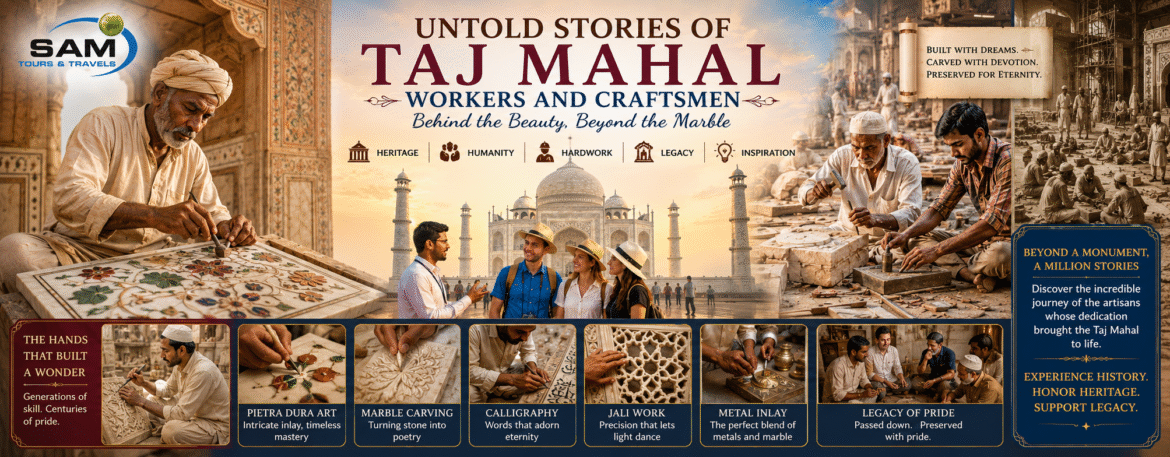
The Taj Mahal is widely admired as a symbol of eternal love and one of the most beautiful monuments in the world. Located in Agra, India, the monument continues to attract millions of visitors every year. While most people know it as a masterpiece built by Emperor Taj Mahal in memory of Mumtaz Mahal, very few truly understand the human effort, craftsmanship, and untold stories of the thousands of workers who brought this wonder to life.
Behind its white marble beauty lies a powerful story of artisans, laborers, architects, and craftsmen whose skills shaped one of the greatest architectural wonders ever created.
The Vision Behind the Monument
The story of the Taj Mahal begins with Emperor Shah Jahan, who commissioned the monument in the 17th century after the death of his beloved wife, Mumtaz Mahal. Heartbroken by her passing, he envisioned a structure that would represent eternal love, unmatched beauty, and divine perfection.
However, this vision could not have become reality without the immense contribution of thousands of skilled workers and craftsmen from across the Mughal Empire and beyond.
The Massive Workforce Behind the Taj Mahal
Historical estimates suggest that more than 20,000 artisans and workers contributed to the construction of the Taj Mahal over a period of nearly 20 years. This workforce included:
- Master architects from Persia and Central Asia
- Calligraphers and stone carvers from India
- Marble inlay artists (pietra dura specialists)
- Masons, laborers, and engineers
- Sculptors and decorative artisans
Each group had a specific role, and together they transformed raw materials into a breathtaking architectural wonder.
What makes their contribution extraordinary is that most of them worked with simple tools, yet achieved unmatched precision that still amazes engineers today.
The Master Architect and His Team
The main architect is believed to be Ustad Ahmad Lahauri, a highly skilled designer of the Mughal era. However, the Taj Mahal was not the work of a single mind. It was a collaborative effort involving experts from different regions.
These craftsmen brought together Persian, Islamic, and Indian architectural styles, blending them seamlessly into one unified design. The result was a monument that reflects symmetry, balance, and spiritual elegance.
The workers followed extremely detailed instructions, but they also contributed their own creativity in carving patterns, floral designs, and decorative elements.
Life of the Workers During Construction
The construction of the Taj Mahal was not just an architectural achievement—it was also a massive human effort that shaped the lives of thousands of workers.
Living Conditions
Workers lived in temporary settlements near the construction site. These settlements included basic shelters, food arrangements, and workspaces. While royal support ensured resources were available, life was still physically demanding.
Working Hours
Artisans worked long hours, often from sunrise to sunset. Marble carving, stone inlay, and engraving required extreme precision and patience, making the work both physically and mentally exhausting.
Skilled Labor Importance
Unlike ordinary construction projects, the Taj Mahal demanded highly specialized skills. A single mistake in carving marble or placing gemstone inlay could ruin weeks of work. This pressure made the craftsmen highly disciplined and focused.
The Art of Marble Inlay: A Lost Masterpiece Skill
One of the most remarkable contributions of the craftsmen was the intricate marble inlay work known as pietra dura. This technique involved embedding semi-precious stones into white marble to create floral patterns and geometric designs.
Workers used stones such as:
- Jade
- Jasper
- Turquoise
- Lapis lazuli
- Agate
Each piece was carefully cut and polished before being inserted into precisely carved marble grooves.
This technique required extreme precision, and many artisans spent years mastering it. Even today, very few craftsmen can replicate the same level of detail.
Calligraphy: The Voice of Stone
Another group of highly skilled workers were the calligraphers. They inscribed verses from the Quran on the walls of the Taj Mahal using black marble.
What makes this work extraordinary is the optical illusion used in the design. The calligraphy appears uniform from the ground, but it is actually scaled so that it looks proportional when viewed from below.
This required advanced mathematical understanding, artistic skill, and deep knowledge of geometry.
The Untold Struggles of Craftsmen
While the Taj Mahal represents beauty and love, the stories of the workers also include hardship.
Many artisans came from distant regions, leaving their families behind for years. They worked under strict supervision, and the pressure to maintain perfection was extremely high.
There are historical debates and legends suggesting harsh conditions and even punishment for mistakes. However, historical evidence also suggests that many skilled workers were respected and valued for their craftsmanship.
What is clear is that their dedication came at the cost of personal sacrifice.
The Engineering Genius Behind the Structure
Beyond artistic beauty, the Taj Mahal is also an engineering marvel. The craftsmen worked under advanced structural planning that ensured:
- Perfect symmetry across the entire complex
- Earthquake-resistant foundation design
- Balanced dome structure
- Precision water reflection system
The workers had to execute these designs without modern machinery, relying only on manual tools and traditional engineering knowledge.
The precision achieved by them still amazes modern architects and engineers.
Cultural Fusion in Craftsmanship
One of the most fascinating aspects of the Taj Mahal’s construction is the cultural diversity of its workers. Craftsmen from Persia, Turkey, India, and Central Asia contributed to the project.
This cultural fusion is visible in:
- Islamic calligraphy
- Persian floral patterns
- Indian stone carving styles
- Central Asian architectural symmetry
The workers did not just build a monument—they created a shared cultural masterpiece.
Legacy of the Workers and Craftsmen
Today, the Taj Mahal stands as a UNESCO World Heritage Site and one of the most visited monuments in the world. But behind its fame lies the legacy of thousands of unnamed workers whose skills made it possible.
Their contributions remind us that great monuments are not built by rulers alone, but by the hands of skilled artisans whose names often remain unknown.
The craftsmanship of these workers continues to inspire modern architecture, design, and art across the world.
Conclusion
The untold stories of the Taj Mahal workers and craftsmen reveal a powerful truth: behind every great monument lies human dedication, sacrifice, and extraordinary skill. The beauty of Taj Mahal is not just in its marble and symmetry, but in the hands of thousands of artisans who transformed a royal vision into reality.
Their legacy lives on in every carved flower, every polished stone, and every perfectly aligned dome. The Taj Mahal is not just a symbol of love—it is also a monument to human creativity, patience, and mastery.
For More Information : Read More