
·
Last Updated: August 18, 2026
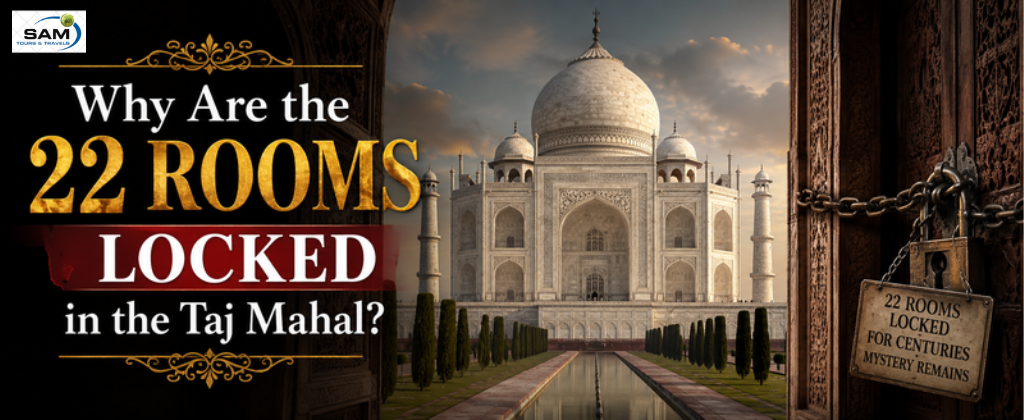
Why Are the 22 Rooms Locked in the Taj Mahal?
Introduction
The Taj Mahal is one of the world’s most admired monuments and a UNESCO World Heritage Site. Every year, millions of visitors travel to Agra to witness its breathtaking white marble architecture, intricate carvings, and timeless love story. However, beyond its beauty lies one of India’s most discussed mysteries—the 22 locked rooms in the Taj Mahal.
For decades, these sealed chambers have sparked curiosity among historians, archaeologists, tourists, and conspiracy theorists. Some believe the rooms contain hidden treasures, while others claim they conceal ancient Hindu temples or secret Mughal passages. As a result, countless debates, documentaries, books, and online discussions have tried to answer one simple question:
Why are the 22 rooms locked in the Taj Mahal?
The truth, however, is more practical than many of the theories circulating online. According to the Archaeological Survey of India (ASI), these rooms are part of the monument’s lower structure and have remained closed primarily for conservation, structural safety, and restricted public access.
This article explores the complete history behind these mysterious chambers. We’ll separate facts from myths, examine historical records, discuss ASI’s official explanations, and understand why the rooms continue to attract worldwide attention.
Whether you’re planning a visit to the Taj Mahal or simply fascinated by historical mysteries, this guide provides a balanced and evidence-based perspective.
Why Do the 22 Locked Rooms Attract So Much Attention?
Mysteries naturally capture people’s imagination. The Taj Mahal already carries an aura of romance and grandeur, so any hidden area within the monument quickly becomes a topic of public interest.
Several factors contribute to the popularity of this mystery:
- Restricted public access creates curiosity.
- Social media often spreads unverified claims.
- Numerous YouTube videos promote sensational theories.
- Legal petitions have requested access to the rooms.
- Historical debates continue among researchers.
- The monument’s immense global popularity amplifies every rumor.
Whenever an area remains inaccessible, speculation often replaces verified information. This has happened repeatedly with the Taj Mahal’s lower chambers.
Understanding the Structure of the Taj Mahal
Before discussing the locked rooms, it’s important to understand the monument’s architecture.
The Taj Mahal is much more than the white marble mausoleum visible from the outside. The entire complex includes:
- The grand marble mausoleum
- A raised marble platform
- Underground chambers
- Foundation corridors
- Service passages
- Garden complexes
- A mosque
- A guest house
- Entrance gateways
- Water channels
- Underground structural spaces
Many visitors don’t realize that the visible monument represents only a portion of the complete architectural design.
Like many Mughal buildings, the Taj Mahal contains several enclosed rooms beneath the main platform. These spaces were designed for structural balance, maintenance, humidity control, and support rather than public exhibitions.
What Exactly Are the 22 Locked Rooms?
The so-called 22 locked rooms are a series of interconnected chambers located beneath the marble platform on the river-facing side of the Taj Mahal.
These rooms are generally inaccessible to visitors.
Unlike the central mausoleum, these chambers contain simple brickwork, plastered walls, and architectural support elements rather than decorative marble interiors.
Historians believe these rooms were originally constructed as part of the monument’s engineering design.
Several old photographs taken before stricter conservation measures show corridors and arched doorways leading into some of these lower sections.
Over time, access became increasingly restricted.
Who Built the Taj Mahal?
Construction of the Taj Mahal began in 1632 under the Mughal emperor Shah Jahan after the death of his beloved wife, Mumtaz Mahal.
Historical records indicate that approximately 20,000 artisans, craftsmen, engineers, calligraphers, and laborers worked on the monument for over two decades.
The project involved:
- Persian architects
- Indian stone craftsmen
- Central Asian artisans
- Marble workers
- Calligraphers
- Masonry experts
The completed complex became one of the greatest architectural achievements of the Mughal Empire.
Where Are These Rooms Located?
The locked chambers are situated beneath the marble platform facing the Yamuna River.
Unlike the main tourist pathway, this section remains closed to visitors.
The rooms extend along the lower level and are connected through corridors featuring repeated arches—a common design element in Mughal architecture.
These chambers are not visible during a regular Taj Mahal tour.
Only authorized personnel conducting conservation or structural inspections may enter when necessary.
Are These Rooms Completely Hidden?
Not exactly.
Some parts of the lower structure have been photographed over the years.
Several historical images and maintenance photographs reveal long corridors lined with identical rooms.
However, public entry has remained restricted for many decades.
Because visitors cannot freely access these chambers, speculation continues to grow.
Why Is There So Much Confusion?
The confusion mainly arises because verified information is often overshadowed by sensational claims.
Online videos frequently suggest that the rooms contain:
- Hidden royal treasures
- Ancient manuscripts
- Secret tunnels
- Hindu idols
- Lost Mughal artifacts
- Underground temples
Despite these claims, no conclusive archaeological evidence has been publicly presented to support such theories.
Professional historians emphasize the importance of relying on documented records rather than speculation.
What Will This Guide Cover?
In the following sections, we’ll explore:
- The official explanation provided by the Archaeological Survey of India.
- Why the rooms remain sealed.
- Popular myths and conspiracy theories.
- Historical documents related to the chambers.
- Engineering reasons behind the underground structure.
- Court cases and public petitions.
- What historians and conservation experts say.
- Whether the rooms might ever be opened to the public.
By examining each topic carefully, we can better understand why the mystery of the 22 locked rooms in the Taj Mahal continues to fascinate people around the world.
The History Behind the 22 Locked Rooms: How They Were Built and Their Original Purpose
The Hidden Foundation of the Taj Mahal
When people admire the Taj Mahal, they usually focus on its dazzling white marble dome, elegant minarets, and intricate carvings. However, the monument’s true strength lies beneath the surface. Hidden below the marble platform is a carefully engineered foundation that has supported the structure for nearly four centuries.
The 22 locked rooms in the Taj Mahal are part of this hidden foundation. These chambers were not built as tourist attractions. Instead, they played an important role in supporting one of the world’s greatest architectural masterpieces.
To understand why these rooms exist, it’s essential to explore how Mughal architects designed monuments during the 17th century.
Why Did Mughal Architects Build Underground Chambers?
Mughal architecture combined beauty with engineering. Large monuments such as forts, palaces, and mausoleums often included underground rooms, passageways, and foundation chambers.
These spaces served several practical purposes:
- Supporting the weight of massive structures.
- Improving structural stability.
- Reducing pressure on the foundation.
- Allowing maintenance work.
- Managing moisture and airflow.
- Creating balanced load distribution.
Rather than filling the entire platform with solid material, architects used a series of interconnected chambers. This design reduced the overall weight while maintaining exceptional strength.
As a result, the Taj Mahal has remained structurally stable despite centuries of environmental challenges.
Why Was the Taj Mahal Built Near the Yamuna River?
One of the most remarkable aspects of the Taj Mahal is its location on the banks of the Yamuna River.
Although the riverside setting creates breathtaking views, it also presented major engineering challenges.
The soil near rivers is naturally softer than inland ground. Constructing a massive marble monument on such terrain required advanced planning and innovative construction techniques.
To strengthen the foundation, Mughal engineers:
- Dug deep wells.
- Filled them with stone and timber.
- Built strong retaining walls.
- Created foundation chambers.
- Designed load-distribution corridors.
- Raised the monument on a massive platform.
The underground rooms helped distribute the enormous weight of the marble mausoleum more evenly across the foundation.
The Role of the Raised Marble Platform
Many visitors overlook the importance of the Taj Mahal’s raised platform.
The white marble mausoleum does not sit directly on the ground. Instead, it stands on a large elevated platform constructed with brick masonry and marble cladding.
This platform serves several functions:
Structural Support
The platform spreads the monument’s weight over a larger area.
Flood Protection
Because the Yamuna River occasionally experienced seasonal flooding, the elevated platform protected the mausoleum from water damage.
Architectural Symmetry
The raised base enhances the monument’s grandeur while maintaining perfect visual balance.
Foundation Access
The chambers beneath the platform allowed workers to inspect and maintain parts of the structure when necessary.
The 22 locked rooms in the Taj Mahal are located within this platform rather than beneath the central tomb itself.
Were the Rooms Designed for Royal Use?
One of the most common misconceptions is that these chambers served as royal living quarters.
Historical evidence does not support this claim.
Unlike Mughal palaces, the Taj Mahal was built as a mausoleum—a monument dedicated to Mumtaz Mahal’s memory.
The lower chambers contain simple construction materials instead of luxurious decorations.
Researchers who have studied available photographs describe features such as:
- Plain brick walls.
- Lime plaster surfaces.
- Repeating arches.
- Utility corridors.
- Structural partitions.
These characteristics are consistent with engineering spaces rather than royal apartments.
Construction Techniques Used in the Foundation
The Taj Mahal showcases extraordinary engineering for its time.
Builders used several advanced techniques that contributed to the monument’s durability.
Brick Masonry
Although the exterior features white Makrana marble, much of the internal structure consists of high-quality baked bricks bonded with lime mortar.
These bricks form the walls of many underground chambers.
Lime Mortar
Instead of modern cement, Mughal builders relied on lime mortar mixed with natural materials.
This traditional mixture offered flexibility and durability, allowing the building to withstand minor ground movements over centuries.
Load Distribution
The interconnected rooms helped distribute vertical pressure throughout the foundation.
Rather than concentrating weight in one location, the design spread the load evenly.
This reduced the risk of cracks and structural stress.
Why Were So Many Chambers Built?
Visitors often ask why exactly there are 22 locked rooms in the Taj Mahal.
The number is largely a result of architectural planning rather than symbolism.
Large Mughal structures commonly featured repeating chambers because they offered several engineering benefits.
These include:
- Balanced structural support.
- Efficient construction.
- Easier maintenance.
- Improved ventilation.
- Better moisture control.
- Reduced material usage.
Instead of one enormous underground hall, engineers created multiple smaller rooms separated by supporting walls.
This approach strengthened the entire platform.
Did Workers Use These Rooms During Construction?
Many historians believe the chambers were actively used while the Taj Mahal was under construction.
Workers may have stored:
- Building materials.
- Stone-cutting tools.
- Scaffolding equipment.
- Lime mixtures.
- Timber supplies.
- Construction implements.
Once the project was completed, many of these spaces became unnecessary for daily use.
Over time, public access gradually decreased.
How Did the Chambers Help Preserve the Monument?
One often-overlooked purpose of the underground rooms is environmental protection.
Large stone monuments constantly respond to changes in:
- Temperature.
- Humidity.
- Groundwater levels.
- Air circulation.
The network of chambers beneath the platform likely helped regulate these conditions.
The empty spaces reduced pressure on the structure while allowing limited airflow within the foundation.
Although modern conservation methods differ, historical architecture frequently relied on passive engineering solutions like these.
Are Similar Chambers Found in Other Mughal Monuments?
Yes.
The Taj Mahal is not unique in having underground spaces.
Several Mughal monuments include hidden passages, storage rooms, and foundation chambers.
Examples include:
- Agra Fort.
- Red Fort in Delhi.
- Humayun’s Tomb.
- Fatehpur Sikri.
- Akbar’s Tomb at Sikandra.
In most cases, these areas remain inaccessible to tourists because they are intended for structural maintenance or conservation purposes.
This demonstrates that hidden chambers were a common feature of Mughal architecture rather than an unusual mystery.
Why Were the Rooms Eventually Closed?
As the Taj Mahal aged, conservation became a top priority.
Authorities gradually restricted access to areas that were not designed for tourism.
The underground chambers were closed for several practical reasons:
- Protecting fragile masonry.
- Preventing unauthorized entry.
- Limiting humidity changes.
- Ensuring visitor safety.
- Supporting long-term preservation.
- Reducing wear on historic structures.
Closing these rooms helped minimize potential damage caused by large numbers of visitors.
Do Historical Records Mention the Rooms?
Historical records describe the Taj Mahal’s complex construction, although they do not always provide detailed descriptions of every underground chamber.
Architectural surveys conducted over the years have documented the existence of these rooms as part of the monument’s lower structure.
While the chambers are real, historical evidence does not indicate that they were intended to hide secret treasures or mysterious artifacts.
Instead, they appear to be functional components of a carefully planned engineering system.
What We Know So Far
The 22 locked rooms in the Taj Mahal were almost certainly designed as part of the monument’s structural foundation. Their location beneath the raised marble platform, plain construction, and architectural layout suggest practical engineering purposes rather than ceremonial or residential use.
Although these chambers continue to inspire public curiosity, understanding their architectural role provides valuable context for one of history’s greatest monuments.
Why Are the 22 Rooms Locked in the Taj Mahal? The Official ASI Explanation
The Question Everyone Wants Answered
The mystery surrounding the 22 locked rooms in the Taj Mahal has fascinated people for decades. Every year, countless visitors ask the same question:
Why are these rooms locked, and what is hidden inside them?
While social media and online discussions often suggest dramatic explanations, the official position is far more practical. The Archaeological Survey of India (ASI), which is responsible for maintaining the Taj Mahal, has consistently stated that these rooms are closed to protect the monument and preserve its structural integrity.
Understanding the ASI’s role helps separate verified facts from speculation.
What Is the Archaeological Survey of India (ASI)?
The Archaeological Survey of India (ASI) is the government agency responsible for preserving India’s historical monuments, archaeological sites, and cultural heritage.
Its responsibilities include:
- Conserving historical monuments.
- Conducting archaeological research.
- Restoring damaged structures.
- Managing tourist access.
- Protecting UNESCO World Heritage Sites.
- Ensuring long-term preservation.
Since the Taj Mahal is one of India’s most important historical landmarks, the ASI closely monitors every aspect of its maintenance.
This includes areas that are not open to the general public, such as the 22 locked rooms in the Taj Mahal.
Why Does the ASI Keep the Rooms Locked?
According to the ASI, the lower chambers remain closed primarily for conservation and safety reasons.
Several practical factors influence this decision.
1. Structural Preservation
The underground rooms are part of the Taj Mahal’s foundation.
Allowing thousands of visitors into these confined spaces every day could place unnecessary stress on the historic structure.
Restricting access helps preserve the monument for future generations.
2. Visitor Safety
Many of the lower chambers were never designed for tourism.
The rooms feature:
- Narrow corridors.
- Low ceilings.
- Limited lighting.
- Restricted ventilation.
- Uneven flooring.
Opening such areas without significant modifications could pose safety risks to visitors.
Rather than altering the historic structure, the ASI limits access.
3. Environmental Conservation
Historic buildings are highly sensitive to environmental changes.
Large crowds introduce:
- Heat.
- Moisture.
- Carbon dioxide.
- Dust.
- Vibrations.
These factors can accelerate the deterioration of ancient masonry and plaster.
By keeping the chambers closed, the ASI helps maintain stable environmental conditions inside the monument.
4. Preventing Damage
The Taj Mahal attracts millions of visitors every year.
Even small amounts of physical contact can damage historic surfaces over time.
Restricting access reduces the risk of:
- Scratches.
- Graffiti.
- Accidental breakage.
- Unauthorized photography.
- Vandalism.
Protecting the monument remains the highest priority.
Are the Rooms Permanently Sealed?
No.
A common misconception is that the rooms have been permanently sealed forever.
In reality, the rooms may be opened by authorized conservation staff whenever inspections or maintenance work is required.
However, they are not accessible to the general public.
This distinction is important.
The rooms are restricted—not abandoned.
Does the ASI Believe There Is a Mystery?
The ASI has never officially stated that the rooms contain hidden treasures, ancient temples, or secret artifacts.
Instead, conservation experts describe the chambers as ordinary architectural spaces that form part of the monument’s lower structure.
Their focus remains on preservation rather than speculation.
Why Doesn’t the ASI Simply Open the Rooms?
Many people argue that opening the rooms would end all speculation.
However, heritage conservation involves careful decision-making.
Opening restricted areas would require:
- Structural assessments.
- Safety modifications.
- Visitor management systems.
- Environmental monitoring.
- Security arrangements.
- Ongoing maintenance.
Such changes could alter the original historic fabric of the monument.
The ASI generally avoids unnecessary interventions that might affect the authenticity of protected heritage sites.
How Heritage Sites Around the World Handle Restricted Areas
The Taj Mahal is not unusual in restricting access to certain sections.
Many famous monuments worldwide have areas that remain closed to visitors.
Examples include:
- Underground passages in medieval castles.
- Hidden service corridors in royal palaces.
- Ancient burial chambers.
- Fragile archaeological excavation sites.
- Restricted conservation laboratories.
- Structural maintenance tunnels.
These restrictions are standard practice in heritage management.
The goal is to preserve history, not conceal it.
Have Conservation Experts Visited the Rooms?
Yes.
Authorized engineers, conservation specialists, and ASI officials periodically inspect restricted areas whenever necessary.
These inspections help monitor:
- Moisture levels.
- Structural stability.
- Cracks.
- Foundation movement.
- Salt deposits.
- Biological growth.
Regular monitoring allows conservation teams to identify problems before they become serious.
Why Isn’t Every Inspection Made Public?
Many people assume that if inspections occur, detailed photographs and reports should always be released publicly.
However, this is not standard practice in heritage conservation.
Internal inspection reports often contain technical information intended for engineers and conservation professionals rather than the general public.
In many countries, similar documentation for protected monuments is not routinely published unless required.
What About the Claims of Hidden Treasure?
One of the most persistent rumors suggests that the 22 locked rooms in the Taj Mahal contain royal treasure.
There is no verified archaeological evidence supporting this claim.
Historical records indicate that the Taj Mahal was built as a mausoleum, not as a treasury.
Unlike forts or palaces, it was never intended to store wealth.
No officially documented excavation has uncovered hidden treasure within these chambers.
Do the Rooms Contain Ancient Hindu Temples?
Another widely discussed theory claims that the locked rooms hide an ancient Hindu temple.
This claim has generated significant public debate over the years.
However, professional historians note that extraordinary historical claims require strong archaeological evidence.
To date:
- No officially published excavation has confirmed such a structure inside the restricted chambers.
- The ASI has not announced findings supporting this theory.
- Most discussions rely on interpretations, photographs, or historical arguments rather than verified archaeological discoveries.
As a result, the claim remains unproven.
Why Does the Mystery Continue?
Despite official explanations, public curiosity remains strong for several reasons.
Limited Access
People naturally become curious about places they cannot enter.
Social Media
Online platforms often favor dramatic stories over technical explanations.
Videos with sensational titles tend to receive more attention than conservation reports.
Historical Interest
The Taj Mahal is one of the world’s most famous monuments.
Even small mysteries surrounding it attract international discussion.
Lack of Public Awareness
Many visitors are unaware that restricted areas are common in historical monuments.
Understanding conservation practices helps place the locked rooms in proper context.
The Difference Between Mystery and Conservation
It is important to distinguish between two separate ideas.
Mystery encourages speculation.
Conservation focuses on protecting historical structures using scientific methods.
The ASI approaches the locked rooms from a conservation perspective.
While the public may view them as mysterious, heritage professionals see them as sensitive structural spaces requiring careful preservation.
Key Takeaways
The official explanation for the 22 locked rooms in the Taj Mahal is based on preservation rather than secrecy.
According to the ASI:
- The rooms are part of the monument’s lower structure.
- They remain closed to protect the building.
- Visitor safety is a major concern.
- Environmental stability must be maintained.
- Authorized inspections occur when required.
- No official evidence supports claims of hidden treasure or secret chambers.
Although curiosity continues to grow, the available evidence suggests that conservation—not concealment—is the primary reason these rooms remain inaccessible.
Popular Myths and Conspiracy Theories About the 22 Locked Rooms in the Taj Mahal
Why Have So Many Theories Emerged?
The 22 locked rooms in the Taj Mahal have become one of India’s most talked-about historical mysteries. Since the rooms are not open to the public, many people have tried to explain their purpose through theories, assumptions, and speculation.
Over the years, books, television programs, blogs, YouTube videos, and social media posts have presented a wide range of claims. Some are based on historical interpretations, while others have little or no documented evidence.
To better understand the mystery, it is important to separate verified facts from unverified theories.
How Do Historical Myths Spread?
Whenever access to a historical site is restricted, curiosity naturally increases.
Several factors contribute to the spread of myths:
- Limited public access.
- Viral social media content.
- Selective historical interpretations.
- Clickbait headlines.
- Lack of official awareness.
- Public fascination with hidden places.
Many online videos present theories as established facts, even when they have not been supported by archaeological research.
This is one reason the mystery of the 22 locked rooms in the Taj Mahal continues to attract worldwide attention.
Theory 1 – Do the Locked Rooms Hide an Ancient Hindu Temple?
Perhaps the most widely discussed claim is that the Taj Mahal was built over an ancient Hindu temple and that the 22 locked rooms contain evidence of this earlier structure.
Supporters of this theory often suggest that hidden idols, carvings, or inscriptions remain inside the sealed chambers.
What Is the Basis of This Theory?
Those who support this idea often point to:
- Certain architectural features.
- Historical interpretations.
- Alternative readings of old documents.
- Claims made in books and public discussions.
Some also argue that specific design elements resemble those found in Hindu temple architecture.
What Do Mainstream Historians Say?
Most professional historians and conservation experts state that no officially verified archaeological evidence has been published confirming the existence of a hidden temple within the restricted chambers.
While scholars continue to debate aspects of Mughal history, extraordinary claims require strong archaeological proof.
At present, no official excavation or conservation report has confirmed this theory.
Theory 2 – Are There Hidden Treasures Inside the Rooms?
Another popular belief suggests that the Mughal Empire stored valuable treasures beneath the Taj Mahal.
According to this theory, the rooms contain:
- Gold.
- Precious jewels.
- Royal artifacts.
- Rare manuscripts.
- Ancient coins.
- Valuable ornaments.
This idea has inspired numerous documentaries and fictional stories.
Is There Any Evidence?
No verified archaeological findings have confirmed the presence of hidden treasure inside the 22 locked rooms in the Taj Mahal.
The Taj Mahal was designed primarily as a mausoleum rather than a royal treasury.
Historically, Mughal wealth was typically stored inside heavily guarded forts and palaces rather than burial monuments.
Therefore, historians generally consider this theory unlikely.
Theory 3 – Do Secret Tunnels Lead to Agra Fort?
Some people believe underground tunnels connect the Taj Mahal with Agra Fort.
According to this claim, Mughal rulers used these secret routes during emergencies.
Why Does This Theory Exist?
Secret tunnels were common in some medieval forts around the world.
Since both the Taj Mahal and Agra Fort were built during the Mughal period, many assume a hidden connection must exist.
What Does Historical Research Suggest?
Although Agra Fort contains underground passages, there is no officially documented evidence proving that a tunnel connects it directly to the Taj Mahal.
Most historians believe this story belongs to local folklore rather than established historical fact.
Theory 4 – Were Royal Secrets Hidden in These Rooms?
Another theory suggests that Shah Jahan stored confidential documents inside the chambers.
Some versions claim the rooms contain:
- Royal correspondence.
- Political agreements.
- Family records.
- Court documents.
However, historians note that Mughal administrative records were generally preserved in royal archives rather than inside mausoleums.
No verified documents support this theory.
Theory 5 – Are Ancient Scientific Instruments Hidden Below?
A less common claim proposes that the chambers contain astronomical devices or scientific instruments from earlier civilizations.
Supporters argue that advanced knowledge was intentionally concealed.
Despite its popularity online, no archaeological survey has produced evidence supporting this idea.
Professional researchers generally classify it as speculation.
Theory 6 – Are There Hidden Human Remains?
Some stories suggest that additional royal family members or important nobles were buried inside the restricted chambers.
However, historical records identify the principal burials within the Taj Mahal complex.
No verified archaeological discoveries indicate the presence of secret burial chambers beneath the platform.
Theory 7 – Were the Rooms Used as Secret Escape Routes?
Movies and historical fiction often feature hidden escape passages beneath palaces and forts.
Because of this, some visitors believe the 22 locked rooms in the Taj Mahal were connected to emergency escape routes.
Although underground passages existed in several Mughal forts, historians have found no verified evidence that the Taj Mahal’s lower chambers served this purpose.
The monument functioned as a mausoleum rather than a military fortress.
Theory 8 – Are the Rooms Haunted?
One of the more sensational claims circulating online is that the sealed chambers are haunted.
Stories describe mysterious sounds, unusual energy, or unexplained events.
These tales have become popular in paranormal television programs and internet discussions.
However, there is no scientific or historical evidence supporting paranormal claims related to the Taj Mahal.
Most experts consider such stories part of local folklore.
Why Do These Theories Continue to Gain Popularity?
Even without verified evidence, the theories surrounding the 22 locked rooms in the Taj Mahal continue to spread.
Several reasons explain this phenomenon.
Curiosity About Hidden Places
People naturally wonder what lies behind closed doors.
Restricted access often encourages speculation.
Influence of Social Media
Videos with dramatic titles often receive millions of views.
Sensational content tends to spread more quickly than detailed historical explanations.
Selective Use of Historical Information
Some discussions highlight isolated architectural features while ignoring broader historical context.
This can create misleading conclusions.
Lack of Public Access
Because ordinary visitors cannot enter the rooms, many questions remain unanswered in the public imagination.
This absence of firsthand experience allows rumors to flourish.
What Do Historians Recommend?
Most historians encourage a careful, evidence-based approach when discussing historical mysteries.
Rather than accepting every theory as fact, they recommend asking important questions:
- Is the claim supported by archaeological evidence?
- Has it been verified by professional researchers?
- Are reliable historical documents available?
- Have independent experts examined the evidence?
These questions help distinguish historical research from speculation.
Facts vs. Myths
| Popular Claim | Current Historical Evidence |
|---|---|
| Hidden Hindu temple | No officially verified archaeological evidence confirming this claim. |
| Secret treasure | No documented discoveries supporting the claim. |
| Underground tunnel to Agra Fort | No verified historical evidence of a direct tunnel. |
| Hidden royal archives | No documented records confirming this theory. |
| Secret escape routes | No archaeological proof linking the rooms to escape passages. |
| Haunted chambers | No scientific evidence supporting paranormal claims. |
Why Responsible History Matters
The Taj Mahal is one of the world’s greatest cultural treasures. Understanding its history requires balancing curiosity with credible research.
Mysteries can inspire exploration, but responsible historical study depends on documented evidence, archaeological investigation, and careful analysis.
The 22 locked rooms in the Taj Mahal remain an intriguing subject, yet many popular theories have not been verified by official archaeological findings.
Keeping an open mind while relying on reliable evidence allows visitors to appreciate both the monument’s beauty and its fascinating history.
Key Takeaways
- The 22 locked rooms in the Taj Mahal have inspired many theories over the years.
- Popular claims include hidden temples, secret treasures, underground tunnels, royal archives, and escape routes.
- Most of these theories lack officially verified archaeological evidence.
- Historians recommend relying on documented research rather than speculation.
- The mystery continues largely because the rooms are not open to the public.
Historical Records, Mughal Documents, and What They Reveal About the 22 Locked Rooms in the Taj Mahal
Can Historical Records Solve the Mystery?
The 22 locked rooms in the Taj Mahal have generated countless debates, but one of the best ways to investigate the mystery is by examining historical records. Instead of relying on rumors or social media discussions, historians turn to contemporary documents, architectural surveys, travelers’ accounts, and Mughal chronicles.
These sources provide valuable insights into how the Taj Mahal was built, how it was used, and what early visitors observed. While they do not answer every question, they help us distinguish documented history from modern speculation.
Why Are Historical Documents Important?
Historical monuments often become surrounded by myths over time. To understand their true history, researchers study evidence created during or close to the period when the monument was built.
For the Taj Mahal, important historical sources include:
- Mughal court chronicles.
- Persian manuscripts.
- Architectural records.
- European travelers’ accounts.
- Early British surveys.
- Archaeological reports.
- Restoration documents.
Each source contributes a piece to the overall historical picture.
Mughal Court Chronicles
The Mughal Empire maintained detailed records of major construction projects.
Royal historians documented important events, including:
- Construction timelines.
- Financial expenses.
- Royal ceremonies.
- Court activities.
- Architectural achievements.
These chronicles describe the Taj Mahal as the mausoleum commissioned by Emperor Shah Jahan in memory of Mumtaz Mahal.
They also discuss the large workforce involved in constructing the monument.
Do Mughal Records Mention the 22 Locked Rooms?
One of the most common questions is whether Mughal documents specifically describe the 22 locked rooms in the Taj Mahal.
The available historical records focus primarily on:
- The mausoleum.
- The marble decorations.
- The gardens.
- The mosque.
- The guest house.
- The overall construction project.
They do not provide detailed descriptions of every underground chamber within the foundation.
This absence has contributed to public curiosity, but it does not necessarily indicate secrecy.
Large architectural projects often leave many engineering details undocumented in narrative histories.
Persian Historical Texts
Persian was the official language of the Mughal court.
Many surviving documents describe the Taj Mahal’s construction, artistic design, and symbolic significance.
These texts celebrate:
- The monument’s beauty.
- Its architectural perfection.
- The craftsmanship involved.
- The emperor’s devotion to Mumtaz Mahal.
However, they rarely discuss technical engineering spaces beneath the marble platform.
This is not unusual, as court histories typically emphasized royal achievements rather than construction mechanics.
European Travelers’ Accounts
During the 17th and 18th centuries, several European travelers visited Agra and documented their experiences.
Their writings describe:
- The grandeur of the Taj Mahal.
- The marble craftsmanship.
- Precious stone inlay work.
- The gardens.
- The surrounding city.
Some visitors also mentioned portions of the lower structure and foundation areas.
However, none of the widely accepted contemporary accounts describe hidden treasures, secret temples, or mysterious artifacts inside the underground rooms.
Early British Surveys
When British administrators began documenting India’s historical monuments during the 18th and 19th centuries, they conducted architectural surveys of many Mughal structures.
These surveys recorded:
- Building dimensions.
- Structural conditions.
- Decorative elements.
- Foundation layouts.
- Repair requirements.
The lower chambers beneath the Taj Mahal were recognized as part of the monument’s architecture rather than as unexplained hidden spaces.
Architectural Drawings and Engineering Studies
Modern architectural studies provide another valuable source of information.
Researchers who have examined the Taj Mahal’s structural design note several important features.
The monument includes:
- Foundation chambers.
- Brick masonry walls.
- Supporting arches.
- Utility corridors.
- Ventilation spaces.
- Load-bearing partitions.
These characteristics are consistent with advanced Mughal engineering practices.
They suggest that the underground rooms were designed to strengthen the platform rather than conceal secret objects.
Why Don’t Historical Records Describe Every Room?
Many people wonder why no historical document provides a complete description of each underground chamber.
There are several practical reasons.
Construction Details Were Not Always Recorded
Royal chronicles focused on major events rather than technical engineering information.
Details about brick chambers or foundation corridors were often considered routine construction work.
Some Records Have Been Lost
Over the centuries, many historical documents have disappeared because of:
- Wars.
- Fires.
- Floods.
- Natural deterioration.
- Political changes.
As a result, historians do not possess every original construction record.
Engineering Plans Were Functional Documents
Architectural drawings were created to guide builders.
Many such plans were never intended for public preservation.
Consequently, only a limited number have survived.
What Do Archaeological Surveys Show?
Archaeological surveys conducted during restoration and conservation projects have helped researchers understand the monument’s structure.
These studies confirm that the lower level contains multiple interconnected rooms built using brick masonry and lime mortar.
The available evidence supports the conclusion that these spaces were integrated into the monument’s foundation system.
Importantly, no officially published archaeological survey has reported discoveries of hidden treasure, secret temples, or concealed royal vaults within these rooms.
Why Are Old Photographs Important?
Historical photographs taken during the colonial period offer valuable visual evidence.
Some images show:
- Arched corridors.
- Brick chambers.
- Closed doorways.
- Lower-level passageways.
These photographs demonstrate that the chambers are genuine architectural features rather than modern inventions.
However, the images do not reveal extraordinary objects or hidden structures.
Have Researchers Studied the Rooms?
Yes.
Architects, conservation experts, and historians have studied the Taj Mahal extensively over the years.
Their research focuses on:
- Structural stability.
- Material conservation.
- Moisture control.
- Marble preservation.
- Foundation performance.
Although researchers acknowledge the existence of the 22 locked rooms in the Taj Mahal, their studies generally describe them as functional architectural spaces.
Why Does the Lack of Detailed Documentation Create Speculation?
Whenever historical records leave unanswered questions, speculation often fills the gaps.
People naturally ask:
- Why aren’t the rooms open?
- Why weren’t they described in detail?
- Could something still remain undiscovered?
These questions are understandable.
However, historians caution that an absence of evidence should not automatically be interpreted as evidence of hidden secrets.
Responsible historical research relies on documented facts rather than assumptions.
What Do Historians Generally Agree On?
Although debates continue regarding certain aspects of Mughal history, there is broad agreement on several points.
Most historians accept that:
- The Taj Mahal was commissioned by Emperor Shah Jahan.
- It was built as the mausoleum of Mumtaz Mahal.
- The lower chambers form part of the monument’s architectural design.
- Underground rooms are common in large Mughal structures.
- No officially verified archaeological evidence currently supports claims of hidden treasure or secret temples inside the restricted chambers.
This consensus is based on available historical documents, architectural studies, and conservation research.
Why Is Evidence More Important Than Assumptions?
The mystery surrounding the 22 locked rooms in the Taj Mahal continues because curiosity often exceeds available information.
While unanswered questions are fascinating, history is strongest when supported by:
- Archaeological findings.
- Contemporary records.
- Architectural analysis.
- Scientific conservation studies.
- Verified documentation.
Using these sources helps preserve the integrity of historical research while allowing room for future discoveries.
Key Takeaways
Mughal chronicles describe the construction of the Taj Mahal but do not provide detailed descriptions of every underground chamber.
Persian texts focus on the monument’s artistic and symbolic significance rather than its engineering details.
European travelers admired the Taj Mahal but did not report hidden treasures or secret temples inside the lower chambers.
Early British surveys recognized the underground rooms as part of the monument’s architectural structure.
Modern architectural and archaeological studies identify the rooms as functional elements of the foundation system.
No officially verified historical record confirms popular theories about concealed temples, treasure, or mysterious artifacts.
Court Cases, RTI Requests, and Legal Debates About the 22 Locked Rooms in the Taj Mahal
Why Did the Mystery Reach the Courts?
The mystery surrounding the 22 locked rooms in the Taj Mahal has not remained limited to history books or online discussions. Over the years, it has also entered the legal system through public petitions, Right to Information (RTI) applications, and court cases.
Many individuals have asked the government to open the rooms for inspection, arguing that doing so could settle long-standing debates. Others have requested access to historical records or sought clarification from government agencies about why the chambers remain closed.
These legal developments have attracted significant media attention and further increased public interest in the subject.
Why Were Legal Petitions Filed?
People who approached the courts generally had different reasons for doing so. Some wanted greater transparency, while others hoped that scientific examination of the rooms would answer historical questions.
Common reasons included:
- Requesting a survey of the locked rooms.
- Seeking public access to restricted areas.
- Asking for historical records.
- Clarifying the purpose of the chambers.
- Resolving public speculation.
- Encouraging archaeological investigation.
Although the motivations varied, most petitions centered on one question:
Why are the 22 rooms in the Taj Mahal locked?
Understanding the Role of the Courts
It is important to understand that courts do not decide historical facts. Their primary role is to determine whether government authorities have acted according to the law.
In matters involving protected monuments, courts typically consider:
- Existing heritage laws.
- Public safety.
- Conservation requirements.
- Government responsibilities.
- Administrative procedures.
Questions about archaeology and conservation are generally left to qualified experts and relevant government agencies.
The 2022 Petition That Drew National Attention
One of the most widely discussed legal developments occurred in 2022, when a petition was filed before the Allahabad High Court requesting that the 22 locked rooms in the Taj Mahal be opened and scientifically examined.
The petitioner argued that opening the chambers could help clarify ongoing historical debates and reduce speculation.
The case quickly became a major topic in national media.
What Did the Petition Request?
The petition broadly sought:
- Access to the locked rooms.
- Examination by experts.
- Greater transparency regarding the restricted chambers.
- Clarification about their historical significance.
The request reflected public curiosity rather than presenting new archaeological evidence.
How Did the Court Respond?
The Allahabad High Court did not order the opening of the rooms.
Instead, the court observed that historical questions should generally be addressed through academic research, archaeological investigation, and competent authorities rather than through judicial proceedings.
The court emphasized that it was not the appropriate forum to resolve historical debates or speculation.
This distinction is important because courts decide legal matters, while historians and archaeologists investigate historical evidence.
Did the Court Confirm Any Theory?
No.
One common misconception is that the court either confirmed or rejected specific theories about the 22 locked rooms in the Taj Mahal.
In reality, the court did not make any findings about what is inside the rooms.
It also did not endorse claims involving:
- Hidden temples.
- Secret treasures.
- Underground tunnels.
- Ancient artifacts.
- Alternative historical narratives.
The court’s focus remained on the legal issues before it rather than on historical conclusions.
What Are RTI Applications?
The Right to Information (RTI) Act allows Indian citizens to request information from public authorities.
Over the years, some individuals have used RTI applications to seek information related to the Taj Mahal, including questions about:
- Conservation practices.
- Restricted areas.
- Maintenance activities.
- Historical records.
- Administrative decisions.
RTIs are intended to improve transparency in government functioning.
Can an RTI Force the Opening of the Rooms?
No.
An RTI application can request information that already exists in government records, but it cannot compel authorities to undertake new actions, such as opening restricted heritage spaces or conducting fresh archaeological investigations.
For example, an RTI may seek copies of inspection reports if they are available and legally disclosable. However, it does not authorize public access to protected areas.
Why Doesn’t the Government Open the Rooms to End the Debate?
This question is frequently raised.
From a heritage management perspective, opening restricted areas involves much more than unlocking a door.
Authorities must consider:
Structural Safety
Historic buildings can be vulnerable to increased foot traffic and environmental changes.
Conservation Standards
Protected monuments are managed according to established conservation principles that prioritize long-term preservation over public access.
Visitor Management
Opening additional areas would require:
- Safety assessments.
- Emergency planning.
- Security arrangements.
- Environmental monitoring.
- Infrastructure improvements.
Such changes could affect the original character of the monument.
Are There Laws Protecting the Taj Mahal?
Yes.
The Taj Mahal is protected under Indian heritage laws and is also recognized as a UNESCO World Heritage Site.
These protections help ensure that:
- Historic structures are preserved.
- Unauthorized alterations are prevented.
- Conservation decisions are made carefully.
- Archaeological integrity is maintained.
Because of these protections, changes to visitor access are not made casually.
Why Are Heritage Decisions Left to Experts?
Conservation of historical monuments requires expertise from multiple fields.
Professionals involved may include:
- Archaeologists.
- Structural engineers.
- Conservation architects.
- Historians.
- Materials scientists.
- Heritage managers.
These specialists evaluate the condition of monuments before recommending any changes.
Their decisions are based on scientific assessment rather than public speculation.
Does Public Curiosity Matter?
Yes.
Public interest plays an important role in encouraging historical research and cultural appreciation.
Many important archaeological discoveries have begun with thoughtful questions.
However, curiosity alone is not sufficient to justify interventions in protected heritage sites.
Responsible investigation must balance public interest with the need to preserve irreplaceable monuments.
What Can Visitors Learn From This Debate?
The discussion surrounding the 22 locked rooms in the Taj Mahal highlights several broader lessons.
It reminds us that:
- Historical monuments often contain restricted areas.
- Preservation sometimes requires limiting public access.
- Legal proceedings are different from historical research.
- Extraordinary claims require credible evidence.
- Scientific investigation remains the foundation of responsible archaeology.
Understanding these principles helps visitors appreciate both the monument and the importance of conserving it.
The Difference Between Transparency and Preservation
Some people believe transparency requires opening every part of a historical monument.
Conservation experts, however, emphasize that transparency can also involve sharing verified information while protecting fragile structures from unnecessary disturbance.
In other words, preserving a monument and informing the public are complementary goals—not opposing ones.
Key Takeaways
The mystery of the 22 locked rooms in the Taj Mahal has led to petitions, RTI applications, and public debate.
A widely discussed 2022 petition before the Allahabad High Court sought access to the rooms for examination.
The court did not order the rooms to be opened and did not make findings about what they contain.
RTI applications can request existing government information but cannot compel authorities to open protected areas.
Heritage laws and conservation standards play a major role in decisions about restricted access.
Experts generally recommend that historical questions be addressed through evidence-based research rather than speculation.
The Engineering Secrets Behind the 22 Locked Rooms in the Taj Mahal
The Taj Mahal Is More Than a Beautiful Monument
The Taj Mahal is celebrated worldwide for its stunning white marble, perfect symmetry, and timeless architecture. However, its greatest achievement is not only artistic—it is also an engineering masterpiece.
Standing on the banks of the Yamuna River for nearly 400 years, the monument has survived floods, earthquakes, changing weather conditions, and millions of visitors. One of the reasons for this remarkable durability is its carefully designed foundation.
The 22 locked rooms in the Taj Mahal are believed to be an important part of this engineering system. Rather than being mysterious chambers built to hide secrets, many architectural experts consider them functional spaces that help support and protect the monument.
Why Was the Taj Mahal Built on a Raised Platform?
The Taj Mahal was constructed beside the Yamuna River, where the soil is naturally softer than inland terrain.
Building such a massive marble monument directly on soft ground would have created serious structural challenges.
To overcome this problem, Mughal engineers designed a large raised platform that:
- Distributed the weight evenly.
- Protected the monument from flooding.
- Improved long-term stability.
- Enhanced the monument’s visual grandeur.
The 22 locked rooms in the Taj Mahal are located within this elevated platform rather than beneath the central dome.
How Heavy Is the Taj Mahal?
Although exact estimates vary, the Taj Mahal weighs hundreds of thousands of tons when considering:
- Marble walls.
- Brick foundations.
- Decorative stonework.
- Minarets.
- Domes.
- Supporting structures.
Supporting such enormous weight required advanced engineering that was centuries ahead of its time.
Why Were Underground Chambers Necessary?
Instead of creating one massive solid foundation, Mughal architects divided the lower level into multiple interconnected chambers.
This design offered several important advantages.
Better Weight Distribution
Each chamber helped spread the load across the entire platform.
Instead of concentrating pressure in one location, the structure distributed it evenly.
This reduced stress on the foundation.
Increased Structural Strength
Multiple supporting walls are generally stronger than one large open space.
The walls between the chambers act like internal supports, strengthening the platform.
This technique is still used in modern engineering.
Reduced Construction Material
Building a completely solid platform would have required significantly more bricks and mortar.
Using chambers reduced material consumption while maintaining structural stability.
It was an efficient and practical solution.
Why Exactly 22 Rooms?
Many visitors wonder whether the number 22 has a symbolic meaning.
At present, there is no verified historical evidence suggesting that the number itself carried special religious or political significance.
Most architectural historians believe the number simply reflects the engineering layout chosen during construction.
The chambers appear to have been designed according to structural requirements rather than symbolism.
The Importance of Brick Masonry
Although the Taj Mahal is famous for its white marble exterior, much of its internal structure consists of brick masonry.
Builders used high-quality baked bricks because they offered:
- Excellent strength.
- Long lifespan.
- Good moisture resistance.
- Flexibility under load.
Many of the 22 locked rooms in the Taj Mahal feature brick walls covered with lime plaster.
This construction method has proven remarkably durable over the centuries.
Why Was Lime Mortar Used Instead of Cement?
Modern buildings rely on cement, but Mughal builders used lime mortar.
Lime mortar offered several advantages.
Flexibility
Unlike rigid cement, lime mortar can accommodate minor structural movement without cracking.
Breathability
It allows moisture to evaporate naturally, helping preserve masonry.
Longevity
Properly prepared lime mortar can last for centuries.
Many parts of the Taj Mahal still contain original lime mortar from the 17th century.
How Did the Yamuna River Influence the Design?
The Yamuna River played a major role in the monument’s engineering.
While it enhanced the beauty of the Taj Mahal, it also created challenges.
Riverbank soil is generally:
- Softer.
- More moisture-rich.
- Less stable.
To address these conditions, Mughal engineers:
- Constructed deep foundations.
- Built retaining structures.
- Raised the monument above ground level.
- Created interconnected foundation chambers.
The 22 locked rooms formed part of this comprehensive engineering strategy.
Did the Chambers Help Control Moisture?
Many conservation experts believe the underground spaces also contributed to environmental regulation.
The chambers likely helped:
- Reduce moisture accumulation.
- Improve air circulation.
- Limit pressure from groundwater.
- Protect the upper marble platform.
Although modern technology now assists conservation efforts, these traditional engineering methods have helped preserve the monument for generations.
Why Are the Chambers Still Important Today?
Even after nearly four centuries, the lower foundation remains an essential part of the Taj Mahal’s stability.
Conservation specialists continue to monitor factors such as:
- Foundation movement.
- Moisture levels.
- Cracks.
- Salt deposits.
- Masonry condition.
Protecting the 22 locked rooms in the Taj Mahal is therefore an important aspect of preserving the entire monument.
Can Modern Engineers Learn From the Taj Mahal?
Absolutely.
Architects and engineers around the world continue to study the Taj Mahal because it demonstrates:
- Advanced load distribution.
- Durable material selection.
- Excellent structural planning.
- Environmental adaptation.
- Long-term resilience.
The monument proves that careful design and quality craftsmanship can withstand centuries of natural and human impact.
Common Misconceptions About the Rooms
Several misconceptions continue to circulate online.
Myth: The rooms exist only to hide secrets.
Fact: Architectural evidence suggests they serve structural and engineering purposes.
Myth: Underground chambers are unusual in Mughal architecture.
Fact: Similar foundation chambers appear in several Mughal monuments.
Myth: The rooms have no practical function.
Fact: Their location and construction indicate they contribute to the monument’s structural stability.
Why Engineering Is Often Overlooked
Most visitors focus on the Taj Mahal’s beauty, marble craftsmanship, and romantic history.
Few realize that beneath the visible monument lies an equally impressive achievement in engineering.
The 22 locked rooms in the Taj Mahal remind us that great architecture depends not only on what we see above ground but also on the carefully planned structures hidden below.
Key Takeaways
The Taj Mahal’s foundation is a remarkable example of Mughal engineering.
The 22 locked rooms in the Taj Mahal are widely understood to be part of the raised platform supporting the monument.
These chambers help distribute weight, strengthen the structure, and contribute to long-term stability.
Brick masonry and lime mortar played a crucial role in the monument’s durability.
The Yamuna River significantly influenced the foundation’s design.
Modern conservation efforts continue to monitor these structural spaces to preserve the Taj Mahal for future generations.
What Is Inside the 22 Locked Rooms of the Taj Mahal? Facts, Observations, and Expert Opinions
The Question That Continues to Fascinate Millions
Among all the mysteries surrounding the Taj Mahal, one question stands above the rest:
What is actually inside the 22 locked rooms of the Taj Mahal?
Because these chambers are not open to tourists, countless theories have emerged over the years. Some claim they contain hidden treasures, while others suggest they conceal ancient artifacts or secret passages.
However, available historical records, architectural studies, and observations made during conservation work paint a much more practical picture.
Let’s examine what is currently known about these rooms based on documented information rather than speculation.
Have People Ever Seen the Inside of the Rooms?
Yes—but only a limited number of people.
The rooms are not open to the public, but authorized personnel such as:
- ASI conservation officers
- Structural engineers
- Archaeologists
- Restoration specialists
- Maintenance teams
may enter when inspections or conservation work are required.
Over the years, a few photographs of some lower-level corridors have circulated in books, reports, documentaries, and media discussions.
These images show architectural features rather than hidden treasures.
What Do Available Photographs Reveal?
Although not every chamber has been publicly documented, available photographs generally show:
- Long brick corridors.
- Arched doorways.
- Plain plastered walls.
- Masonry construction.
- Repeating structural rooms.
- Limited natural lighting.
Unlike the richly decorated marble mausoleum above, the lower chambers appear simple and functional.
This supports the view that they were built for engineering purposes rather than ceremonial use.
Are the Rooms Decorated Like the Main Mausoleum?
No.
The main mausoleum is famous for:
- White Makrana marble.
- Pietra dura (stone inlay) artwork.
- Intricate floral carvings.
- Quranic calligraphy.
- Precious gemstones.
- Highly polished surfaces.
The 22 locked rooms in the Taj Mahal are very different.
The visible portions consist mainly of:
- Brick masonry.
- Lime plaster.
- Simple arches.
- Utility-style construction.
This contrast suggests that the underground chambers were never intended for public display.
Do the Rooms Contain Hidden Treasure?
This is one of the most popular claims on the internet.
However, there is no officially verified archaeological evidence that the rooms contain:
- Gold.
- Jewels.
- Royal treasure.
- Ancient coins.
- Precious artifacts.
- Hidden wealth.
If such discoveries had been made during conservation work, they would likely require official documentation and archaeological reporting.
At present, no such verified reports have been published.
Could There Be Secret Passages?
Another frequently discussed theory involves hidden tunnels leading away from the Taj Mahal.
Large forts often included escape routes or underground passages, so many people assume the Taj Mahal must have similar features.
However, the Taj Mahal served as a mausoleum, not a military fortress.
No officially documented archaeological evidence confirms that the 22 locked rooms connect to secret tunnels extending beyond the monument.
Most experts believe the corridors primarily serve structural and maintenance purposes.
Have Archaeologists Found Ancient Artifacts?
Conservation work occasionally uncovers historical materials in old monuments.
Examples from heritage sites around the world include:
- Pottery fragments.
- Construction tools.
- Bricks.
- Lime mortar samples.
- Architectural remains.
However, no officially published archaeological findings indicate that remarkable artifacts have been discovered inside the restricted chambers of the Taj Mahal.
The available evidence points to ordinary structural spaces rather than hidden archaeological collections.
Why Do the Rooms Look So Different?
Many visitors expect every part of the Taj Mahal to resemble the magnificent marble monument above ground.
In reality, most historic buildings separate decorative areas from functional spaces.
The lower chambers prioritize:
- Strength.
- Stability.
- Accessibility for maintenance.
- Load distribution.
- Environmental control.
Beauty was concentrated in the areas intended for public and ceremonial viewing.
Do the Rooms Have Windows?
Some sections contain small openings or ventilation features.
These may have helped:
- Improve airflow.
- Reduce moisture.
- Maintain stable environmental conditions.
- Allow limited natural light.
Such openings are common in historical foundation chambers.
They support the idea that these spaces served practical engineering functions.
Why Aren’t More Interior Photographs Released?
This question often appears in public discussions.
There are several possible reasons.
Conservation Priority
The primary goal is preserving the monument rather than documenting every restricted space for public viewing.
Security Considerations
Many heritage sites avoid publishing detailed images of restricted areas to discourage unauthorized access.
Limited Public Interest in Technical Areas
Conservation reports often focus on engineering details rather than producing visitor-oriented photographic collections.
Could the Rooms Contain Undiscovered Features?
History occasionally surprises researchers.
New discoveries continue to emerge at archaeological sites around the world.
However, responsible historians emphasize an important principle:
Possibility should not be confused with evidence.
Until verified archaeological research identifies something new, it is inappropriate to present speculation as historical fact.
Why Do Internet Videos Show Different Claims?
Online videos frequently present dramatic interpretations because sensational stories attract viewers.
Common video titles include claims such as:
- “The Truth Hidden for Centuries!”
- “Secrets Inside the Taj Mahal!”
- “What the Government Doesn’t Want You to See!”
While these titles generate curiosity, they often rely on assumptions rather than verified archaeological evidence.
Viewers should always compare such claims with reliable historical sources.
What Do Conservation Experts Say?
Conservation professionals generally describe the lower chambers as:
- Structural spaces.
- Foundation rooms.
- Engineering corridors.
- Maintenance areas.
- Historic masonry sections.
Their focus is preserving these spaces rather than assigning mysterious interpretations.
Could the Rooms Ever Be Opened to Tourists?
This remains uncertain.
If authorities were ever to consider public access, they would first need to evaluate:
- Structural safety.
- Visitor capacity.
- Ventilation.
- Lighting.
- Emergency exits.
- Conservation risks.
Because preservation is the highest priority, such decisions require extensive planning.
At present, the rooms remain restricted.
What Can Visitors Actually See Today?
Although tourists cannot enter the locked rooms, they can still experience many remarkable parts of the Taj Mahal complex.
Visitors may explore:
- The marble mausoleum.
- Beautiful Mughal gardens.
- The mosque.
- The guest house.
- The grand entrance gateway.
- Reflecting pools.
- Scenic views of the Yamuna River.
These areas showcase the extraordinary artistry that has made the Taj Mahal one of the world’s greatest architectural achievements.
Facts vs. Online Rumors
| Online Rumor | Verified Information |
|---|---|
| Hidden treasure is stored inside. | No officially verified archaeological evidence supports this claim. |
| Secret tunnels connect to distant locations. | No confirmed archaeological documentation has established such tunnels. |
| Ancient idols have been discovered. | No official reports confirm these discoveries. |
| The rooms are filled with priceless artifacts. | Available evidence describes them as structural chambers. |
| Nobody has ever entered the rooms. | Authorized conservation personnel may access them when necessary. |
Key Takeaways
The 22 locked rooms in the Taj Mahal are real architectural spaces beneath the raised platform.
Available photographs show simple brick corridors and structural chambers rather than lavish interiors.
No officially verified archaeological evidence confirms the presence of treasure, hidden temples, or secret passages.
Conservation experts view the rooms primarily as functional components of the monument’s foundation.
Public curiosity remains high because access is restricted, but historical conclusions should be based on documented evidence.
Frequently Asked Questions About the 22 Locked Rooms in the Taj Mahal
Frequently Asked Questions (FAQs)
The mystery of the 22 locked rooms in the Taj Mahal has inspired countless questions from travelers, history enthusiasts, students, and researchers. Below are answers to some of the most commonly searched questions based on historical records, architectural studies, and officially available information.
1. Why are the 22 rooms locked in the Taj Mahal?
The 22 locked rooms in the Taj Mahal are generally believed to be part of the monument’s lower structural platform. According to the Archaeological Survey of India (ASI), these chambers remain closed to help preserve the monument, ensure visitor safety, and protect the historic structure from unnecessary environmental changes and damage.
2. What is inside the 22 locked rooms?
Available photographs and architectural observations indicate that the rooms contain simple brick masonry, lime-plastered walls, arches, and structural corridors. There is no officially verified archaeological evidence confirming the presence of hidden treasures, secret temples, or mysterious artifacts inside these chambers.
3. Can tourists visit the locked rooms?
No. The rooms are not open to the general public. Access is restricted to authorized personnel involved in conservation, maintenance, or structural inspections.
4. Who is allowed to enter the rooms?
Entry is generally limited to:
- Archaeological Survey of India (ASI) officials
- Conservation experts
- Structural engineers
- Archaeologists
- Maintenance personnel working on the monument
These visits occur only when necessary for inspection or preservation work.
5. Were the rooms built to hide something?
There is no verified historical evidence suggesting that the chambers were constructed to hide treasures, royal documents, or religious artifacts. Most architectural studies describe them as part of the Taj Mahal’s engineering and foundation system.
6. Is there a hidden temple inside the Taj Mahal?
This claim has been widely discussed in public debates. However, no officially published archaeological investigation has confirmed the existence of a hidden temple inside the restricted rooms. Historians emphasize that such claims require strong archaeological evidence.
7. Do the rooms contain Mughal treasure?
No verified archaeological report has confirmed that treasure is stored inside the 22 locked rooms in the Taj Mahal. Historical records describe the Taj Mahal as a mausoleum rather than a treasury.
8. Are there secret tunnels beneath the Taj Mahal?
Stories about underground tunnels are popular, but no officially documented archaeological evidence confirms tunnels extending from the Taj Mahal to other monuments such as Agra Fort. Most experts consider these stories part of local folklore.
9. Why doesn’t the government open the rooms?
Authorities prioritize conservation over tourism. Opening restricted areas would require structural assessments, environmental monitoring, safety upgrades, and long-term maintenance. Heritage experts generally avoid changes that could affect the monument’s original condition.
10. Has any court ordered the rooms to be opened?
No. While legal petitions have requested access to the rooms, no court has ordered that the chambers be opened for public viewing. Courts have generally treated the matter as one involving heritage conservation rather than judicial determination of historical questions.
11. Are the rooms dangerous?
The rooms were designed as structural spaces rather than visitor attractions. They may include narrow corridors, limited ventilation, uneven flooring, and low ceilings. Restricting access helps ensure visitor safety and protects the historic structure.
12. How old are the 22 locked rooms?
The chambers were constructed during the building of the Taj Mahal in the 17th century, along with the rest of the monument’s foundation. This means they are nearly 400 years old.
13. Why do conspiracy theories continue?
Several factors contribute to ongoing speculation:
- Restricted public access.
- Viral social media content.
- Popular documentaries.
- Historical curiosity.
- Lack of public familiarity with conservation practices.
Closed spaces naturally encourage imagination, especially in famous historical monuments.
14. Are similar underground rooms found in other Mughal monuments?
Yes. Many Mughal structures include underground chambers, storage spaces, corridors, and foundation rooms. Examples include:
- Agra Fort
- Red Fort
- Humayun’s Tomb
- Fatehpur Sikri
- Akbar’s Tomb at Sikandra
These features were common in Mughal architecture and often served practical engineering purposes.
15. Could future research reveal new information?
History and archaeology continue to evolve. If future scientific investigations uncover new evidence, historians will carefully examine and publish their findings. Until then, responsible historical interpretation relies on verified documentation rather than speculation.
Common Myths vs. Historical Facts
Understanding the difference between rumors and documented information helps visitors appreciate the Taj Mahal more accurately.
| Myth | Historical Fact |
|---|---|
| The rooms contain hidden gold and jewels. | No officially verified archaeological evidence supports this claim. |
| Secret idols have been discovered. | No published official report confirms such discoveries. |
| Nobody has entered the rooms for centuries. | Authorized conservation personnel may enter when necessary. |
| The rooms were built to hide secrets. | Architectural studies indicate they are part of the foundation system. |
| Courts confirmed hidden structures. | Courts have not made such findings. |
| Every underground room is mysterious. | Underground chambers are common in many large historical monuments. |
Interesting Facts About the Taj Mahal
Here are some fascinating facts that often surprise visitors.
The Taj Mahal Changes Color
Depending on the time of day, the white marble can appear:
- Soft pink at sunrise.
- Bright white during daylight.
- Golden during sunset.
- Silvery under moonlight.
More Than 20,000 Workers Built the Monument
Craftsmen, architects, calligraphers, stonecutters, and laborers from different regions contributed to the construction of the Taj Mahal.
Precious Stones Decorate the Marble
The famous Pietra Dura technique uses semi-precious stones to create intricate floral designs that remain one of the monument’s greatest artistic achievements.
The Minarets Lean Slightly Outward
Each of the four minarets was designed with a slight outward inclination. This engineering feature helps protect the main mausoleum by directing falling debris away from the central structure in the unlikely event of structural failure.
The Taj Mahal Is a UNESCO World Heritage Site
Its outstanding universal value has earned global recognition as one of the world’s greatest architectural masterpieces.
Why Responsible History Matters
The mystery surrounding the 22 locked rooms in the Taj Mahal reminds us that curiosity is an important part of learning. At the same time, historical understanding should be guided by reliable evidence, careful research, and professional conservation practices.
While unanswered questions may continue to inspire discussion, preserving one of humanity’s greatest monuments remains the highest priority.
By combining curiosity with evidence-based thinking, visitors can appreciate both the legend and the reality of the Taj Mahal.
Key Takeaways
The 22 locked rooms in the Taj Mahal remain closed primarily for conservation and safety.
No officially verified archaeological evidence confirms popular theories involving treasure, hidden temples, or secret tunnels.
Authorized experts may access the chambers for inspections and preservation work.
Similar underground rooms exist in several Mughal monuments.
Historical mysteries should be explored through credible research rather than speculation.
Conclusion: Will the Mystery of the 22 Locked Rooms in the Taj Mahal Ever Be Solved?
A Mystery That Continues to Inspire Curiosity
For centuries, the Taj Mahal has captivated visitors with its breathtaking beauty, remarkable craftsmanship, and timeless story of love. Yet, alongside its architectural brilliance lies one of its most intriguing questions: Why are the 22 rooms locked in the Taj Mahal?
After exploring historical records, architectural studies, conservation practices, legal debates, and popular theories, one thing becomes clear—the mystery continues not because of confirmed hidden discoveries, but because restricted access naturally fuels curiosity.
The 22 locked rooms in the Taj Mahal have become a symbol of unanswered questions, encouraging people around the world to learn more about India’s rich architectural and cultural heritage.
What We Know Based on Available Evidence
Although many theories exist, the available historical and architectural evidence points toward a practical explanation.
Current research indicates that:
- The rooms are located beneath the raised marble platform.
- They are part of the Taj Mahal’s structural foundation.
- Their construction reflects advanced Mughal engineering.
- They help support the enormous weight of the monument.
- Public access is restricted to protect the building and ensure visitor safety.
- Authorized conservation teams may enter when inspections are required.
These conclusions are supported by architectural observations and conservation practices rather than sensational speculation.
What We Still Don’t Know
Despite extensive research, a few questions remain unanswered.
For example:
- Have all the chambers been fully documented for public reference?
- Could future conservation studies reveal additional architectural details?
- Will authorities ever permit limited public access?
- Could modern non-invasive technology provide new insights into the lower structure?
These questions continue to interest historians, archaeologists, and visitors alike.
However, until new verified evidence emerges, responsible historical interpretation must rely on documented facts rather than assumptions.
Why Conservation Comes Before Curiosity
Many visitors understandably wish to explore every corner of the Taj Mahal.
However, preserving a nearly 400-year-old monument requires careful decision-making.
Historic structures are extremely sensitive to:
- Moisture.
- Temperature changes.
- Human traffic.
- Vibrations.
- Air quality.
- Physical contact.
Even small environmental changes can affect fragile masonry over time.
For this reason, conservation experts often restrict access to vulnerable areas.
The goal is simple:
Protect the monument so future generations can continue to admire it.
How Modern Technology May Help in the Future
Today’s archaeological techniques are far more advanced than those available decades ago.
Instead of physically opening fragile areas, researchers increasingly use non-invasive technologies such as:
- Ground-penetrating radar (GPR).
- 3D laser scanning.
- Digital mapping.
- Structural monitoring sensors.
- Thermal imaging.
- High-resolution architectural documentation.
If future studies are conducted, these technologies could provide additional information while minimizing risks to the monument.
Lessons From the Mystery
The story of the 22 locked rooms in the Taj Mahal teaches several valuable lessons.
Curiosity Encourages Learning
Questions inspire historical research and cultural appreciation.
Evidence Matters
Responsible history depends on archaeological findings, reliable documentation, and careful analysis.
Preservation Is Essential
Some parts of historical monuments remain closed not because they hide extraordinary secrets, but because they require protection.
Heritage Belongs to Everyone
The Taj Mahal is not only India’s pride but also a shared treasure of humanity.
Protecting it benefits future generations across the world.
Tips for Visitors Interested in the Mystery
If you’re planning to visit the Taj Mahal, here are a few suggestions to make your experience even more meaningful.
Learn About the Architecture
Understanding the engineering behind the monument helps you appreciate its brilliance beyond its appearance.
Hire a Licensed Guide
A knowledgeable guide can explain the monument’s history while helping distinguish historical facts from popular myths.
Visit the Taj Mahal Museum
The museum inside the complex provides valuable historical information, photographs, architectural drawings, and artifacts related to the monument’s construction.
Respect Restricted Areas
Areas closed to visitors are protected for conservation reasons.
Respecting these restrictions helps preserve the monument for future generations.
Explore Other Mughal Monuments
To better understand Mughal architecture, consider visiting:
- Agra Fort.
- Fatehpur Sikri.
- Akbar’s Tomb.
- Itmad-ud-Daulah’s Tomb.
- Mehtab Bagh.
These monuments provide additional context for the engineering techniques used during the Mughal period.
Final Thoughts
The mystery of the 22 locked rooms in the Taj Mahal continues to capture the imagination of millions.
Some see hidden stories waiting to be discovered.
Others view the chambers as remarkable examples of Mughal engineering.
At present, the available historical and architectural evidence suggests that these rooms are primarily structural spaces designed to support one of the world’s greatest monuments.
While speculation will likely continue, the true legacy of the Taj Mahal lies not only in its mysteries but also in its extraordinary artistry, innovation, and cultural significance.
Whether future research uncovers new details or simply reinforces existing knowledge, the Taj Mahal will remain one of humanity’s most admired architectural achievements.
Frequently Asked Questions (SEO Optimized)
1. Why are the 22 rooms locked in the Taj Mahal?
The rooms are generally kept closed for conservation, structural protection, and visitor safety. They form part of the monument’s lower foundation and are not included in the regular tourist route.
2. What is inside the 22 locked rooms of the Taj Mahal?
Available observations suggest the rooms contain brick masonry, lime-plastered walls, structural arches, and engineering spaces. There is no officially verified evidence of hidden treasures or secret temples.
3. Can visitors enter the locked rooms?
No. The rooms are not open to tourists. Only authorized conservation and maintenance personnel may access them when required.
4. Is there a hidden temple inside the Taj Mahal?
No officially published archaeological investigation has confirmed the existence of a hidden temple inside the restricted rooms.
5. Are there secret tunnels beneath the Taj Mahal?
There is no officially verified archaeological evidence confirming secret tunnels connecting the Taj Mahal to other monuments.
6. Has treasure ever been found inside the rooms?
No officially documented archaeological report has confirmed the discovery of treasure within the locked chambers.
7. Who maintains the Taj Mahal?
The Archaeological Survey of India (ASI) is responsible for preserving and maintaining the Taj Mahal.
8. Could the rooms be opened in the future?
Any future decision would depend on conservation priorities, structural assessments, and heritage management policies.
9. Why is the Taj Mahal considered an engineering masterpiece?
Its advanced foundation system, precise symmetry, load distribution, durable materials, and innovative construction techniques have allowed it to remain stable for nearly 400 years.
10. What makes the Taj Mahal one of the world’s greatest monuments?
Its architectural beauty, historical importance, artistic craftsmanship, cultural significance, and engineering excellence have earned it recognition as one of the most iconic landmarks on Earth.
Article Summary
The 22 locked rooms in the Taj Mahal continue to inspire curiosity among historians, travelers, and researchers. While many myths suggest hidden treasures, ancient temples, or secret passages, the available historical records and architectural evidence indicate that these chambers are most likely part of the monument’s structural foundation. Conservation experts prioritize preserving these sensitive areas, which is why they remain closed to the public. Until new evidence emerges through responsible archaeological research, the mystery should be approached with curiosity, respect, and a commitment to historical accuracy.