
·
Last Updated: August 18, 2026
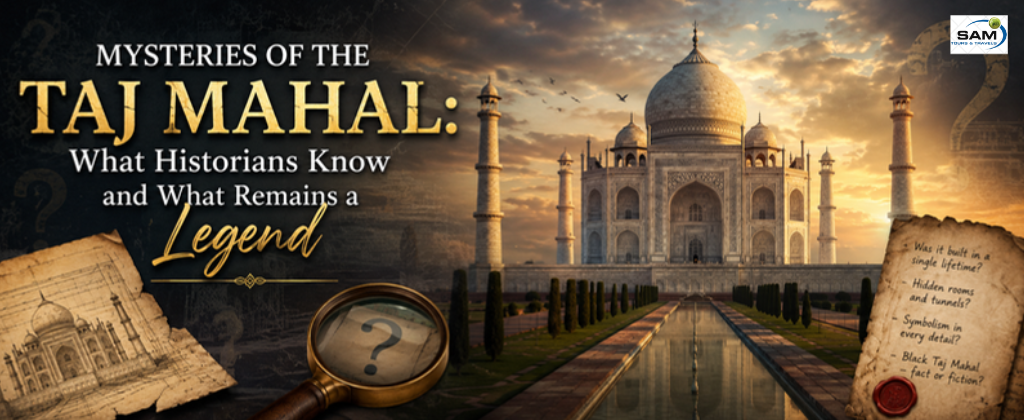
Mysteries of the Taj Mahal: What Historians Know and What Remains a Legend
The Taj Mahal is one of the world’s most celebrated monuments, admired for its breathtaking architecture and timeless story of love. Built by Mughal Emperor Shah Jahan in memory of his wife Mumtaz Mahal, it attracts millions of visitors every year. Yet beyond its white marble beauty lies a collection of mysteries that have fascinated historians, travelers, and storytellers for centuries.
From sealed chambers and hidden tunnels to the famous Black Taj Mahal legend, many questions continue to surround this UNESCO World Heritage Site. While historians have answered some of these mysteries with evidence, others remain topics of debate or local folklore.
In this article, we explore the biggest mysteries of the Taj Mahal, separating historical facts from enduring legends.
Why Does the Taj Mahal Inspire So Many Mysteries?
Every iconic monument develops stories over time, but the Taj Mahal is unique. Its extraordinary beauty, remarkable engineering, and emotional history naturally spark curiosity.
Several factors contribute to its mysterious reputation:
- Limited historical records on certain construction details
- Sealed areas that are not open to the public
- A romantic story that has inspired countless legends
- Stunning architecture that still amazes modern engineers
- Centuries of folklore passed down by local communities
Together, these elements have created an enduring sense of mystery.
Mystery 1: The Sealed Rooms Beneath the Taj Mahal
One of the most discussed mysteries involves the sealed rooms beneath the Taj Mahal.
Several chambers located in the lower sections of the monument remain closed to visitors. Their existence has led to numerous theories, including claims that they hide royal treasures, ancient temples, or secret documents.
What Historians Know
Architectural experts believe these rooms were built for practical reasons.
Possible purposes include:
- Supporting the foundation
- Controlling humidity inside the monument
- Providing storage during construction
- Protecting structural stability
No archaeological evidence has shown that the sealed rooms contain hidden treasures or secret relics.
Although the rooms continue to attract public interest, historians generally consider them an architectural feature rather than a historical mystery.
Mystery 2: Did Shah Jahan Plan to Build a Black Taj Mahal?
Perhaps the most famous legend is the story of the Black Taj Mahal.
According to this tale, Shah Jahan intended to build a second mausoleum made entirely of black marble across the Yamuna River. The two monuments would have been connected by a bridge, symbolizing the eternal union of Shah Jahan and Mumtaz Mahal.
What Historians Know
This story became popular after the writings of French traveler Jean-Baptiste Tavernier in the 17th century.
However, modern historians have found no reliable Mughal records confirming such a project.
The dark stones discovered across the river were later identified as weathered white marble rather than black marble.
Most experts now believe the Black Taj Mahal is a fascinating legend rather than historical fact.
Mystery 3: Were the Builders’ Hands Really Cut Off?
Many people have heard the dramatic story that Shah Jahan ordered the hands of the Taj Mahal’s artisans to be cut off so they could never build another masterpiece.
This story appears in countless books, television programs, and online articles.
What Historians Know
There is no credible historical evidence supporting this claim.
Contemporary Mughal records make no mention of such punishment.
In fact, many artisans later worked on other royal projects during Shah Jahan’s reign.
Historians generally regard this tale as one of the most persistent myths surrounding the Taj Mahal.
Mystery 4: Are There Secret Tunnels Connecting Agra Fort?
Another popular mystery claims that underground tunnels connect the Taj Mahal to Agra Fort.
According to the legend, members of the royal family used these hidden passages to travel safely during emergencies.
What Historians Know
Although Mughal forts often included underground passages, no confirmed tunnel directly connecting Agra Fort and the Taj Mahal has ever been discovered.
Engineers and archaeologists have found no evidence supporting this theory.
The story remains an interesting part of local folklore.
Mystery 5: Why Does the Taj Mahal Change Color?
Visitors often notice that the Taj Mahal appears different throughout the day.
It may look:
- Soft pink at sunrise
- Bright white during midday
- Golden in the evening
- Silver beneath moonlight
For centuries, people believed the monument possessed magical qualities.
What Historians Know
The explanation lies in science.
The polished Makrana marble reflects sunlight differently depending on:
- The angle of the sun
- Atmospheric conditions
- Humidity
- Air pollution
- Moonlight
The changing colors are a natural optical effect rather than a supernatural phenomenon.
Mystery 6: How Was the Taj Mahal Built So Precisely?
Even after nearly 400 years, engineers remain impressed by the monument’s precision.
The entire complex demonstrates extraordinary symmetry.
Its massive dome, towering minarets, and intricate marble carvings were completed without modern construction equipment.
What Historians Know
Historical records show that more than 20,000 craftsmen worked on the monument.
The builders used advanced techniques for their time, including:
- Complex scaffolding systems
- Mathematical planning
- Pulley mechanisms
- Skilled stone carving
- Precise geometric measurements
Rather than being mysterious, the Taj Mahal reflects the exceptional engineering skills of Mughal architects.
Mystery 7: Is the Taj Mahal Perfectly Symmetrical?
At first glance, everything appears perfectly balanced.
However, one surprising detail often escapes visitors.
Shah Jahan’s cenotaph is slightly offset from the exact center.
What Historians Know
Originally, only Mumtaz Mahal’s cenotaph occupied the central position.
After Shah Jahan’s death, he was buried beside her.
His tomb was added later, creating the only significant break in the monument’s otherwise perfect symmetry.
This subtle imperfection tells part of the monument’s emotional story.
Mystery 8: Do Hidden Messages Exist in the Calligraphy?
The Taj Mahal contains beautiful Quranic inscriptions around its entrances and walls.
Some believe these inscriptions hide secret codes or mystical messages.
What Historians Know
The calligraphy consists primarily of verses from the Quran discussing:
- Paradise
- Mercy
- Resurrection
- Divine judgment
- Eternal peace
No credible evidence supports theories about hidden codes.
The inscriptions were intended to inspire spiritual reflection rather than conceal mysteries.
Mystery 9: How Has the Taj Mahal Survived for Centuries?
Despite floods, earthquakes, pollution, and changing climates, the Taj Mahal continues to stand.
Many wonder how such an enormous structure has remained stable for nearly four centuries.
What Historians Know
Several engineering features contribute to its longevity.
These include:
- Deep wooden foundations supported by groundwater
- A raised marble platform
- Outward-leaning minarets designed for earthquake safety
- High-quality Makrana marble
- Exceptional craftsmanship
Modern conservation efforts also play an important role in preserving the monument.
Mystery 10: Why Are Some Areas Still Closed to Visitors?
Many tourists notice that certain sections of the Taj Mahal remain inaccessible.
This has fueled theories about hidden artifacts and secret discoveries.
What Historians Know
Authorities restrict access mainly for:
- Structural preservation
- Visitor safety
- Security
- Conservation of fragile areas
Closing vulnerable sections helps protect one of the world’s most valuable heritage sites.
Myths vs. Historical Facts
| Mystery | Historical Evidence |
|---|---|
| Black Taj Mahal existed | No reliable evidence supports the legend. |
| Builders’ hands were cut off | No historical records confirm this story. |
| Secret tunnels connect Agra Fort | No verified tunnel has been discovered. |
| Hidden treasure lies beneath the monument | No archaeological proof exists. |
| The marble changes color because of magic | It is caused by natural light reflection. |
| The monument is perfectly symmetrical | Shah Jahan’s cenotaph creates a slight asymmetry. |
Why These Mysteries Continue to Fascinate the World
The Taj Mahal represents more than architecture.
It combines history, romance, religion, engineering, and artistic excellence.
Whenever historical records leave unanswered questions, legends naturally emerge.
These mysteries encourage researchers to continue studying the monument while inspiring travelers to explore its beauty firsthand.
Even when historians solve one mystery, another often captures public imagination.
That balance between fact and folklore keeps the Taj Mahal endlessly fascinating.
Frequently Asked Questions (FAQs)
What is the biggest mystery of the Taj Mahal?
The legend of the Black Taj Mahal remains one of the most famous mysteries, although historians have found no convincing evidence that such a monument was ever planned.
Are there hidden rooms inside the Taj Mahal?
Yes. Several rooms remain sealed, but experts believe they serve structural and conservation purposes rather than hiding treasures or secret artifacts.
Is it true that the workers’ hands were cut off?
No. Historians have found no reliable records supporting this claim. It is widely considered a myth.
Why does the Taj Mahal change color?
The white Makrana marble reflects sunlight and moonlight differently throughout the day, creating the appearance of changing colors.
Are there still unsolved mysteries about the Taj Mahal?
Yes. While many legends have been explained through historical research, some questions about construction methods and certain architectural details continue to interest scholars.
Conclusion
The mysteries of the Taj Mahal continue to captivate people across the globe. While historians have uncovered the truth behind many popular legends, the monument still holds an air of wonder that keeps visitors intrigued. Stories of hidden chambers, secret tunnels, and the Black Taj Mahal may not always be supported by evidence, but they remain an important part of the monument’s cultural legacy.
Ultimately, the Taj Mahal’s greatest mystery may not be what lies beneath its marble floors or behind its sealed doors. Instead, it is how a monument built nearly four centuries ago continues to inspire curiosity, admiration, and imagination in every generation.