
·
Last Updated: August 18, 2026
How the Taj Mahal Was Built Without Modern Machines: Detailed Guide


The Taj Mahal is one of the greatest wonders of the world. It was built in the 17th century. At that time, there were no machines, no cranes, and no modern tools.
Still, the monument stands strong today. This raises an important question—how did people build such a massive structure without modern technology?
The answer lies in smart planning, skilled workers, and simple but powerful techniques.
Strong Vision and Leadership
The Taj Mahal was built under the orders of Shah Jahan. He wanted to create something unique and timeless.
So, he brought together the best architects, engineers, and craftsmen from different regions. Because of this, the project had clear direction and strong leadership from the beginning.
This planning helped avoid mistakes and delays.
Smart Planning Without Machines
There were no computers. However, the builders still created a perfect design.
They used hand-drawn maps and simple tools. They also used basic geometry to measure distance and balance.
As a result, the Taj Mahal looks perfectly symmetrical from every side. Even today, experts admire this level of accuracy.
Transporting Heavy Materials
One of the biggest challenges was moving heavy stones.
The white marble used in the Taj Mahal came from far places like Rajasthan. So, workers had to transport it over long distances.
They used:
- Elephants for carrying heavy blocks
- Wooden carts for transport
- Human strength for lifting and pulling
Although the process was slow, it was effective. Step by step, all materials reached Agra.
Lifting Materials Without Cranes
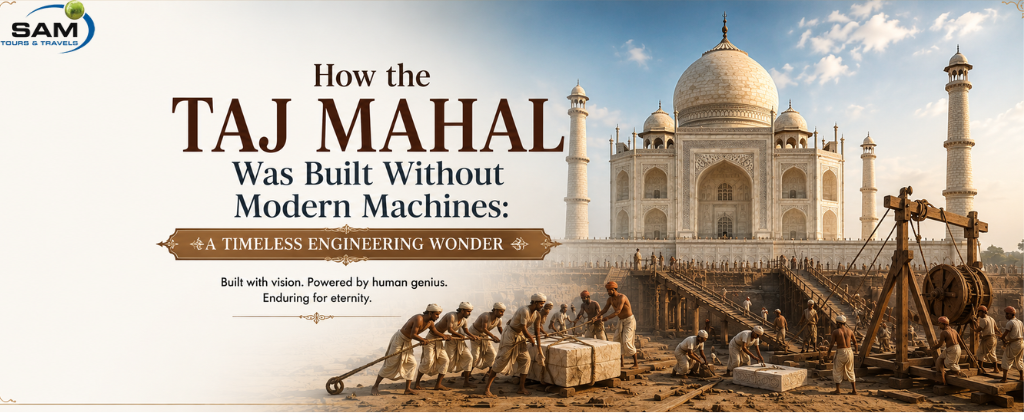
Today, we use cranes to lift heavy objects. However, builders at that time used ramps.
They built long mud ramps around the structure. Then, workers pulled stones up using ropes.
This method required teamwork. Many workers pulled together at the same time. Because of this, they were able to lift very heavy stones to great heights.
Strong Foundation Near the River
The Taj Mahal stands near the Yamuna River. This made the construction more difficult.
So, builders created a strong foundation using a special technique. They dug deep wells into the ground. Then, they filled these wells with stone and wood.
This created a stable base. As a result, the Taj Mahal has remained strong for hundreds of years.
Skilled Workers and Fine Craftsmanship
The beauty of the Taj Mahal comes from its details.
Thousands of skilled workers worked on:
- Marble carving
- Stone cutting
- Calligraphy
- Decorative designs
Each worker focused on one task. Therefore, the final result looks perfect.
They also used a special technique called pietra dura. In this method, colorful stones are placed inside marble to create beautiful patterns.
Strong Materials Without Cement
Modern cement did not exist at that time. Instead, builders used a traditional mixture.
This mixture included:
- Lime
- Sand
- Natural materials
Even without cement, this mixture created a strong bond. Because of this, the structure has lasted for centuries.
Perfect Symmetry and Design
The Taj Mahal is famous for its balance and symmetry.
Builders measured everything carefully. Then, they repeated the same design on both sides.
This careful planning made the monument look equal from every angle.
Role of Teamwork
The construction of the Taj Mahal was not the work of one person.
Around 20,000 workers worked together for more than 20 years. Each person had a clear role.
Because of teamwork and discipline, the project was completed successfully.
Why This Construction Still Inspires Us
Even today, engineers and architects study the Taj Mahal.
It shows that:
- Great planning is more important than machines
- Skilled workers can achieve amazing results
- Simple tools can create great structures
So, the Taj Mahal is not just a monument. It is also a lesson in creativity and hard work.
Conclusion
The Taj Mahal was built without modern machines. Still, it stands as one of the most beautiful structures in the world.
This was possible because of smart ideas, strong planning, and skilled workers. Every step of the process was carefully planned and executed.
When you visit the Taj Mahal, you are not just seeing a building. You are seeing the result of human effort, creativity, and dedication.
For More Information : Read More